Disclaimer: Information found on CryptoreNews is those of writers quoted. It does not represent the opinions of CryptoreNews on whether to sell, buy or hold any investments. You are advised to conduct your own research before making any investment decisions. Use provided information at your own risk.
CryptoreNews covers fintech, blockchain and Bitcoin bringing you the latest crypto news and analyses on the future of money.


The distinct features of cryptocurrencies render them a compelling topic for game theory examination, as they can elucidate the motivations and actions associated with trading and investing. This article explores the idea of the prisoner’s dilemma, the process of mining cryptocurrencies, and blockchain forks that are pertinent to the game theory surrounding Bitcoin and other cryptocurrencies.
Overview of game theory and cryptocurrencies
Game theory serves as a mathematical framework that clarifies decision-making in strategic contexts. Cryptocurrencies, such as Bitcoin (BTC), have garnered attention from game theorists due to their decentralized characteristics and their potential to transform conventional financial systems.
The prisoner’s dilemma in cryptocurrency mining
The classic game theory example known as the prisoner’s dilemma involves two individuals who must make a decision without knowledge of the other’s choice. Within the realm of cryptocurrency mining, the prisoner’s dilemma can illustrate why miners might prioritize their own interests, even when it may not benefit the network overall.
The first miner to successfully solve a complex mathematical problem is rewarded with new BTC units. Both computational power and energy consumption are critical components of the mining process. One of the primary challenges in cryptocurrency mining is the tragedy of the commons, which occurs when individuals prioritize personal interests over the collective needs. By engaging in cryptocurrency mining, miners may prioritize their own financial gain over the network’s overall security and stability.
The prisoner’s dilemma provides a useful framework for understanding this behavior. In the scenario, two individuals are apprehended for a crime and are given the choice to either cooperate or betray each other. If both choose to cooperate, their sentences are reduced. If one betrays the other, the betrayer receives a lighter sentence, while the other faces a longer one. If both betray each other, they both receive a moderate penalty.
Related: How does blockchain solve the Byzantine generals problem?
Miners encounter a similar decision-making scenario while mining cryptocurrencies. The network remains secure and stable if all miners work together honestly and contribute. However, a single miner may gain more by acting maliciously or opting out of contributing to the network if they choose to prioritize their own interests.
To illustrate how the prisoner’s dilemma applies to cryptocurrency mining, consider the diagram below, which depicts two miners in a cryptocurrency pool.
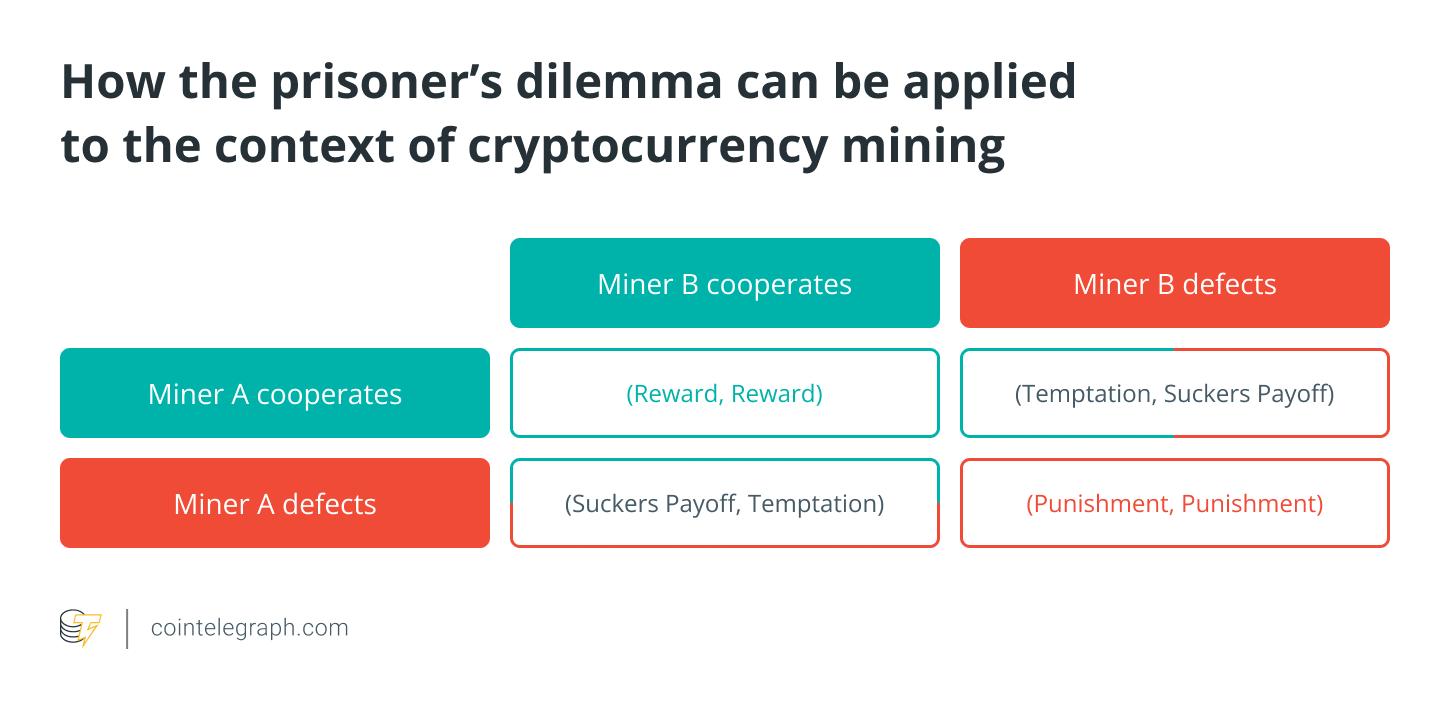
The diagram above features Miner A and Miner B, two miners within a cryptocurrency mining pool. They can either cooperate (continue mining together) or defect (leave the pool and mine independently). The rewards and outcomes are based on the traditional prisoner’s dilemma scenario:
- If both miners cooperate, they both receive a reward (e.g., a share of the mining profits).
- If Miner A defects while Miner B cooperates, Miner A gains a temptation payoff (e.g., a larger share of the mining profits), while Miner B receives a suckers payoff (e.g., a smaller share of the mining profits).
- If Miner A cooperates while Miner B defects, Miner A receives a suckers payoff, while Miner B gains a temptation payoff.
- If both miners defect, they both incur a punishment (e.g., reduced overall mining profits).
This diagram demonstrates how the prisoner’s dilemma can be contextualized within cryptocurrency mining. It outlines the potential rewards and outcomes for each combination of cooperation and defection, aiding miners in their decisions about whether to remain in a pool or mine independently.
Related Posts
To mitigate this issue, cryptocurrency networks can introduce various incentives and mechanisms to motivate miners to act in the network’s collective interest. For instance, networks can reward miners who contribute positively to the network with lower fees or enhanced mining rewards. Additionally, networks may implement penalties or protective measures to deter malicious actions.
The game theory of blockchain forks
Blockchain forks present another scenario where game theory can elucidate the decision-making processes of participants. A fork occurs when a blockchain network diverges into two separate paths, often due to disagreements among participants regarding the network’s direction.
From a game theory perspective, a fork can be viewed as a coordination game. In a coordination game, two or more players must collaborate to achieve a shared goal. Participants in a blockchain fork must come together to determine which fork to support and which to abandon.
A notable example of a blockchain fork occurred in 2017 when the Bitcoin network split into two distinct forks: Bitcoin and Bitcoin Cash. This instance is one of the most recognized cases of a blockchain fork, arising from disagreements within the Bitcoin community on how to scale the network to accommodate an increasing transaction volume.
In this scenario, members of the Bitcoin community faced the decision of whether to remain with the original Bitcoin network or transition to the new Bitcoin Cash network. The choice was complex, as each fork presented its own advantages and disadvantages. For example, while Bitcoin Cash provided faster transaction times and lower fees, Bitcoin maintained a larger network and greater acceptance.
Participants in this situation had to weigh their personal preferences and beliefs regarding the potential future value of each network within the framework of game theory. If participants believed Bitcoin Cash had a stronger potential for long-term growth, they might be inclined to support it, even at the cost of leaving the original Bitcoin network.
Related: How to buy Bitcoin Cash: A beginner’s guide for buying BCH
To further understand how game theory applies to blockchain forks, consider the diagram below, which illustrates two miners deciding whether to adopt a new fork in the blockchain or continue with the old fork.
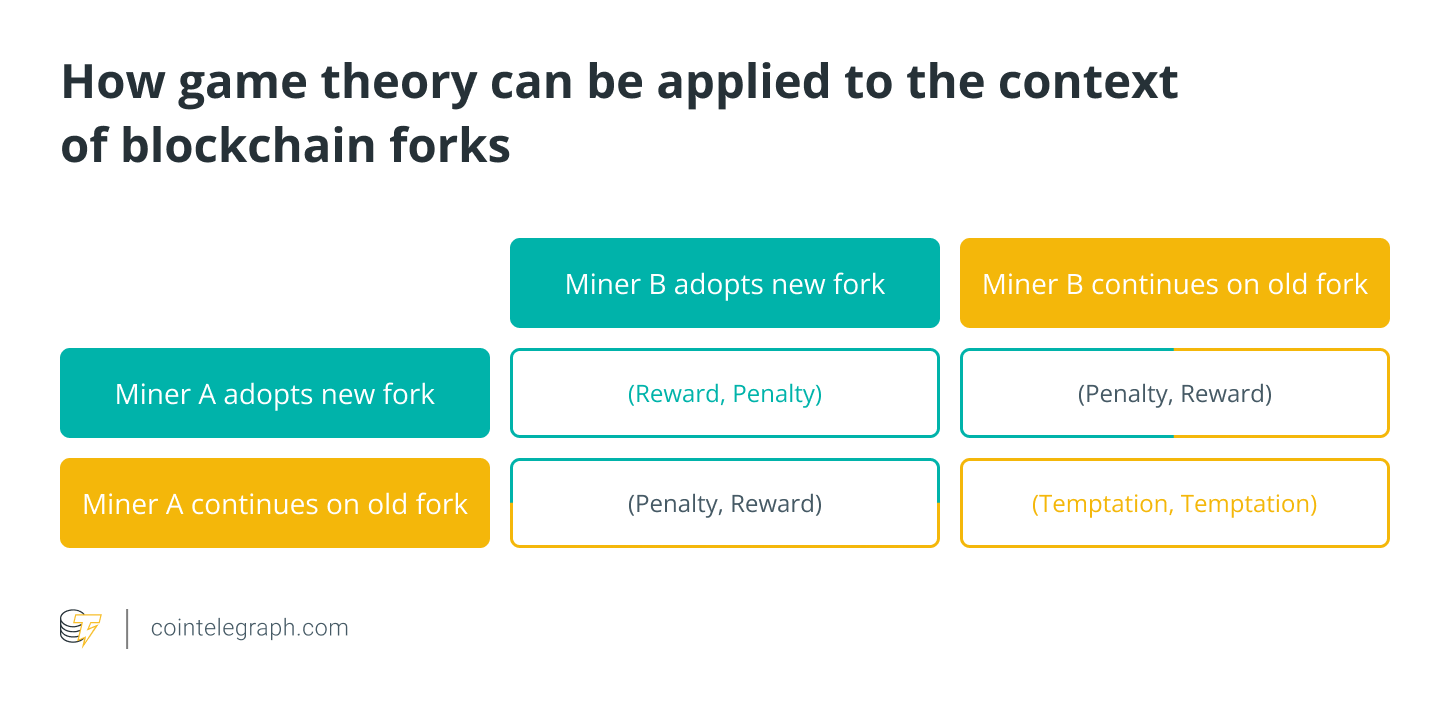
The diagram above illustrates the strategic decision-making of two miners, Miner A and Miner B, on a blockchain, as they face the choice of either adopting a new fork or remaining on the old fork. The rewards and penalties are based on the following assumptions:
- If both miners adopt the new fork, they both receive a reward (e.g., enhanced mining efficiency).
- If Miner A adopts the new fork while Miner B continues on the old fork, Miner A incurs a penalty (e.g., reduced mining efficiency), while Miner B receives a reward.
- If Miner A continues on the old fork while Miner B adopts the new fork, Miner A receives a reward, while Miner B incurs a penalty.
- If both miners continue on the old fork, they both receive a temptation payoff (e.g., retaining control over the blockchain).
This diagram illustrates how game theory can be applied to the context of blockchain forks. It highlights the potential rewards and penalties for each combination of adopting or not adopting a new fork, assisting miners in their decisions about whether to transition to a new fork or remain with the existing one.
To address this challenge, cryptocurrency networks can implement various mechanisms to ensure that forks occur as seamlessly as possible. For instance, networks can introduce replay protection, which prevents transactions on one network from being replicated on the other.
