Disclaimer: Information found on CryptoreNews is those of writers quoted. It does not represent the opinions of CryptoreNews on whether to sell, buy or hold any investments. You are advised to conduct your own research before making any investment decisions. Use provided information at your own risk.
CryptoreNews covers fintech, blockchain and Bitcoin bringing you the latest crypto news and analyses on the future of money.


In terms of delivering stable value, stablecoins and central bank digital currencies (CBDCs) seem to represent two aspects of the same concept. However, crypto stable assets can offer entirely distinct applications that CBDCs cannot match.
The crucial factor is programmability — smart contracts that automate and introduce new functionalities to currency. This programmability enables asset backing and decentralization that current CBDC frameworks cannot achieve. Developers should leverage the programmable potential that stable assets present instead of attempting to rival CBDCs.
Issuers of stable assets assert that they can enhance the existing monetary system in three primary ways.
Firstly, stable assets can lower the expenses associated with traditional financial activities, such as decentralized borrowing and lending through decentralized finance (DeFi) and remittances.
Related: CBDCs will lead to absolute government control
Secondly, individuals in nations facing hyperinflation utilize stable assets to safeguard their earnings and stabilize payments, as seen with the Reserve protocol in Venezuela.
Thirdly, stablecoins can facilitate more privacy-focused transactions, exemplified by MobileCoin (MOB).
These three functions of stable assets align with the current financial system’s framework. Therefore, it is important to recognize that the issues addressed by stablecoins could theoretically also be resolved by CBDCs.
Asset-backing with utility assets
The asset-backing for most stable assets today is primarily modeled after traditional finance. Their reserves consist solely of financial assets. Tether (USDT) and USD Coin (USDC) are supported by financial assets such as commercial paper, U.S. dollars, and U.S. Treasurys. Dai (DAI) is backed by USDC, Bitcoin (BTC), Ether (ETH), and other stable assets. However, stable assets can also encompass assets with more direct utility that are not typically included in the financial system, such as innovative real-world assets. This leads to additional features that enhance the practical applications of the stable asset itself, which CBDCs cannot replicate.
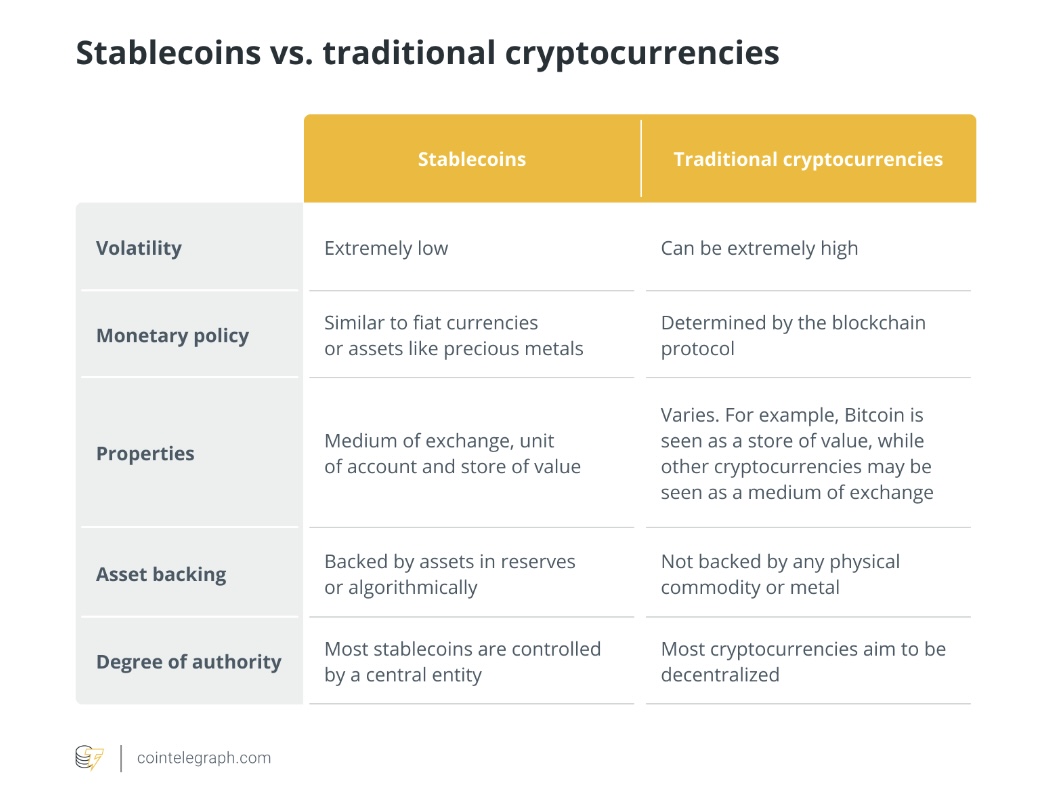
Kolektivo, for instance, aims to establish natural capital community currencies where tokenized land assets and food forests support stable assets. The concept of backing a financial system with natural capital is not new and has been discussed by thinkers like Charles Eisenstein, who contend that such a monetary system would promote environmental conservation.
Related Posts
Likewise, communities could tokenize various real-world assets in their local areas to create community stablecoins that connect their assets to the wider financial system. Grassroots Economics employs Community Inclusion Currencies in Kenya, which are backed by pooling local goods and services along with donor funds in the form of cash and vouchers. Following recent banking crises, Coinbase advocated for “flatcoins” that align with inflation rates — this could involve a collection of utility assets such as real estate and commodities.
Related: Flatcoiners should take a cue from TerraUSD’s fate
Stable assets, naturally, will require a robust and diverse range of assets in their reserves to ensure stability. By incorporating additional real-world assets and utilizing a transparent, open blockchain infrastructure, stable assets can achieve far more than current currencies.
Trust and programmability through decentralization
The fundamental technical advantage of blockchain technology is decentralization. USDC and USDT largely exemplify the opposite of decentralization. Users must trust that the issuers of each — Circle and Tether, respectively — are responsible actors effectively managing issuance and reserves. In contrast, DAI represents a more decentralized approach. Anyone can mint DAI by borrowing it through an overcollateralized model and govern the protocol using the governance token MKR (MKR). Governance holders vote on any modifications or actions undertaken by the protocols, such as investing $500 million of protocol-held DAI into U.S. Treasurys and corporate bonds.
Decentralization also enhances programmability. Users can determine and govern the execution of programmable money. For instance, a community could create a stablecoin that automatically allocates a portion of funds to a community investment vehicle governed by a DAO composed of local members. GoodDAO of GoodDollar oversees the protocol’s distribution of universal basic income, which is supported by reward-generating DeFi to maintain price stability. Similarly, governance holders can opt to direct returns from the underlying stable asset collateral towards positive climate initiatives (e.g., Spirals Protocol).
Decentralization can empower stable-asset holders, which can, in turn, promote transparency in issuance and management (including independent decision-making) and facilitate the development of new features driven by user needs.
Lessons for programmable money moving forward
The crypto sector, encompassing both centralized and decentralized entities, has the potential to create more innovative functions through asset-backing and decentralization. In the United States, a significant challenge has been the absence of regulatory clarity, including the failure to differentiate between blockchain technology and its utility versus speculation. Moving forward, the issuance of new stable assets in the U.S. may become increasingly challenging with a potential moratorium — thus, innovation may need to occur internationally.
Encouraging innovation and promoting real-world applications of blockchain technology necessitates a new approach to developing novel tools. Stable assets are not designed to compete with CBDCs or even conventional payment systems but rather to operate as something entirely distinct. However, they will only achieve this if the technology is utilized to innovate beyond existing monetary frameworks. Asset-backing and decentralization are two essential pillars to focus on in this endeavor.
Nikhil Raghuveera is head of strategy and innovation at the Celo Foundation, a nonprofit organization supporting the development of the Celo blockchain. He is also a senior fellow at the Atlantic Council’s GeoEconomics Center. Nikhil has previously worked in management consulting, nonprofit management, and economic consulting. He graduated with an MBA from The Wharton School and an MPA from the Harvard Kennedy School.
The author of this column has not been compensated by any projects mentioned. This article is for general information purposes and is not intended to be and should not be taken as legal or investment advice. The views, thoughts, and opinions expressed here are the author’s alone and do not necessarily reflect or represent the views and opinions of Cointelegraph.
