Disclaimer: Information found on CryptoreNews is those of writers quoted. It does not represent the opinions of CryptoreNews on whether to sell, buy or hold any investments. You are advised to conduct your own research before making any investment decisions. Use provided information at your own risk.
CryptoreNews covers fintech, blockchain and Bitcoin bringing you the latest crypto news and analyses on the future of money.


A group of researchers at the Singapore University of Social Sciences has recently evaluated current decentralized autonomous organization (DAO) voting systems to identify the most effective one.
The researchers ultimately determined that the widely used voting systems each possess their own strengths and weaknesses, and that a new approach integrating what they viewed as the most advantageous aspects of each would be “more efficient” than the current methods.
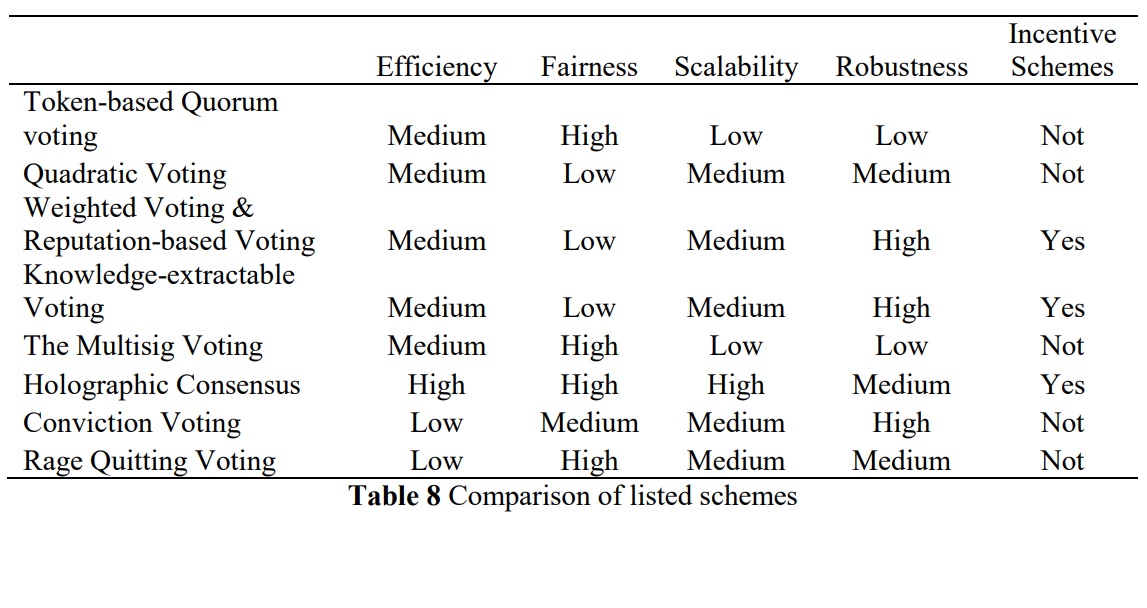
Titled “Voting Schemes in DAO Governance,” the team’s paper examines eight existing methods for DAO governance and evaluates their perceived merits and drawbacks.
The methods analyzed include: token-based quorum voting, quadratic voting, weighted and reputation-based voting, knowledge-extractable voting, multisig voting, holographic consensus, conviction voting, and rage-quitting voting.
Related: How do you DAO? Can DAOs scale and other burning questions
Each voting method was assessed based on five criteria: efficiency (speed of proposal selection and approval), fairness (regarding voter equality), scalability (capacity to adapt storage/computation/communications based on the number of voters), robustness (resilience to attacks and collusion), and incentive structures (whether the design encourages voter participation).
The “holographic consensus” method achieved the highest overall ratings, receiving “high” scores in all categories except for “robustness.”
Related Posts
 Screenshot of “Voting Schemes in DAO Governance” research paper. Source: Singapore University of Social Sciences
After completing their analysis, the researchers aimed to develop “a hypothetical voting mechanism for a fully decentralized and permissionless DAO governance.” To achieve this, they crafted a scheme to enhance conviction voting using a “holographic mechanism.” According to the study:
“We know that the downside of the conviction voting mechanism is that it takes time to approve an urgent proposal. To address this concern, we introduce a blind betting mechanism: each member could choose whether to bet on any proposals with a certain number of their tokens.”
This approach would enable stakeholders to wager tokens on the likelihood of a proposal being approved or rejected, and based on the result, the proposal would either be expedited or delayed — potentially enhancing the overall speed and resilience of DAO governance.
The proposed scheme would also introduce an incentive structure whereby those betting “veto” would forfeit their tokens if consensus favored those voting “pass,” and vice versa.
The researchers assert that this will motivate stakeholders to present “a good proposal that is more likely to pass and get rewarded,” thereby speeding up the processing of proposals deemed both urgent and beneficial.
The researchers conclude by stating that their proposed scheme surpasses current efforts, although they acknowledge that it is not without its own challenges:
“Our hypothetical scheme has a better design incorporating key features from other schemes. However, it is not flawless and might face challenges in implementation. Nevertheless, we aim to inspire innovative design thinking.”
