Disclaimer: Information found on CryptoreNews is those of writers quoted. It does not represent the opinions of CryptoreNews on whether to sell, buy or hold any investments. You are advised to conduct your own research before making any investment decisions. Use provided information at your own risk.
CryptoreNews covers fintech, blockchain and Bitcoin bringing you the latest crypto news and analyses on the future of money.


The developers of the recently launched Shibarium mainnet have refuted claims regarding bridge issues and asset losses, asserting that the screenshots circulating within the crypto community are inaccurate.
In a blog entry dated Aug. 17, Shytoshi Kusama, co-founder of the Shiba Inu ecosystem, attributed the technical challenges in Shibarium, an Ethereum layer-2 scaling blockchain that was initiated just hours prior, to a significant surge in transactions and user engagement.
Referencing data from Alchemy, Kusama noted that the project had allocated 400 million compute units for the month but encountered 160 million compute units in almost 30 minutes following Shibarium’s launch. “While we anticipated a busy period, we did not foresee this level of traffic occurring so rapidly,” he stated, adding that:
“Our team has been diligently working to scale (even though validators were already set to autoscale when we made the announcement) and to restore the chain to a capacity that can accommodate the influx of our decentralized nation state.”
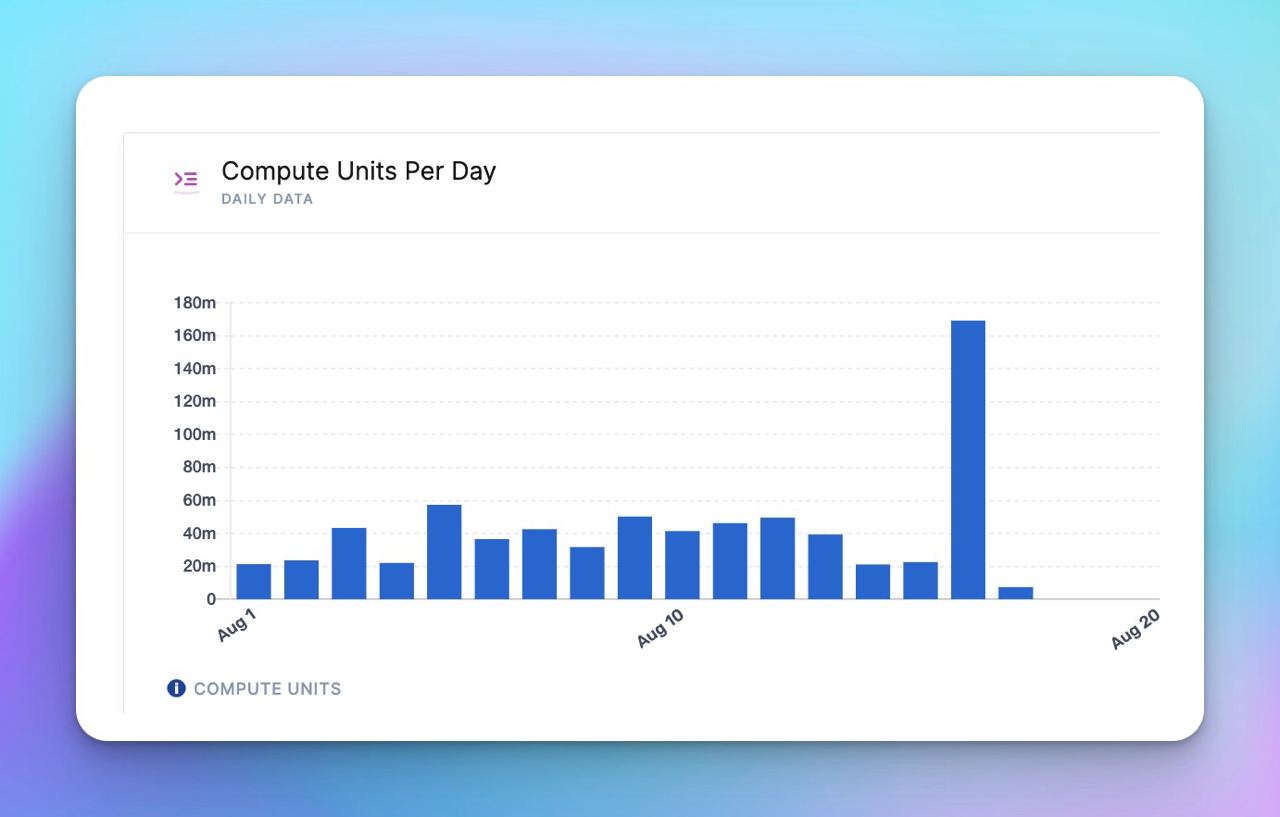 Shibarium’s compute units consumption. Source: Alchemy/Shibarium.
Related Posts
Initial worries regarding Shibarium emerged in the crypto community after screenshots allegedly captured an internal Telegram discussion among Shibarium developers, suggesting that the team was reportedly unable to retrieve assets transferred to the Shibarium network.
In case yall were wondering how Shibarium is going pic.twitter.com/S5vjTxoMDk
— ʎppɐꓷ ɯooɹɥS (@shroom_daddy) August 16, 2023
In support of the investigation, blockchain investigator ZachXBT clarified that while he could not verify whether the assets had been lost, the RPC – the node responsible for running essential blockchain client software – had been compromised. As of the time of writing, the Shibarium RPC website is still offline.
“Please allow us time to scale […] and then restore our remarkable chain once more,” Kusama requested in the blog post, dismissing the speculation as FUD, an abbreviation for “fear, uncertainty, and doubt.”
Shibarium employs a novel consensus mechanism known as proof-of-participation (PoP), where validators are chosen based on their cryptocurrency holdings. It is intended to interact with the primary Ethereum layer-1 blockchain, aiming to provide more efficient and scalable transactions. Its mainnet was launched after extensive testing involving millions of users and the creation of 21 million wallets.
Magazine: Deposit risk: What do crypto exchanges really do with your money?
