Disclaimer: Information found on CryptoreNews is those of writers quoted. It does not represent the opinions of CryptoreNews on whether to sell, buy or hold any investments. You are advised to conduct your own research before making any investment decisions. Use provided information at your own risk.
CryptoreNews covers fintech, blockchain and Bitcoin bringing you the latest crypto news and analyses on the future of money.


A quarterly report centered on zero-knowledge (ZK) technology reveals that privacy, scaling, and identity solutions are key factors driving adoption within the blockchain sector.
The report from validator service provider ZKValidator, titled “The State of ZK,” delves into insights from the zero-knowledge domain, emphasizing significant and emerging use cases, research, product introductions, and noteworthy investment rounds.
The primary focus is on the applications of zero-knowledge proofs. This cryptographic technique enables one party to confirm data or a statement without revealing the underlying information. Privacy emerges as the most crucial factor for adoption in the industry, accounting for 12.9%. Scaling follows as the second most significant application of zero-knowledge technology, representing 9.46%.
Identity solutions and novel zero-knowledge applications rank third and fourth, suggesting that the blockchain ecosystem is keen on investigating how zero-knowledge technology can be utilized in identity management and other innovative applications. Zero-knowledge machine learning (ZK-ML) was also recognized as the most appealing new use case in the field.
The insights were derived from the company’s collaborations with industry participants, including ZK Hack, zkSummit, rhino.fi, Geometry, and University College London. ZKValidator also gathered data and information through its involvement with participants in the production and management of the Zero Knowledge Summit 9 held in Lisbon on April 4.
The report also highlighted the launch of Polygon and zkSync’s zero-knowledge Ethereum Virtual Machine (zkEVM), featuring key data from the two Ethereum scaling solutions.
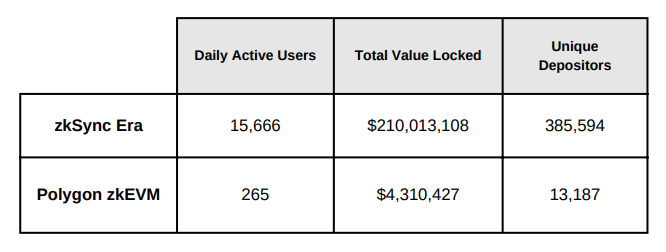 A comparison of zkSync Era and Polygon zkEVM users and total value locked since their mainnet launches in March 2023. Source: The State of ZK: Q1 2023
Since its launch over a month ago, zkSync Era has drawn more daily active users compared to Polygon’s zkEVM. The report suggests that speculation regarding a potential zkSync airdrop later in 2023 may explain the disparity in user numbers between the two zkEVMs.
Related: Polygon’s ‘holy grail’ Ethereum-scaling zkEVM beta hits mainnet
The report also discusses the creation of new products, including Geometry’s Semacaulk, a novel zero-knowledge set membership protocol that provides gas savings compared to Merkle-tree constructions, while ensuring that proofs can be generated swiftly and verified at approximately the same gas cost.
Related Posts
The $7 million ZPrize competition in 2022 contributed to the advancement of ZK technology, with multiscalar multiplication (MSM) on Android mobile devices emerging from the development competition aimed at promoting ZK solutions. According to ZKValidator’s report, MSM has enhanced proof generation time from 2.4 seconds to about half a second, facilitating mobile payments in ZK.
Related: Zero-knowledge proofs coming to Bitcoin, overhauling network state validation
The report also referenced a paper proposing GZKP, a rapid GPU-accelerated zero-knowledge proof system that decreases proof generation time in ZKP by utilizing the hardware similarities of GPUs. Graphics processing units (GPUs) have become increasingly valuable for cryptocurrency miners due to their capacity to process data concurrently, in addition to their applications in machine learning, video editing, and gaming.
Several other zk projects were also noted in the realms of decentralized identity, interoperability, and payments within the Ethereum and Polkadot ecosystems in 2023.
This includes Telepathy, a zkSNARK interoperability protocol for Ethereum, which enables users to access Ethereum state across any chain while maintaining the security of Ethereum’s light client protocol.
Sismo Connect was also mentioned as a privacy-preserving single sign-on solution for applications on both web2 and web3, allowing developers to integrate zk technology into their applications.
Lastly, the Manta Network expanded its zk capabilities to support privacy for non-fungible tokens (NFTs) and soul-bound tokens (SBTs).
Investments were also highlighted, with Ethereum research and development firm The =nil; foundation securing $22 million to further the development of the Proof Marketplace, a solution that enables layer 1 and 2 blockchains to outsource the generation of zk proofs.
Zk-proof developer Proven raised $15.8 million in a seed funding round, while Polyhedra Network obtained $10 million for its blockchain interoperability infrastructure platform.
Zero-knowledge rollups have gained attention throughout the first quarter of 2023. Polygon launched its open-source zkEVM Ethereum scaling technology to mainnet on March 27, while several Ethereum DeFi protocols have adopted zkSync since its alpha launch in March 2023.
Magazine: ZK-rollups are ‘the endgame’ for scaling blockchains: Polygon Miden founder
