Disclaimer: Information found on CryptoreNews is those of writers quoted. It does not represent the opinions of CryptoreNews on whether to sell, buy or hold any investments. You are advised to conduct your own research before making any investment decisions. Use provided information at your own risk.
CryptoreNews covers fintech, blockchain and Bitcoin bringing you the latest crypto news and analyses on the future of money.


An unsuspecting cryptocurrency owner has reportedly become a victim of a staggering $4.46 million phishing scam.
Data from Etherscan indicates that $4.46 million worth of Tether (USDT) was taken from a Kraken cryptocurrency exchange wallet and subsequently transferred to an address concluding with “ACa7.”
The blockchain security company PeckShield has identified this address as belonging to a phishing scammer.
#PeckShieldAlert The address 0x2175…f7D9 was scammed out of 4.46M $USDT
Victim’s address: 0x2175c0082d052872501f7fe54e1aC59858aaf7D9
Scammer’s address: 0xAbb07822F471773Ff00b9444308ceEB7cf0dACa7 pic.twitter.com/Ny9CIrkBxw— PeckShieldAlert (@PeckShieldAlert) September 21, 2023
Another blockchain scam monitoring platform, Scam Sniffer, suggested on September 20 that the funds were transferred to an address associated with a “fraudulent Coinone crypto mining exchange.”
someone withdrew $4.46 million from Kraken to a fake Coinone crypto-mining exchange about 1 hour ago.https://t.co/ued55jlWdM pic.twitter.com/tsV5BGDY0O
— Scam Sniffer (@realScamSniffer) September 20, 2023
Scam Sniffer referenced a user-generated Dune Analytics dashboard, indicating that scams of this nature have led to approximately $337.1 million in USDT being stolen, affecting as many as 21,953 victims.
Related Posts
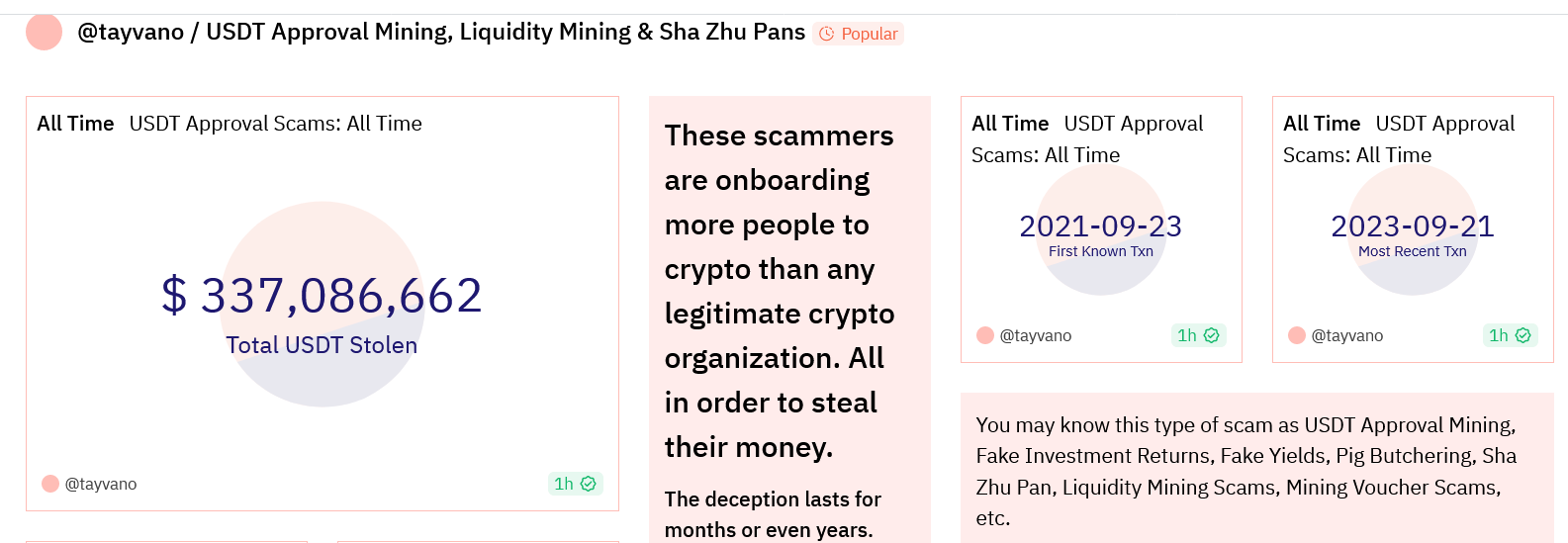 Tayvano’s Dune Analytics dashboard on USDT Approval Scams. Source: Dune Analytics.
Related: Crypto whale loses $24M in staked Ethereum to phishing attack
The Global Anti-Scam Organisation states that this kind of approval mining scam typically deceives victims into permitting unlimited withdrawals from their cryptocurrency wallets.
“When you establish a self-custody crypto wallet […] you acquire a ‘private key’ that is protected through encryption. However, the scammers do not require your seed phrase,” GASO explained on its website, noting that when a victim opts to join the fraudulent mining pool, they are engaging with a button that will request a $10–$50 network fee in Ether (ETH).
While this may appear reasonable, GASO warns that it is a trick:
“This is simply a facade to obtain your digitally signed authorization, granting unlimited access to your wallet via the USDT smart contract.”
Magazine: Asia Express: Thailand’s national airdrop, Delio users screwed, Vietnam top crypto country
