Disclaimer: Information found on CryptoreNews is those of writers quoted. It does not represent the opinions of CryptoreNews on whether to sell, buy or hold any investments. You are advised to conduct your own research before making any investment decisions. Use provided information at your own risk.
CryptoreNews covers fintech, blockchain and Bitcoin bringing you the latest crypto news and analyses on the future of money.


A transaction on the Ethereum blockchain is fundamentally initiated by an external account holder (as opposed to a contract). For instance, when User A transfers 1 Ether (ETH) to User B, the process of debiting one account and crediting another alters the state of the blockchain.
This alteration specifically occurs on the Ethereum Virtual Machine (EVM). Ethereum transactions must be disseminated across the entire network, and any node has the capability to broadcast a request for the execution of a transaction on the EVM.
Once the request is broadcasted, a validator can execute the transaction and communicate the state change to the entire network. Transaction fees are incurred during the validation process, and each transaction must be incorporated into a validated block. There are various types of transactions on the Ethereum network:
- Regular transactions: transactions that occur between two accounts.
- Contract-execution transactions: transactions that interact with deployed smart contracts (where the “to” address is a smart contract address).
- Contract-deployment transactions: transactions that do not have a “to” address (the data field is solely utilized to deploy the smart contract’s code).
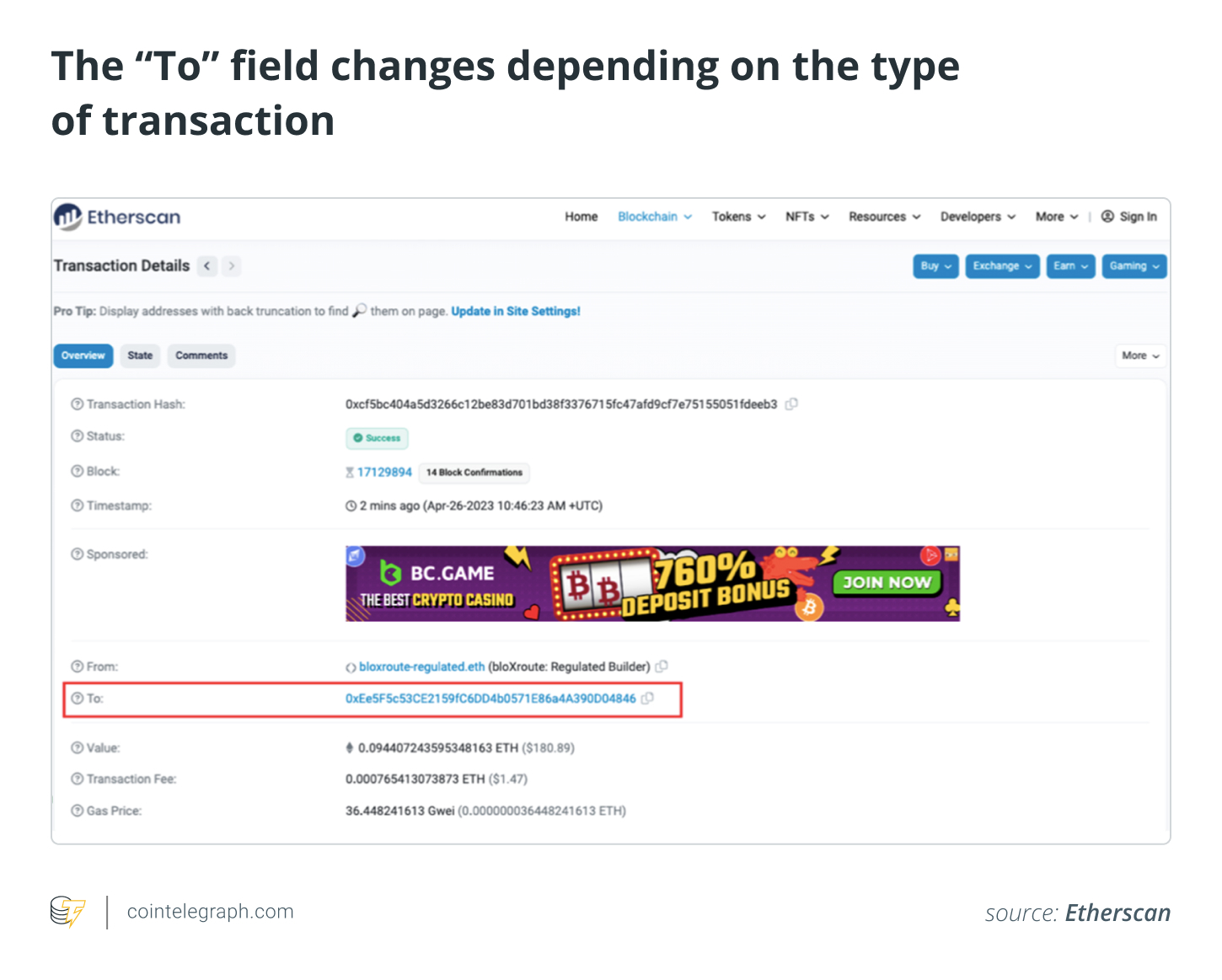
How to verify the status of an Ethereum transaction
Here is a concise step-by-step guide on how to monitor Ethereum transactions:
Step 1: Choose an Ethereum blockchain explorer
Some blockchain explorers are dedicated to Ethereum, such as Etherscan, Ethplorer, and EthVM. Others support multiple blockchains, including Blockchain.com and Tokenview, among others.
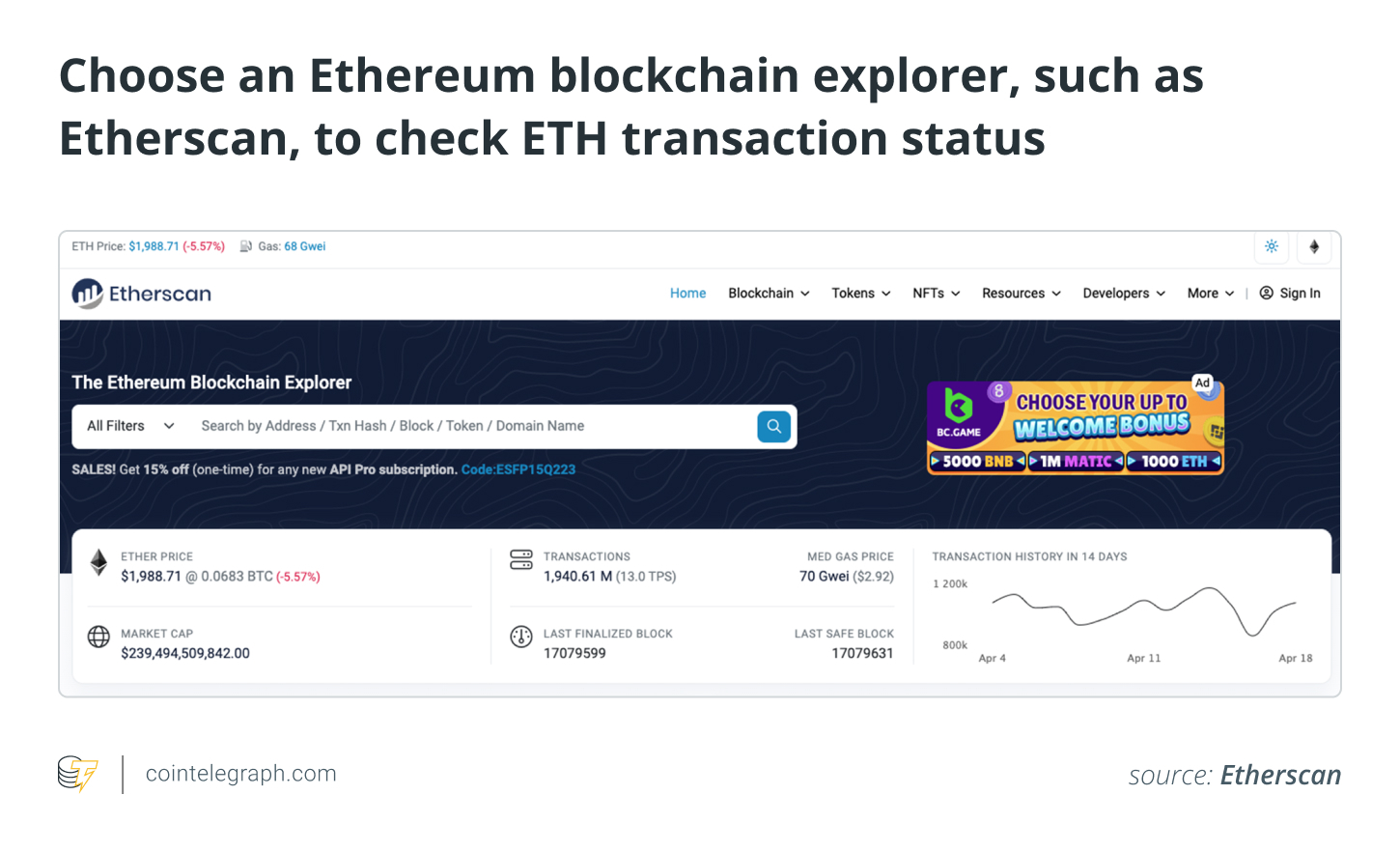
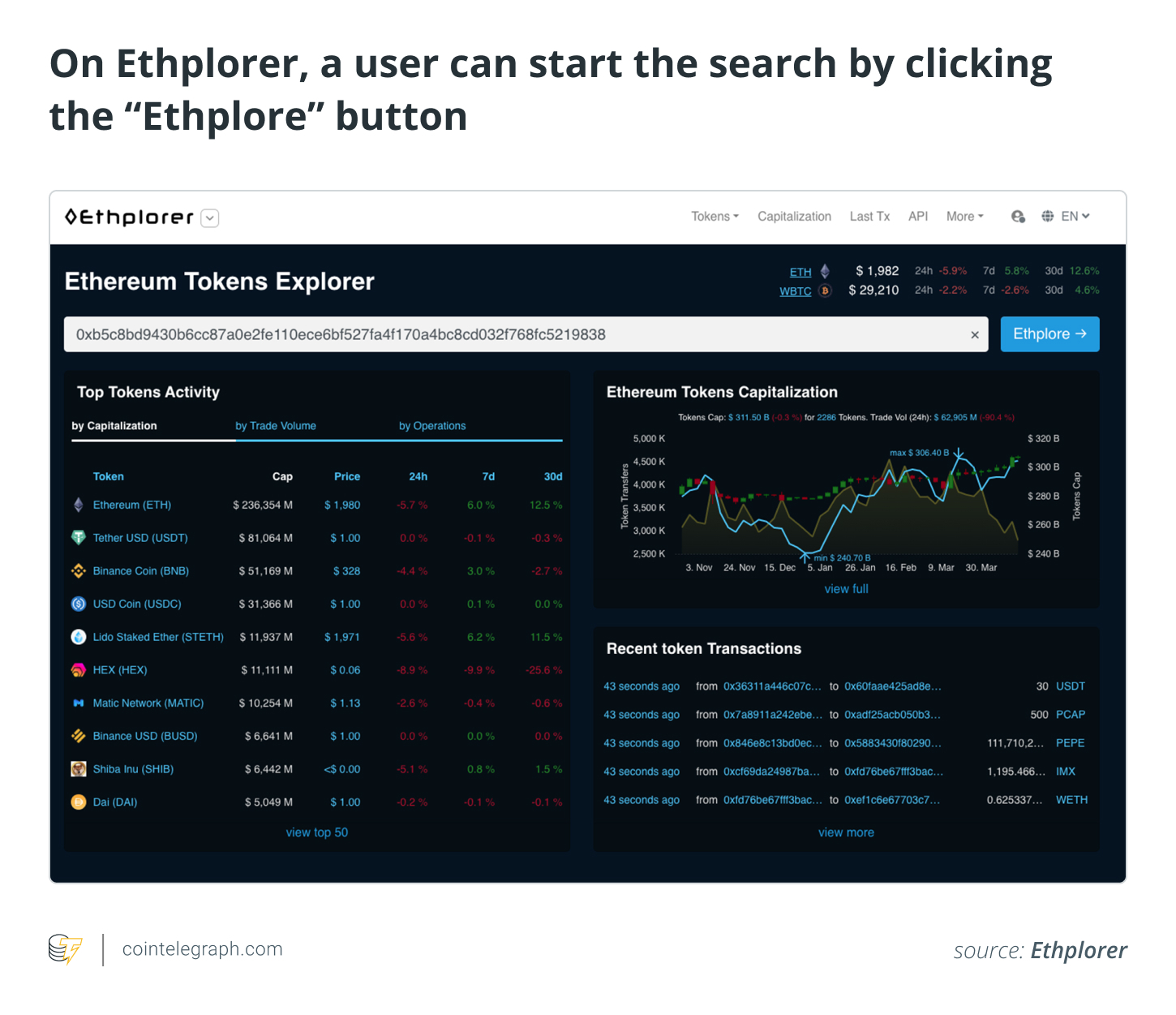
Step 2: Input the transaction hash into the blockchain explorer’s search field
On Etherscan, for instance, the search field is located in the top left corner of the screen next to a dropdown labeled “All Filters.” Depending on the tool, users can search for information using a wallet address, transaction hash (txid), block, token, or domain name.
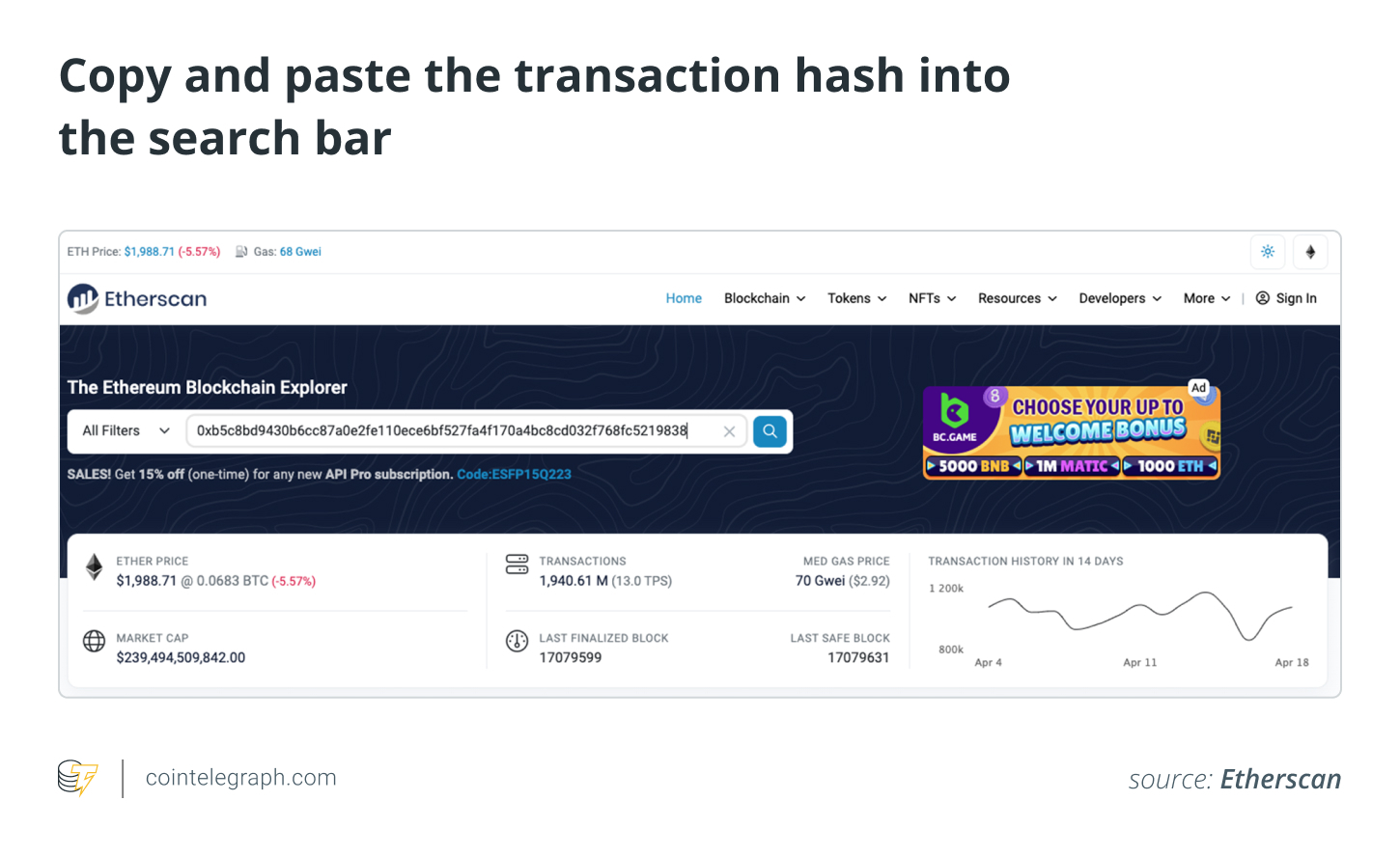
The txid serves as a unique identifier linked to a specific transaction. All transactions executed on-chain, or those involving external addresses, possess a unique txid found in the transaction details.
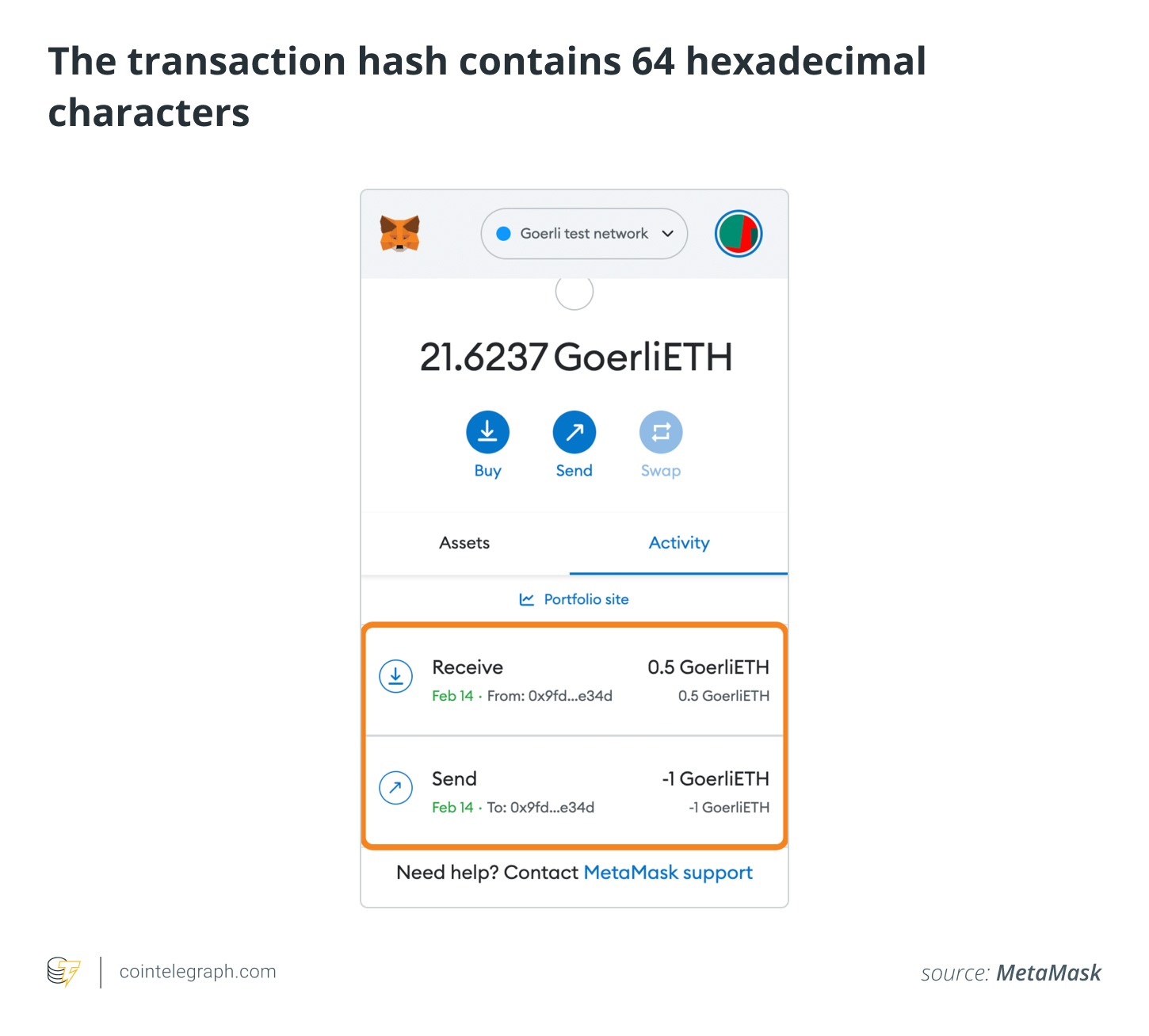
Depending on the platform, it may also be referred to as a “hash” or “txn hash.” It typically appears as a sequence of random letters and numbers. On MetaMask, for example, users can immediately view the txid by clicking the “Activity” tab and selecting the transaction.
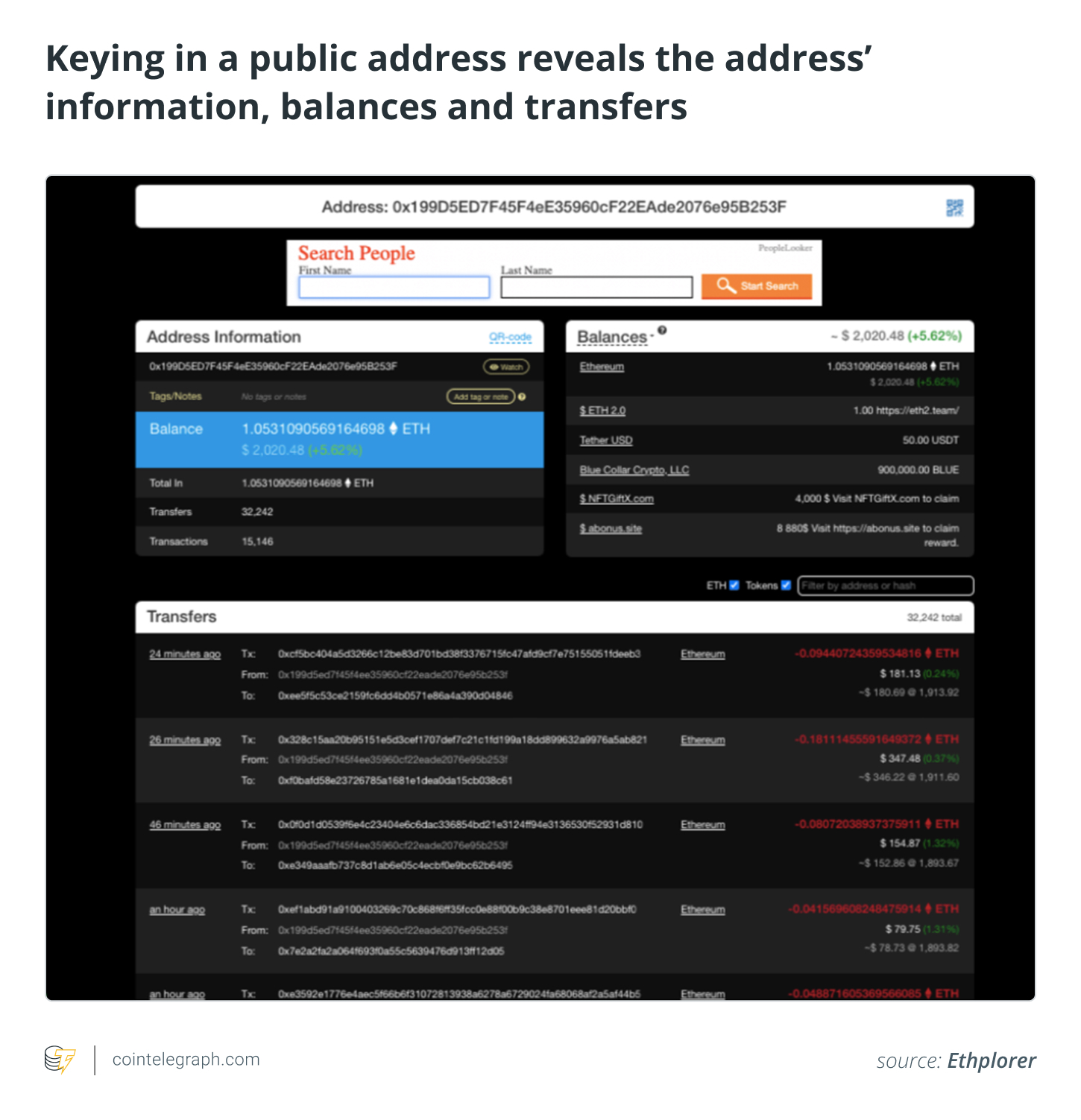
In addition to the txid, traders can also utilize their public address (a string of 42 characters corresponding to their public account). This will direct them to an overview of their wallet activities, enabling them to navigate to the specific transaction independently.
Related: Ethereum wallets: A beginner’s guide to storing ETH
Step 3: Click the “search” or “enter” icon on the blockchain explorer
Step 4: Determine if the transaction was successful
Related Posts
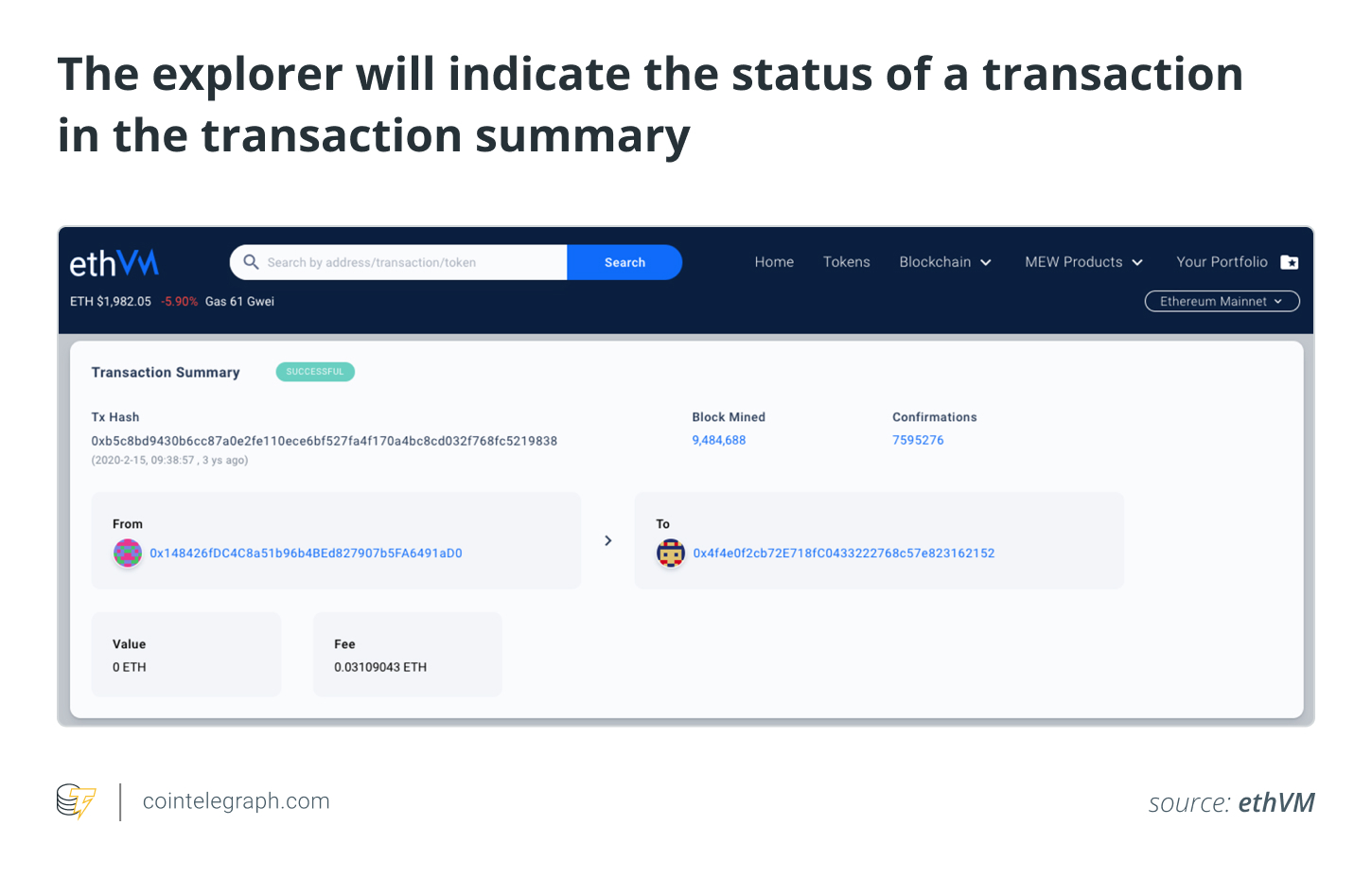
To ascertain if an ETH transaction was successful: Details indicating the transaction’s status will be displayed on the blockchain explorer. If the transaction was successfully validated and is now recorded on the blockchain, it will indicate “success” or “successful.”
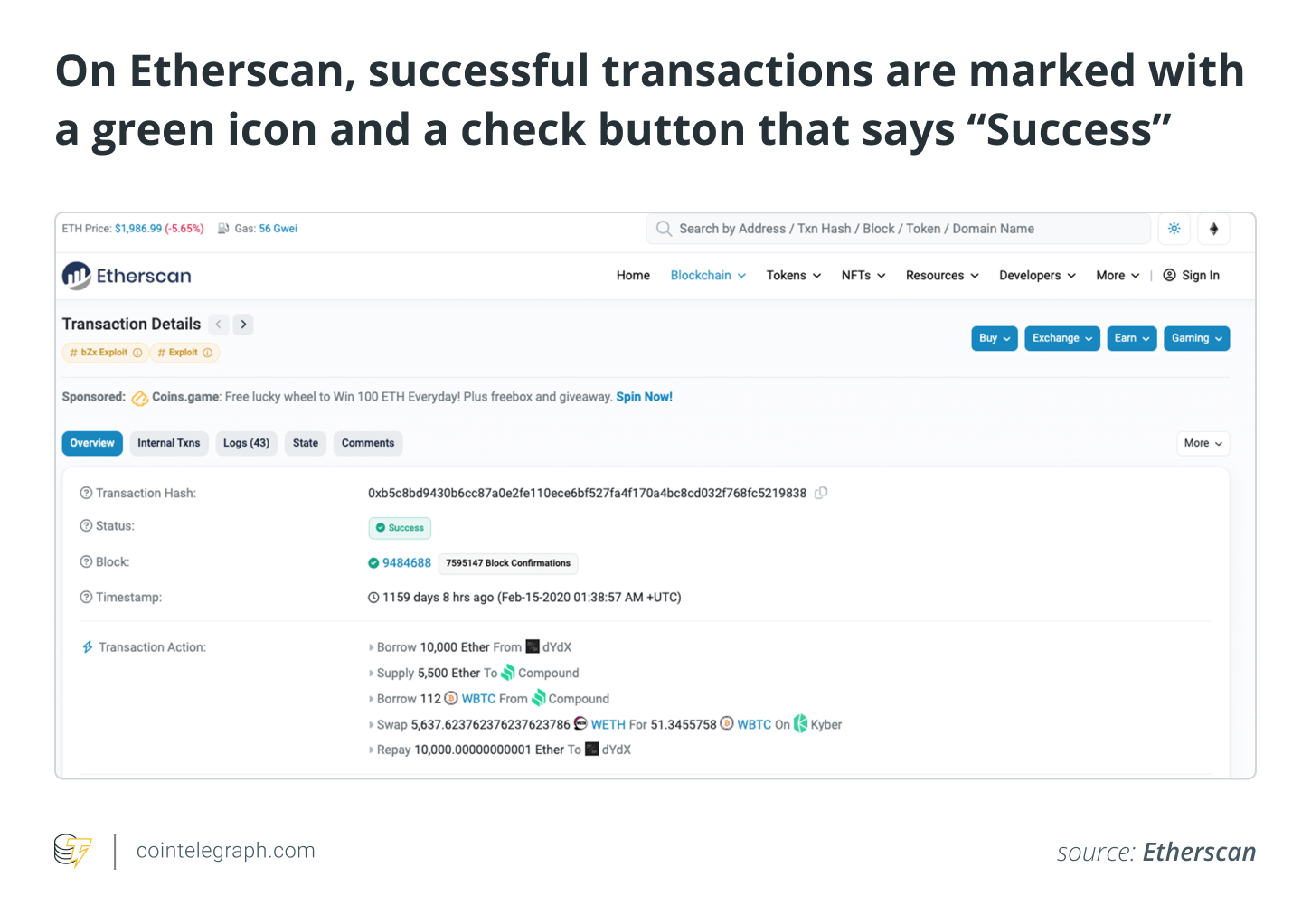
If no errors are shown, it signifies that the transaction was completed successfully. The ETH should be credited to the recipient wallet or exchange account within 24 hours of the transfer.
In the case of a failed Ether transaction, various error messages may appear:
- Error message or symbol: A red exclamation mark or an error message stating “bad instruction” or “out of gas” indicates that the transaction was unsuccessful and the funds did not reach their intended destination. For an “out of gas” error, users can double the gas limit they initially set and attempt again.
- Reverted: This refers to a user error related to a smart contract. It suggests that the user should verify the transaction details.
- Transaction not found: This means either the transaction did not process or it isn’t visible on the blockchain explorer yet. Trying another explorer may help. If it still doesn’t appear on multiple explorers, it is likely that it did not go through.
- Pending: The transaction is still awaiting validation or processing, but it has been located in the explorer’s transaction pool. Occasionally, pending transactions can still be canceled or replaced by the user.
Related: How to sell Ethereum: A beginner’s guide to selling ETH
What is the typical processing time for an Ethereum transaction?
An average transaction on the Ethereum blockchain generally takes between 15 seconds and five minutes to process, influenced by several factors. These factors include the fee paid for processing (transaction fee) and the level of network activity at the time of processing.
Ethereum transitioned from a proof-of-work to a proof-of-stake blockchain following the Merge. However, transaction speeds remain relatively unchanged. According to the Ethereum Foundation, it is a common misunderstanding that the Merge significantly accelerated transactions.
Nonetheless, there is a minor difference, with slots occurring exactly every 12 seconds post-Merge compared to every 13.3 seconds pre-Merge. In any case, this change is hardly perceptible to most users, as processing still primarily relies on network congestion and transaction fees.
When a transaction is initiated, it is recorded in Ethereum’s memory pool (mempool) and awaits validators to pick it up. The mempool operates similarly to a waiting room where pending transactions are held.
Once a validator incorporates transaction data into a block and adds the block to the blockchain, the transaction is deemed complete. It is considered finalized and irreversible after six additional blocks have been mined and added on top of it.
By checking a transaction’s status, traders can verify whether their transaction has succeeded or failed and how many blocks have been created since their transaction was added to the chain.
Why is it important for traders to check a transaction’s status?
Ethereum users must pay gas fees to utilize the network for transferring funds or deploying smart contracts. The fees are largely influenced by the number of participants waiting to execute transactions at any given moment.
Network congestion and demand are thus directly related to transaction costs. When demand is high, costs increase — conversely, when demand is low, costs decrease. In any case, checking a transaction’s status assists a trader in monitoring the cost of utilizing the network.
It can also help users ascertain if the gas fee they paid is adequate for their transaction to be confirmed. Low gas fees can often truncate or delay transactions, causing them to remain pending for extended periods, particularly during times of high network congestion.
Such transactions will stay pending until the gas fees meet the required minimum fees on the network. If this occurs, a user can resend the transaction by resubmitting it and increasing the gas fee while ensuring it retains the same nonce.
In addition to transaction status, Ethereum blockchain explorers can also provide the following useful information:
- Timestamp: the date and time the transaction was recorded on the blockchain.
- Block confirmations: the number of blocks mined since the transaction was confirmed.
- Transaction fee: the fee paid to the miner or validator.
- ETH price: the price of ETH at the time of processing.
- Base fee: the minimum fee required to transact on Ethereum.
- Gas limit: the maximum amount of gas the sender allocates for processing the transaction.
- Nonce: a unique number identifying each transaction executed on a user’s wallet; it increments by one with each new transaction sent.
By being aware of the above, traders can effectively manage their ETH transactions and ensure that transactions are processed accurately and promptly. This aids in facilitating smooth Ethereum transactions when sending and receiving funds or deploying smart contracts. Understanding a transaction’s status can also assist users in adjusting their spending habits and optimizing network usage.
