Disclaimer: Information found on CryptoreNews is those of writers quoted. It does not represent the opinions of CryptoreNews on whether to sell, buy or hold any investments. You are advised to conduct your own research before making any investment decisions. Use provided information at your own risk.
CryptoreNews covers fintech, blockchain and Bitcoin bringing you the latest crypto news and analyses on the future of money.


Cardano ranks among the largest layer-1 blockchain platforms by market capitalization. The initiative is spearheaded by Input-Output (a company founded by Charles Hoskinson), Emurgo, and the Cardano Foundation. The blockchain is named after the Italian mathematician Gerolamo Cardano, while its token, ADA, honors the 19th-century mathematician Ada Lovelace.
Cardano employs Ouroboros, a proof-of-stake (PoS) consensus protocol that enables ADA holders to delegate their assets to staking pools. The total stake empowers each pool to validate transactions, generate blocks, and manage the network.
Ouroboros incorporates cryptography, combinatorics, and mathematical game theory to ensure the protocol’s integrity, sustainability, and efficiency. Validators receive compensation from the Ouroboros protocol, which includes a fixed pool fee and an optional margin. Additionally, Ouroboros directly allocates staking rewards to all delegators.
Combinatorics involves the study of counting and arrangements, while mathematical game theory examines strategic interactions among rational decision-makers.
Staking enables ADA holders who lack the expertise or inclination to operate a node to engage in the network and earn rewards based on the amount of stake delegated. Staking pools serve as a solution for users wishing to stake their tokens on their respective blockchains without necessarily acting as validators on the network.
This article outlines the process of staking ADA in a self-custodial wallet, the necessary tools, and the rewards available to users.
What are self-custodial wallets?
Self-custody refers to a method of holding cryptocurrencies or non-fungible token (NFT) assets in a wallet that is typically accessible and controllable only by the user. The alternative is to store these assets on centralized exchanges, which expose users to counterparty risks if the exchange fails.
However, most self-custodial wallets still require users to manage their private keys. Private keys are essential for users to retain control over their crypto assets. Unlike assets stored on centralized exchanges, self-custody mitigates counterparty risk. This is why it is generally viewed as a preferable option for Web3 users, particularly following the collapse of several exchanges in 2022.
Most layer-1 ecosystems feature their native wallet solutions. For example, Ethereum and ERC-20 assets predominantly utilize MetaMask, while many Solana users depend on Phantom wallets.
When Cardano was launched in 2017, a complete wallet implementation was introduced with IOHK’s Daedalus. Two years later, Emurgo released the Yoroi light wallet. Since the Shelley mainnet hard fork in 2020, the wallet landscape within the Cardano ecosystem has significantly broadened.
There are full-node and light wallets available for Windows, Linux, and Mac as standalone applications, browser extensions, or mobile applications. Furthermore, Cardano wallet applications can support both single- and multi-address wallets. This is due to Cardano being UTXO-based like Bitcoin, rather than account-based like Ethereum.
Additionally, Cardano supports native tokens: each user’s wallet can store not only ADA but also thousands of other tokens and NFTs. Another feature offered by Cardano is the ability to add metadata as part of transactions.
Nami Wallet focuses on NFTs, while Flint Wallet facilitates connections between various chains and technologies. Conversely, Typhon and Etrnl wallets are sophisticated implementations that provide numerous features, such as support for multiple accounts within a user’s wallet, staking, voting, and the capability to transfer an unlimited number of assets to multiple recipients in a single transaction.
A significant aspect of custodial wallet staking in Cardano is that the wallet owner retains their ADA tokens at all times, maintaining full control over them. Delegation is determined by the amount of ADA in the wallet at the last epoch boundary (five days).
How to create a self-custodial wallet on Cardano?
The Yoroi wallet is one of several wallets available for self-custody of Cardano assets. Below are the steps to set up a Yoroi wallet.
Related Posts
- The Yoroi wallet can be downloaded as a browser extension here.
- After downloading and installing the browser extension, clicking on it opens the Yoroi application page.
- On the application page, selecting the “Add New Wallet” option initiates the wallet creation process.
- The next screen presents three options: Connect to hardware wallet, Create wallet, Restore wallet.
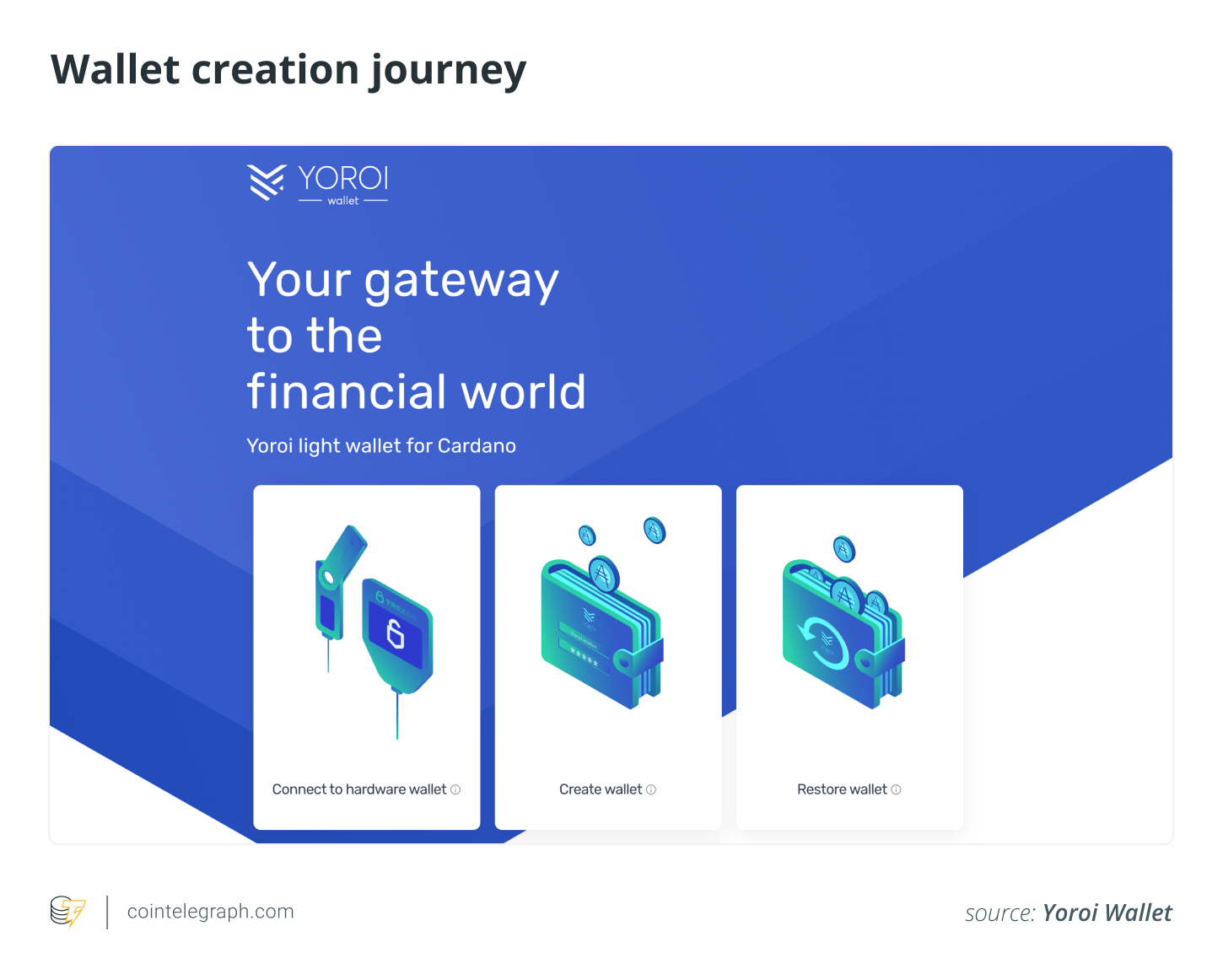
- To create the first Cardano wallet, select the “Create wallet” option.
- Next, users should choose “Cardano” as the currency, and the following screens will prompt them to enter a name for their wallet and a corresponding password.
- The next step involves setting up the recovery phrase, which must be recorded in order and confirmed in the subsequent step.
- The wallet is now prepared to receive Cardano assets.
- To add ADA to the wallet, users can click on the “Receive” tab to obtain the wallet address.
- Users can transfer ADA to the wallet from an exchange to commence the staking process.
How to stake ADA, and what are the staking rewards?
As previously noted, validating transactions on the Cardano network significantly depends on the staking of ADA by validators and other holders through staking pools. In exchange, the network provides staking rewards to these participants. ADA holders who cannot operate validators “delegate” their ADA to staking pools.
Initially, pool operators and delegators received 5% in staking rewards. Over time, this has gradually decreased to approximately 4% due to the planned gradual consumption of reserves. Of the 34.7 billion ADA in circulation, nearly 24.5 billion ADA (69% of the circulating supply) are staked. More than 70% of ADA are staked by holders through staking pools.
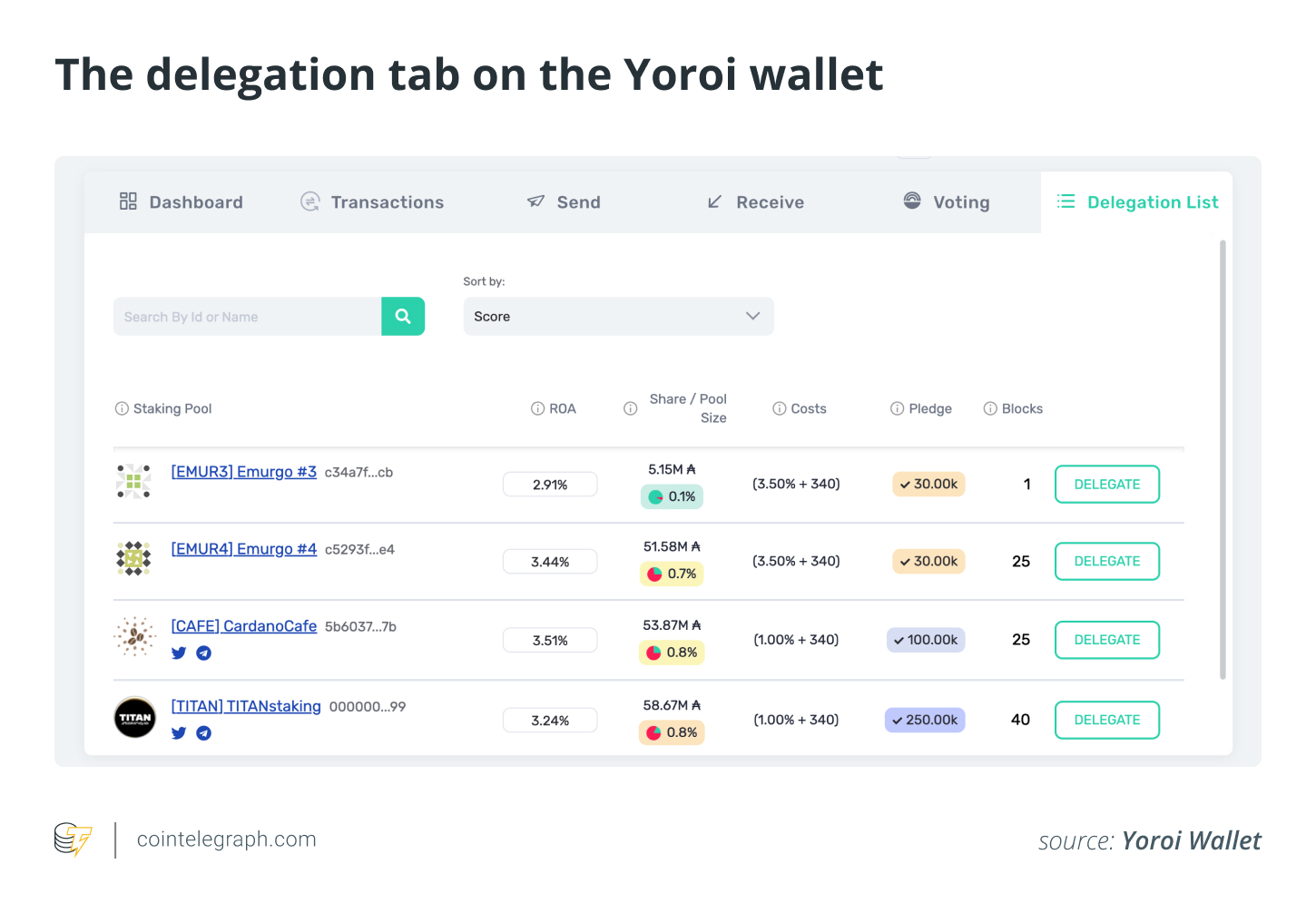
Holders can select from over 3,000 staking pools on the Cardano network. To stake, holders can follow these steps within the Yoroi wallet interface or any other Cardano wallet.
- On the wallet page, the “Delegation list” presents a selection of delegates.
- Pool operators can also contribute to the pool, as indicated by the “Pledge column.” A higher pledge signifies greater investment in the pool.
- Holders wishing to stake can select a pool by clicking the “Delegate” button.
How to stake via Daedalus wallet?
Daedalus is another wallet available for users of the Cardano network. Here are the steps to stake ADA using the Daedalus wallet:
- The appropriate version of the Daedalus wallet is downloaded and installed from the official website: https://daedaluswallet.io/.
- Upon opening the app on a laptop, users are given the option to either restore an existing wallet or create a new one.
- The user is prompted to enter a wallet name and password.
- Selecting the create option provides a 24-word recovery phrase that the user must write down and confirm.
- The wallet is created and begins syncing with the blockchain.
- Once syncing is complete, the user must click on the “Staking” tab to initiate the staking process.
- Clicking on the “Delegation” button directs the user to the delegation center, where they can choose from various staking pools.
- After selecting a stake pool, the user enters the amount of ADA they wish to stake and submits the confirmation.
- Once the transaction is processed, the user’s ADA will be delegated to the pool.
- From this point forward, the chosen pool manages the packaging of transactions into blocks and the validation of the chain.
- At the conclusion of each five-day epoch, the Ouroboros protocol, rather than the pool operator, automatically distributes rewards from the reserves to all ADA wallets.
Troubleshooting common issues with self-custodial ADA staking
Below are some common challenges users may face when staking ADA in a self-custodial wallet, along with potential troubleshooting steps:
- Stake pool not found: If users are unable to locate a suitable stake pool for delegation, they can utilize a stake pool search tool or expand their search criteria to include more options. Dedicated stake pool portals like PoolTool, along with explorers such as Cardanoscan and Cexplorer, provide a more detailed overview of the history and performance of all stake pools.
- Wallet synchronization issues: If a user’s wallet is not syncing properly or showing incorrect information, they can attempt to restart the wallet or use a different device. They may also check for any updates or patches available for their wallet software.
- Transaction errors: If users experience an error while trying to delegate their ADA or withdraw their rewards, they should ensure that they have entered the correct information and that they possess sufficient funds in their wallet to cover any transaction fees. Users can also try clearing their cache or using a different browser.
- Staking rewards not received: To obtain staking rewards, users must verify that their delegation is active and that the pool they have delegated to is producing blocks, as no blocks being generated means no rewards will be distributed. Users should also refresh their wallet or check the blockchain explorer to confirm that the rewards have been allocated.
Users should note that if they are unable to use one of the ADA wallet applications, the recovery phrase can be utilized to restore the wallet in another wallet application at any time, granting access to all their ADA and native assets. If users encounter any additional issues while staking ADA in a self-custodial wallet, they can reach out to their Cardano wallet app support team or consult online forums and communities for assistance.
Furthermore, it is essential for users to never disclose their wallet recovery seed words or screenshots to anyone claiming to assist with their wallet. Additionally, users should be wary of anyone instructing them to transfer their funds to a new address and remain vigilant against potential scams.
