Disclaimer: Information found on CryptoreNews is those of writers quoted. It does not represent the opinions of CryptoreNews on whether to sell, buy or hold any investments. You are advised to conduct your own research before making any investment decisions. Use provided information at your own risk.
CryptoreNews covers fintech, blockchain and Bitcoin bringing you the latest crypto news and analyses on the future of money.


Multichain bridging protocol LiFi has introduced a multi-message aggregator aimed at decentralized autonomous organization (DAO) governance, as stated in an announcement on Aug. 17 by LiFi research lead Arjun Chand. If adopted by decentralized exchanges, lending applications, and various Web3 protocols, this new aggregator is designed to mitigate governance attacks that stem from cross-chain bridges, according to the documentation associated with the aggregator.
This announcement follows an intense discussion regarding bridge security on Uniswap forums in late January and early February, which concluded that no single bridge possesses all the necessary security features for safe governance.
For several months, @lifiprotocol has collaborated closely with @UniswapFND to create Multi-Message Aggregation (MMA), an additional security module for cross-chain messaging.
Here’s why we believe MMA could be a robust solution for various cross-chain messaging requirements! pic.twitter.com/w34g3ZUNfi— Arjun | LI.FI (@arjunnchand) August 17, 2023
The cryptocurrency exchange Uniswap is governed by a decentralized autonomous organization known as UniswapDAO. In January, this DAO initiated discussions about deploying a second instance of Uniswap on the BNB Chain. This raised the question of how Uniswap would be governed across multiple chains, given that all previous votes were conducted on the Ethereum network. On Jan. 24, the DAO voted in favor of launching a second version of Uniswap on the BNB Chain and opted to utilize the bridging protocol Celer for message transmission between BNB and Ethereum.
Although this proposal was approved, a debate quickly arose regarding the selection of the Celer bridge for message delivery. Some DAO members expressed concerns that Celer might not be secure enough to avert cross-chain governance attacks. They suggested alternatives such as Wormhole, LayerZero, or DeBridge. Conversely, other participants supported Celer as the appropriate option.
On Jan. 31, the DAO conducted a second vote to determine which bridge should be employed for governance. Wormhole emerged victorious in the vote and was designated as the official bridge for governance purposes.
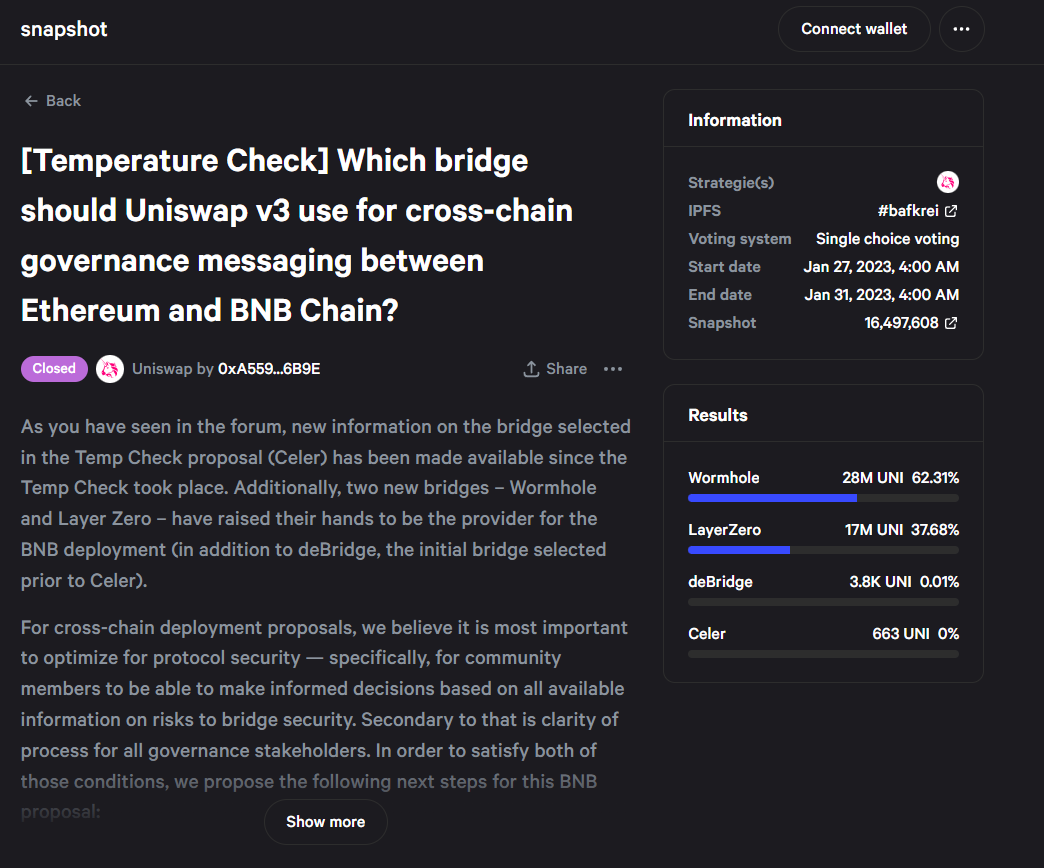 UniswapDAO proposal for cross-chain governance. Source: Uniswap.
Despite Wormhole’s success, the vote was contentious. Only 62% of UNI tokens were utilized for “yes” votes. In contrast, many UniswapDAO proposals typically garnered nearly unanimous support or opposition.
Related Posts
During the discussions leading up to the vote, a number of participants concluded that Uniswap should deploy multiple bridges rather than relying on a single one. This strategy would ensure that if one bridge were compromised, the others could reject any malicious messages, thereby thwarting the attack. However, at that time, no multi-bridge solution was available. Therefore, supporters of the proposal contended that Wormhole should be utilized until a multi-bridge option could be developed.
Related: Token hoarders defeat the purpose of most DAOs: Study
In the announcement from LiFi on Aug. 18, Chand indicated that the team’s new bridge aggregator would offer “a future-proof solution for different cross-chain messaging needs,” thereby allowing protocols to avoid dependence on a single bridge for governance communications.
As per the aggregator’s documentation, protocols can configure LiFi to require that votes be validated on two out of three bridges. For instance, if one bridge indicates that a DAO token holder voted “yes,” while the other two bridges report a “no” vote, the “yes” vote will be validated. The aggregator can also be adjusted to use three out of five bridges or any other ratio that the DAO prefers.
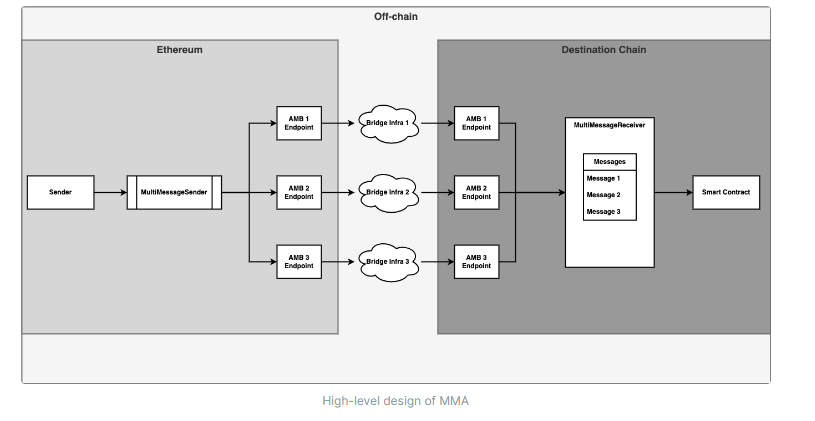 LiFi bridge aggregator design diagram. Source: LiFi.
LiFi is not the only team developing a multi-bridge aggregator for DAO governance. Gnosis launched a comparable protocol named “Hashi” in March.
In June, a UniswapDAO committee asserted that Hashi was “not yet production-ready,” had outstanding audits, and lacked a bug bounty. Consequently, the committee determined that it was not suitable for managing DAO governance.
The LiFi aggregator has also not undergone an audit. In his announcement, Chand stated that “soon, we’ll expand its testing and submit it for an audit by Trail of Bits.”
