Disclaimer: Information found on CryptoreNews is those of writers quoted. It does not represent the opinions of CryptoreNews on whether to sell, buy or hold any investments. You are advised to conduct your own research before making any investment decisions. Use provided information at your own risk.
CryptoreNews covers fintech, blockchain and Bitcoin bringing you the latest crypto news and analyses on the future of money.


Less than 16 hours have elapsed since the introduction of PayPal’s new stablecoin (PYUSD), and opportunists, degens, and potential scammers are already trying to profit from the excitement by launching their own imitation tokens.
Data from decentralized exchange scanner DexScreener indicates that nearly 30 new token pairs featuring the ticker “PYUSD” have emerged in the 16 hours following the announcement.
Today, we’re unveiling a new stablecoin, PayPal USD (PYUSD). It’s designed for payments and is backed by highly liquid and secure assets. Starting today and rolling out in the next few weeks, you’ll be able to buy, sell, hold and transfer PYUSD. Learn more https://t.co/53RRBhmNHx pic.twitter.com/53ur2KmjU7
— PayPal (@PayPal) August 7, 2023
The imitation tokens have been created on various chains, including Binance Smart Chain, Ethereum, and Coinbase’s latest layer 2 Base.
It is crucial to highlight that the authentic PayPal USD token was established in November of the previous year and can be confirmed at the specified contract address.
PayPal has clearly stated that PayPal USD can only be transferred between verified PayPal accounts and other compatible wallets, making it highly improbable that any of the tokens listed under the same ticker on UniSwap or any other decentralized exchange are legitimate.
The largest counterfeit PYUSD token, minted on Ethereum, has recorded an impressive $2.6 million in trading volume since its creation just minutes after PayPal announced the launch of their stablecoin.
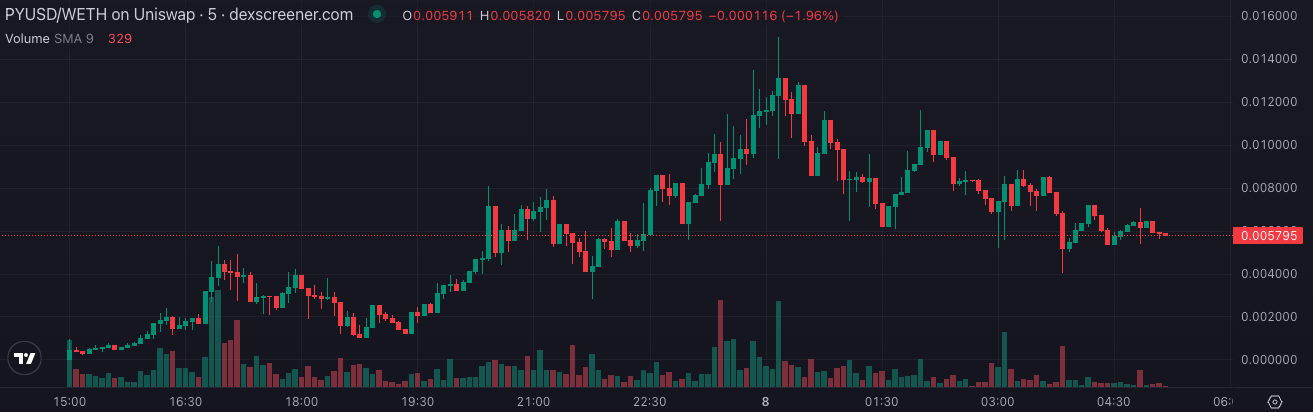 Price action for one counterfeit PYUSD token since inception. Source: DexScreener
Despite experiencing a surge of over 30,000% in the initial eight hours, the token has since dropped more than 66% from its peak value.
Related Posts
One particular token took a slightly humorous approach to PayPal’s stablecoin, choosing the name “PepeYieldUnibotSatoshiDoge.” This counterfeit token has increased by more than 3,000% in the last four hours.
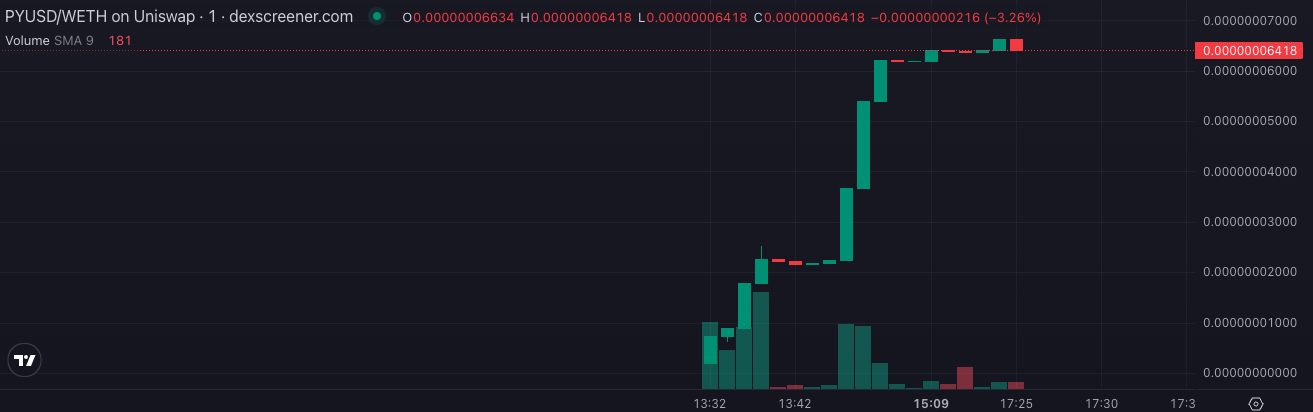 Price action since inception for PepeYieldUnibotSatoshiDoge. Source: DexScreener
It is important to recognize that many of the fraudulent PYUSD tokens listed are likely what are referred to as “honeypots”—meaning that once an investor buys the token, they are unable to sell it, effectively losing their crypto.
Related: Paypal USD: Boon for Ethereum but not decentralization, says community
Unless investors have the ability to audit smart contracts themselves, they often will not discover that the token is a honeypot until they attempt to sell their assets.
Degen traders are known to rush to create new memecoins to take advantage of trending news and developments.
On Aug. 3, anonymous developers launched an “LK-99” token in an effort to profit from the superconductor frenzy.
A week earlier, on July 27, degens produced a collection of over 50 UFO-themed memecoins as the U.S. Congress held a hearing where a whistleblower alleged that the U.S. government was concealing evidence of alien visits to Earth.
Deposit risk: What do crypto exchanges really do with your money?
