Disclaimer: Information found on CryptoreNews is those of writers quoted. It does not represent the opinions of CryptoreNews on whether to sell, buy or hold any investments. You are advised to conduct your own research before making any investment decisions. Use provided information at your own risk.
CryptoreNews covers fintech, blockchain and Bitcoin bringing you the latest crypto news and analyses on the future of money.


Blockchain games initially emerged as a way to effectively evaluate the true capabilities of technology. Nevertheless, ensuring they fulfill that potential continues to be a challenge. Although Illuvium was among the most eagerly awaited crypto game launches in history, the value of its ILV token has drastically decreased since 2021 — by as much as 97%.
The developers of the project have not provided any significant updates for an extended period. The captivating gameplay and stunning visuals are insufficient to prevent the token from declining. This trend is also observable in most GameFi tokens.
To date, blockchain games have largely failed to impress because they do not adequately prioritize delivering a quality user experience. Ultimately, the complexity of developing these games is often underestimated. When GameFi first appeared, it held considerable promise, but it has largely fallen short. Creating high-quality AAA games (those produced by leading publishers) is a challenging and costly endeavor, compounded by fierce competition.
Related: 2023 will see the decline of play-to-earn gaming
Developers and publishers are now resorting to many clichéd approaches and ineffective practices. Numerous games have been hastily produced or poorly crafted. Some have offered little in terms of entertainment value, with the earning potential being the sole reason for player engagement. This often results from insufficient budgets or the rush to release incomplete games. Furthermore, some companies have launched games that do not align with the gameplay showcased in trailers, leading to a loss of trust among players in the industry.
Considering all these factors, it is reasonable to assert that many of these games may not prioritize their player base. Audiences often wait for months for new releases, only to discover that they are of low quality, poorly constructed, and lacking in entertainment.
Illuvium: Overworld is still visually appealing on the low settings of my laptop. @illuviumio #Illuvium #web3game pic.twitter.com/6AGu5tcC2W
— Gringo HodL // (@GringoHodl) August 15, 2023
Illuvium secured funding by launching its ILV token and selling land non-fungible tokens (NFTs) for $72 million prior to the game’s release. Despite this, the public beta launch is being postponed. This situation underscores a significant drawback of AAA games: the focus on earning can detract from the enjoyment of gameplay. The same challenges faced by Illuvium are also present in other AAA blockchain game initiatives.
Pixelmon is notable in discussions about AAA blockchain game projects that failed to meet expectations. The play-to-earn game, inspired by Minecraft, Fortnite, and Pokemon, sold a collection of 10,000 NFTs in 2022, generating around $70 million based on hype — yet the game’s launch did not live up to player expectations. Some characters were basic Unity models, and one user encountered an invisible character. This was not a project that justified a $70 million valuation.
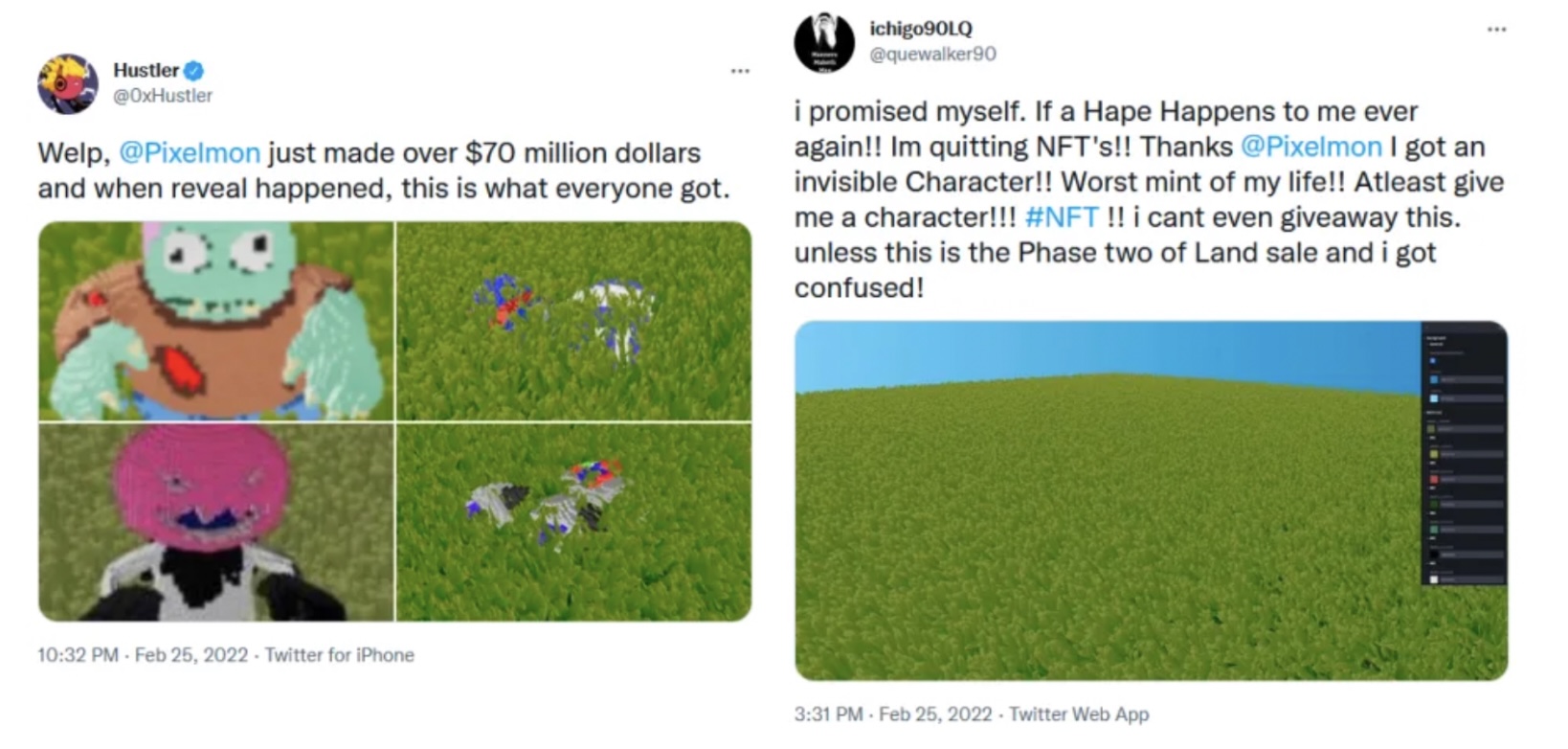 Players weren’t impressed by Pixelmon’s $70 million valuation. Source: Twitter
Related Posts
Developers might prioritize unsustainable economic models over incorporating features that would enhance the player experience. This has become a trend within the GameFi sector, often overlooking engaging gameplay.
In Illuvium’s tokenomics, 45% is allocated for the team and investors. Only 10% is designated for game rewards, a negligible amount compared to the investors’ share. All allocations for token investors will be accessible and can be sold prior to the game’s launch, allowing the Illuvium team and investors the advantage of an early exit.
With these types of games, there is a significant risk of financial loss. Users may need to invest considerable time in the game before realizing any substantial monetary return. It is also important to note that token prices can fluctuate rapidly.
Related: GameFi developers could be facing substantial fines and legal repercussions
In blockchain gaming, there is also a high barrier to entry — significantly impeding the mainstream acceptance of GameFi. Additional value must be provided beyond a monetary return that takes considerable time to accumulate. The user experience requires improvement. This aspect not only discourages players but also investors. The primary goal of token issuance is to enhance its value for the team, investors, and players.
However, with Illuvium, there is a risk for retail investors and players, given that 45% of the tokens may experience selling pressure before the game even launches. Token investors have an incentive to sell when demand for ILV increases, which conflicts with game players, who are seeking a reasonable return on investment from gameplay.
So far, Illuvium has benefited from the excitement surrounding tokens and NFTs — and retail players and investors have bought into the hype — but it has yet to demonstrate genuine value. The game’s strategy of “token first, make the allocations available, and game later” creates a scenario where the interests of investors and players diverge. The game appears to be primarily designed for investors rather than gamers.
While it features some impressive designs and concepts, the game still lacks many essential elements, and there is considerable scope for enhancement.
Investors constitute too large a portion of the game’s user base, making its success more a result of marketing than the quality of the game itself. Illuvium’s current state resembles that of an initial coin offering project, generating excitement for an AAA blockchain title that has yet to be realized. Even if a $100 million title is successfully developed, the question persists: Are there enough blockchain gamers to sustain it?
Takuya Tsuji is the founder of Eureka Entertainment Ltd, a gaming company preparing to launch an upcoming blockchain game, Coin Musme. He previously established Techcross Inc in 2009 as a student at the University of Tokyo, growing it to $70 million in annual revenue. He has also served as a lead developer on DMM Games, a gaming platform in Japan, and has contributed to the development of over 50 game titles.
The views expressed are solely those of the author and do not necessarily reflect the opinions of Cointelegraph. This article is intended for general informational purposes and should not be construed as legal or investment advice.
