Disclaimer: Information found on CryptoreNews is those of writers quoted. It does not represent the opinions of CryptoreNews on whether to sell, buy or hold any investments. You are advised to conduct your own research before making any investment decisions. Use provided information at your own risk.
CryptoreNews covers fintech, blockchain and Bitcoin bringing you the latest crypto news and analyses on the future of money.


Payment channels within the Lightning Network allow users to execute transactions without the need to register each one on the Bitcoin blockchain, thereby reducing congestion and expenses.
Nevertheless, like any network, the Lightning Network is vulnerable to security threats, with routing attacks being one of the potential dangers. These attacks can impact the network’s efficiency, posing financial risks to users.
This article will discuss routing attacks, their mechanisms, various types, and how to recognize and evade them.
What are routing attacks?
By creating a network of payment channels, the Lightning Network — a layer-2 scaling solution for the Bitcoin blockchain — facilitates faster and cheaper transactions. So, is it possible for the Lightning Network to be compromised?
While the Lightning Network enhances scalability and efficiency, it also presents certain challenges and security concerns, including routing attacks. In the context of the Lightning Network, routing attacks refer to intentional efforts by users to exploit weaknesses in the routing system for personal advantage.
An example of a routing attack involves a participant deliberately imposing high routing fees, making it costly for other users to route their payments through that participant’s channels. This could hinder the Lightning Network’s ability to route payments effectively and affordably.
How do routing attacks work?
Malicious users employ various strategies to target vulnerabilities or disrupt the Lightning Network’s payment routing system. As previously mentioned, imposing excessive routing fees is a common tactic to deter other users from routing their funds through specific paths. This can complicate and increase the cost of routing payments, discouraging users from utilizing those routes.
Another approach involves misleading the routing algorithm by disseminating false information or errors throughout the network. For instance, malicious nodes might transmit incorrect channel states, leading to transaction failures and user frustration. Such attacks can undermine the reliability and usability of the Lightning Network.
Furthermore, attackers might execute probing attacks to gather insights into the network’s structure and user behavior, endangering user privacy. They may also attempt to reroute payments intended for legitimate recipients to their own channels.
To mitigate the risks posed by routing attacks, developers and users of the Lightning Network must remain vigilant, enhancing network security, refining routing algorithms, and promoting responsible node management.
Common routing attacks on the Lightning Network
Routing fee sniping
In this type of attack, a rogue node may deliberately set exorbitant routing fees for a payment channel it controls. The attacker benefits from inflated costs whenever someone attempts to route a payment through this channel. This may discourage users from utilizing the Lightning Network due to the steep fees and ineffective routing.
Probabilistic payment fraud
In this attack, a malicious node falsely claims that a payment has failed when, in reality, it was successful. They can achieve this by refusing to send the payment receipt or by feigning an error. This undermines the network’s efficiency by dissuading users from using certain routes or channels.
Channel jamming attacks
A hostile actor intentionally occupies the liquidity in a payment channel to perform channel jamming, a form of denial-of-service attack that makes the channel unavailable to legitimate users and prevents them from transacting. In extreme cases, if multiple channels become clogged simultaneously, the Lightning Network may experience congestion, making it difficult for other users to find reliable methods for making their payments.
Balance manipulation
Lightning Network nodes must maintain a balance within their channels to facilitate payments. A malicious node can deliberately create an imbalanced channel, rendering it ineffective for routing and potentially disrupting the network’s functionality.
Route flapping
In this attack, a rogue node frequently alters its channel limits or fee structures, making it challenging for other nodes to find stable and reliable payment channels. This can result in delays and ineffective routing.
Sybil attacks
A malicious user can seize a significant portion of the network’s routing capacity by establishing multiple fictitious nodes within the network. This can confuse routing algorithms, extort funds, or enable other attacks.
Related Posts
Onion routing attacks
The Lightning Network utilizes onion routing to obscure the involvement of intermediate nodes in a transaction. However, a malicious node may attempt to de-anonymize the transaction by analyzing the routing data if it is part of the route. This could expose the sender, receiver, and amount of the transaction.
Related: What is a phishing attack in crypto, and how to prevent it?
How to identify routing attacks on the Lightning Network
Detecting a routing attack on the Lightning Network can be challenging, as malicious actors often seek to manipulate payment routing for their own benefit. Routing attacks can manifest in various forms, but they generally aim to disrupt the network’s operations or unjustly profit from routing fees.
These attacks may present as unusual payment failures, unexpected routing fees, and abrupt changes in channel liquidity. Such malicious activities can be detected using network monitoring tools, watchtowers, route selection mechanisms, and node behavior analysis. For example, node behavior analysis, including reputation systems and identifying suspicious behavior, can help uncover malicious nodes.
Similarly, if an untrustworthy channel partner attempts to misappropriate funds, watchtowers designed to monitor for suspicious activities can broadcast penalty transactions and observe the blockchain for potential attempts to close the channel.
Engaging actively in the Lightning Network community and studying past attacks can also enhance one’s ability to recognize routing threats. Thus, collaborating with peers to uphold the network’s integrity as it evolves strengthens the security efforts of the network.
Is channel jamming the same as the routing attack?
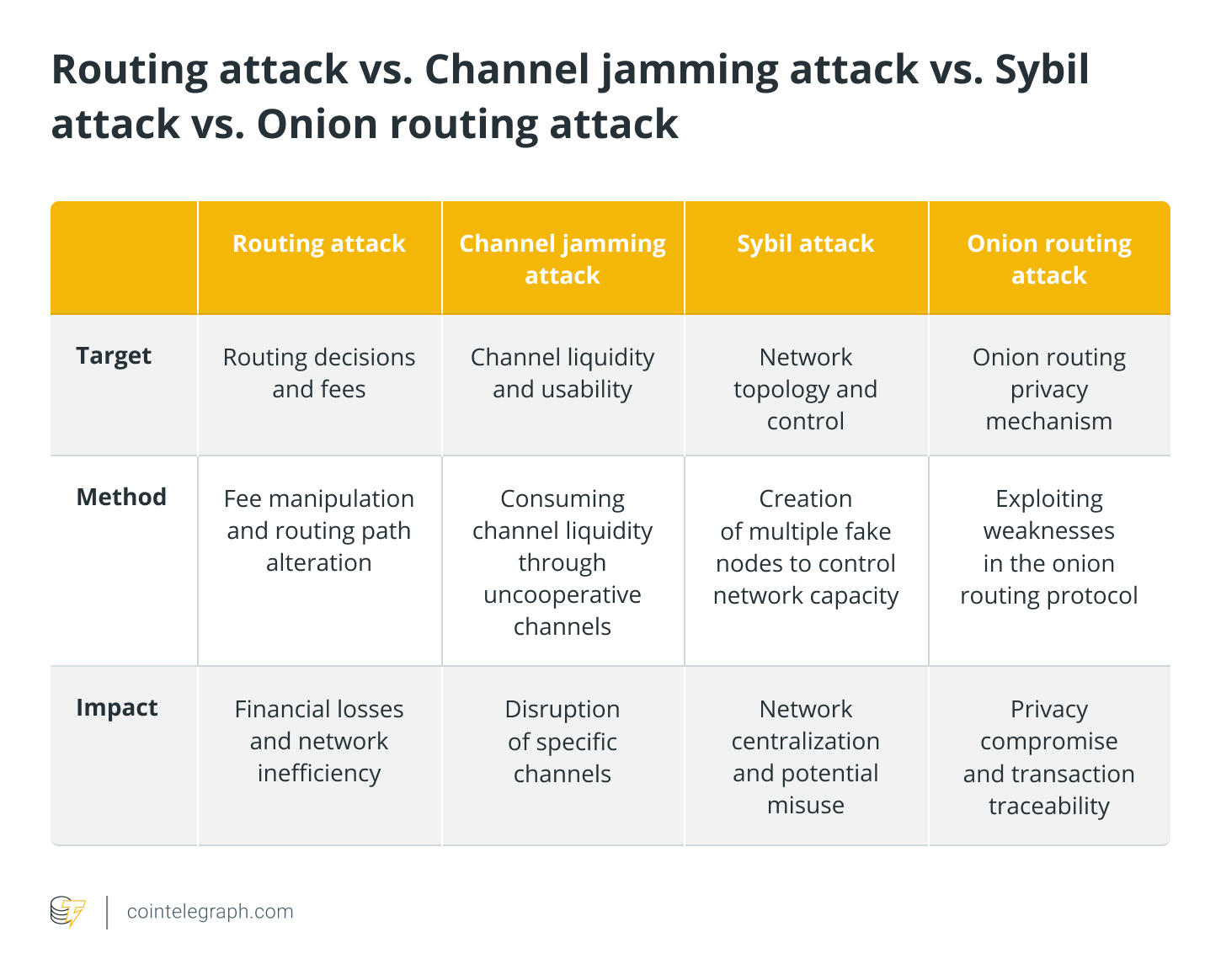
While channel jamming and routing attacks are related within the context of the Lightning Network, they are not identical. A routing attack is a broader term that encompasses various malicious tactics used to manipulate payment routing for personal gain or to disrupt networks.
These tactics may include deliberately rejecting payments, imposing excessive routing fees, or creating ineffective routes. Conversely, channel jamming refers specifically to a type of routing attack where a malicious node inundates a particular channel with numerous small, unsuccessful payments, depleting the channel’s liquidity and preventing legitimate users from routing payments through it.
While channel jamming is one method to disrupt routing, routing attacks encompass a wider array of strategies that threaten the network’s security. Therefore, it is essential for users and node operators to recognize these distinctions to implement appropriate safeguards and enhance the security and efficiency of the Lightning Network.
Related: What is a crypto dusting attack, and how do you avoid it?
How to avoid routing attacks on the Lightning Network
<p safeguarding against routing attacks is vital for the integrity and security of the Lightning Network. The following strategies can assist users in evading routing attacks on the Lightning Network:
Select trusted nodes
As routing intermediaries, choose reliable and reputable Lightning Network nodes. Seek out nodes with a proven track record and positive reviews from users. Moreover, implementing watchtower services can provide an additional layer of security to keep channels safe when users are offline.
Diversify channels
Diversifying routing options is beneficial for preventing payments from becoming overly reliant on a single channel or node. By distributing transactions across multiple channels and nodes, the network becomes less vulnerable to manipulation by attackers aiming to disrupt the flow of funds or extort large sums from users.
Monitor channel activity
Regularly monitoring channel activity is another crucial aspect of detecting and preventing potential attacks, allowing users to identify anomalies or suspicious actions early on.
Keep software updated
Stay informed about the latest updates to the Lightning Network software. Developers frequently release patches and improvements to address security vulnerabilities and enhance network resilience.
By adopting these strategies, users can bolster their defenses against routing attacks and contribute to a more secure environment for transactions on the Lightning Network.
Collect this article as an NFT to preserve this moment in history and show your support for independent journalism in the crypto space.
