Disclaimer: Information found on CryptoreNews is those of writers quoted. It does not represent the opinions of CryptoreNews on whether to sell, buy or hold any investments. You are advised to conduct your own research before making any investment decisions. Use provided information at your own risk.
CryptoreNews covers fintech, blockchain and Bitcoin bringing you the latest crypto news and analyses on the future of money.


The Ethereum DApps ecosystem is flourishing, and the possibilities for decentralized applications (DApps) are vast. Who wouldn’t want to get involved?
Developers now have the ability to create applications with their own native tokens or non-fungible tokens (NFTs) on secure blockchain networks for various purposes — ranging from financial and industrial applications to social media platforms and, naturally, gaming.
Let’s explore some inquiries developers may have and how they can initiate an Ethereum DApp project.
What are DApps?
DApps are blockchain-based iterations of the applications and software we utilize daily. They are powered by smart contract technology and constructed on smart contract-enabled blockchains like Ethereum.
The primary advantages of DApps are that they operate on decentralized blockchains governed by technological or community governance methods rather than individual corporate entities. With blockchain networks, DApp data is not centralized, resulting in enhanced network security. DApps utilize cryptocurrencies, facilitating the allocation and transfer of value, or making payments, significantly easier and more cost-effective than traditional fiat currency transactions.
Can you build DApps on Ethereum without experience?
For individuals who are already software or web developers, Ethereum DApp development may come naturally with a grasp of blockchain technology, smart contracts, the Solidity programming language, and cryptocurrencies.
There are also platforms being developed that will enable developers to create DApps with less knowledge of blockchain, programming, and smart contracts, but having some development experience is beneficial.
Which blockchain is best to create a DApp?
Ethereum’s long-standing presence in the crypto sector and its popularity often make it the preferred blockchain for DApp creation. The network continues to innovate; it is well-established and has a robust ecosystem for DApp development. However, one should consider the transaction or Ethereum gas fees as a significant factor to evaluate against other networks before starting any development projects.
Other smart contract blockchain networks include Solana, Polkadot, BNB Smart Chain, Eos, Tron, and Cardano; each has its own advantages and disadvantages compared to Ethereum.
The selected network may affect the interoperability, scalability, security, and cost of DApp development, as well as determine the community of DApp users that can be engaged upon launch.
To determine which blockchain is most suitable for creating a DApp, developers can start by assessing a DApp’s requirements and objectives, along with evaluating the development expertise within the existing team or the team they hire.
How many DApps run on Ethereum?
There are more than 3,000 DApps currently operating on Ethereum, with additional ones in development. DappRadar is a well-known platform to explore the DApps on Ethereum and its competing networks, as well as to see the number of users each DApp has and the volume of transactions processed.
Why build a DApp on Ethereum?
There are several smart contract blockchains to consider for those intending to build a DApp, but Ethereum is arguably the most recognized and offers the highest level of decentralized security.
Ethereum was the first smart contract blockchain, boasting a large developer community and a wealth of open-source code available for new developers. It is also a popular choice for business developers aiming to create their own enterprise-level blockchain projects.
What are Ethereum DApps examples?
There are hundreds of well-known Ethereum DApps and many more that are in the process of building their user bases; here are a few established and widely used examples:
Uniswap
One of the most utilized Ethereum DApps is the decentralized exchange (DEX) Uniswap, which has now facilitated over $1 trillion in trades on the platform.
OpenSea
The OpenSea platform is among the largest NFT marketplaces, featuring over 2 million NFT collections and 80 million individual NFTs available for purchase.
MetaMask
Serving as both a cryptocurrency wallet and a gateway, or browser, for accessing blockchain-based applications, MetaMask is recognized as a user-friendly crypto tool.
Axie Infinity
This NFT-based game exemplifies an in-play virtual economy in action and ranks as one of the most popular DApp games.
How to build an Ethereum DApp
Related Posts
Aspiring developers can commence Ethereum DApp development by considering the requirements and purpose of a DApp. The next step is to begin researching Ethereum DApp development tools and processes.
DApp and smart contract development can be intricate, and it certainly differs from traditional web or software development. A sensible starting point for in-depth research is Ethereum’s Developer Resources, which serves as “a builder’s manual for Ethereum.” As a tutorial for decentralized applications, it is one of the most comprehensive available.
Five elements to consider while building an Ethereum DApp
An Ethereum DApp development project requires detailed planning, similar to any business or project. To outline how to construct a DApp on Ethereum, here are a few additional components to investigate first:
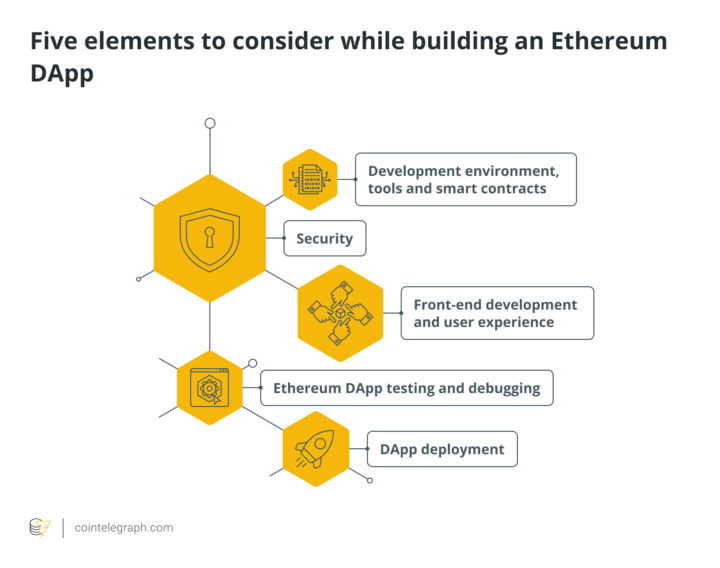
1. Development environment, tools and smart contracts
Once a development team is established, a DApp will require a development environment, typically a blockchain-based testnet, where the Ethereum DApp architecture can be constructed and tested using relevant development tools. Smart contracts must also be meticulously designed and written.
2. Security
Blockchain networks can offer greater security for financial transactions than traditional systems, but it is essential not to overlook Ethereum DApp security. Cryptographic security is complex and must be well understood or managed by experts, keeping in mind that blockchain networks and cryptocurrencies are often targeted by hackers and scammers.
3. Front-end development and user experience
Front-end DApp development typically occurs after the DApp architecture and smart contract are built. A front-end web or Web3 application may utilize more conventional development tools, but the user experience must also be carefully designed to ensure the project’s success.
4. Ethereum DApp testing and debugging
Developers planning to build on Ethereum benefit from blockchain technology that has been utilized and tested, along with open-source code repositories to assist with new projects. However, developers must also test and debug new DApp builds, smart contracts, and UI/UX, as there is nothing worse than launching software that fails to function!
5. DApp deployment
The deployment of an Ethereum DApp will be the final phase of a project and likely the most exhilarating. Once testing and debugging are complete, a DApp is transitioned from its testnet to the Ethereum mainnet, where it can be accessed by users. At this stage, a project’s sales and marketing efforts will commence in earnest.
How much does it cost to build a DApp on Ethereum?
Developers with experience who create their own DApps using the available Ethereum development tools may incur lower building costs. For developers or entrepreneurs looking to hire a DApp developer or an Ethereum DApp development team, estimates can range from $15,000 and above for a simple DApp to $30,000 and above for a more complex DApp or to engage a more seasoned developer.
Challenges associated with DApp development on the Ethereum blockchain
Creating a DApp on Ethereum or any other blockchain will come with its challenges. Here are a few that may need to be anticipated:
Market saturation
With over 3,000 DApps already developed on Ethereum, any new DApp development must vie for attention, at least within the Ethereum community.
Scalability, speed, security, interoperability and decentralization
Every smart contract blockchain is still striving to adequately address blockchain’s promises and the inherent challenge of enabling projects to scale for mainstream adoption while achieving interoperability with other projects and technologies, all while maintaining security and decentralization.
Transaction or gas fees and crypto price volatility
Every transaction within a DApp incurs transaction fees — in Ethereum’s case, gas fees — which are typically passed on to DApp users. Crypto coins or tokens associated with DApps will also experience the price fluctuations seen in the broader market.
Availability of expertise/smart contract complexity
Blockchain development remains a relatively new profession, leading to a genuine shortage of experienced experts, and smart contracts still present technological limitations for developers to navigate.
Lack of sector regulation
As crypto coins and tokens, including those utilized in DApps, have yet to be thoroughly regulated, there is considerable uncertainty surrounding the development of these digital currencies.
User experience
For those outside the crypto community, DApp functionalities can be challenging for consumers accustomed to traditional apps, and many users are still hesitant about utilizing cryptocurrencies.
