Disclaimer: Information found on CryptoreNews is those of writers quoted. It does not represent the opinions of CryptoreNews on whether to sell, buy or hold any investments. You are advised to conduct your own research before making any investment decisions. Use provided information at your own risk.
CryptoreNews covers fintech, blockchain and Bitcoin bringing you the latest crypto news and analyses on the future of money.


The aftermath of the COVID-19 pandemic has elevated the topic of inflation, resulting in heightened interest within the Web3 sector for the development of flatcoins, which are closely related to stablecoins and aim to address inflation risk.
Numerous existing flatcoins, such as Terra’s TerraUSD (UST), are supported by algorithms, serving as a stark reminder of the dangers linked to algorithmic backing, as evidenced by the downfall of LUNA and UST. Thus, while the concept of flatcoins may be attractive, they raise considerable concerns both conceptually and in their design. Ultimately, the viability of flatcoins will hinge on the ability of developers to fulfill their promises.
So far, flatcoin white papers — including one from Coinbase — do not seem to meet their intended objectives, at least in their present form. Specifically, the tokenomics structures of certain projects may present an even greater risk than those of current stablecoin models.
Conceptual Challenges
Assessing the potential applications of flatcoins is indeed essential. While they are often marketed as assets that can help users maintain their purchasing power during times of inflation and economic instability, this notion may be misleading.
Stablecoins are digital representations of fiat currencies, and their value as a medium of exchange and unit of account mirrors that of fiat currencies. Conversely, flatcoins represent an index of the purchasing power of a fiat currency, derived from oracles that gather data on economic indicators like the Consumer Price Index (CPI).
Related: CBDCs will lead to absolute government control
Consequently, the unit value of flatcoins will gradually diverge from the fiat currency they are linked to, as long as inflation is not zero. Therefore, the existence of flatcoins relies on the premise that fiat currencies or their digital equivalents serve as the mediums of exchange and units of account.
In other words, flatcoins cannot surpass stablecoins or fiat currencies in their roles as mediums of exchange and units of account because their existence depends on the superiority of fiat currencies and stablecoins in these functions.
Existing Inflation-Pegged Assets
Flatcoins are financial instruments that expose investors to inflation rates, categorizing them as derivatives of inflation. Asset classes that expose investors to inflation risk have existed for a considerable time.
For example, Treasury Inflation-Protected Securities (TIPS) have been utilized since 1997 to manage inflation risks associated with fixed-rate bonds. Retail investors can easily access TIPS and gain exposure to inflation through exchange-traded funds (ETFs) in their brokerage accounts.
The availability of these established inflation-linked asset classes via ETFs enables both institutional and retail investors to effectively manage their inflation exposure. The potential value proposition of flatcoins as an investment vehicle for inflation hedging may be limited.
Despite some critiques of flatcoins, they possess the potential to contribute positively to the economy. The true innovation of flatcoins lies in their ability to integrate traditional financial instruments onto the blockchain. Flatcoins represent a digitalization of an existing asset class, akin to how stablecoins digitize fiat currencies. This innovation may facilitate more efficient financial transactions and foster competition with traditional financial intermediaries like TIPS ETFs, potentially resulting in enhanced efficiency and reduced costs in financial markets. However, it is crucial to acknowledge that the existence of flatcoins is not a solution to the macroeconomic challenges we currently face.
Design-Level Challenges
Previous discussions have centered on the potential applications and innovations of flatcoins. However, it is important to recognize that the current development of an inflation-pegged stablecoin is still nascent and encounters significant obstacles.
A few projects are underway that are creating CPI-indexed flatcoins, but these initiatives depend on mechanisms similar to those of stablecoins. Some existing flatcoin designs, such as Frax Price Index Share (FPIS) and Reflexer’s Rai Reflex Index (RAI), algorithmically adjust the supply of the flatcoin to maintain the peg to a specific purchasing-power-related index, much like how algorithmic stablecoins maintain their pegs to fiat currencies.
Related Posts
However, algorithmic stablecoins have demonstrated to be a risky design category, as extreme market conditions can trigger a downward spiral akin to a bank run, as illustrated by the collapse of Terra.
For instance, Frax Finance’s white paper regarding the pegging mechanism of its Frax Price Index (FPI) states:
“During times that AMO yield is under the CPI rate, a TWAMM AMO will sell FPIS tokens for FRAX stablecoins to keep the CR at 100% at all times.”
In simpler terms, it indicates that the protocol will sell index tokens for Frax Finance’s stablecoin if the CPI index’s return falls below its actual value. However, this design introduces a vulnerability common in algorithmic stablecoins. If the protocol exhausts its reserve of Frax Price Index Share (FPIS) tokens, a run similar to that of Terra is likely to occur.
Moreover, since inflation seldom turns negative, continuous sales of FPIS tokens will be necessary to uphold the 100% collateral ratio, rendering this design even more prone to runs than other algorithmic stablecoin models.
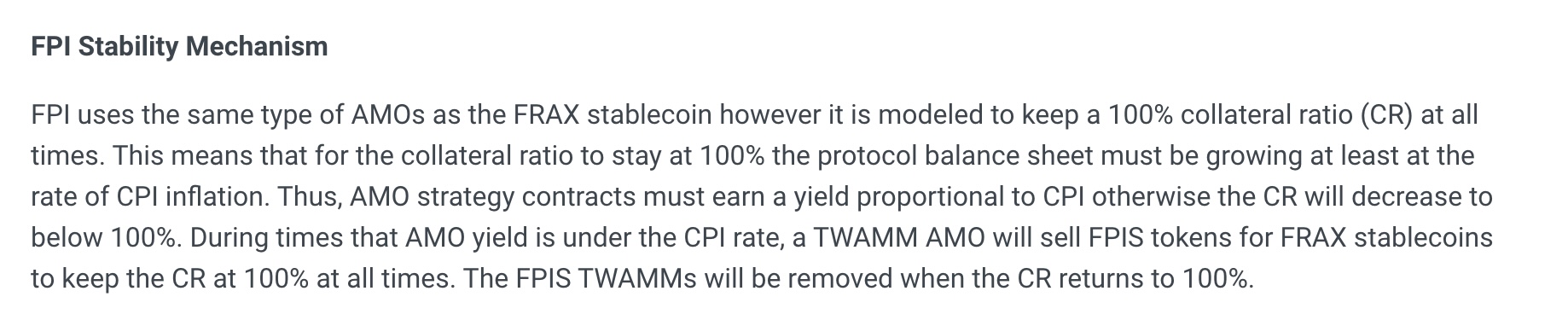 Frax white paper detailing its “stability” mechanism
The tradeoff of depending on alternatives to algorithmic adjustment is the reliance on centralized authorities. Stablecoin projects that utilize fiat money as collateral depend on trust in the project to maintain U.S. dollar escrow. In contrast, those relying on overcollateralized crypto assets face market risks. Unfortunately, flatcoin projects have yet to provide a resolution to this issue.
Another significant obstacle to creating an effective purchasing power index with flatcoins lies in the accuracy of the data supplied by oracle protocols. Relying solely on publicly available CPI data published by the Bureau of Labor Statistics would restrict the true potential of flatcoins. Projects like Chainlink and (my own) IoTeX’s W3bstream have the capability to deliver real-time data that could enable accurate and timely CPI data.
Related: The world could be facing a dark future thanks to CBDCs
The success of flatcoins will rely on the ongoing innovation of oracle teams. A decentralized flatcoin index could significantly enhance existing investment instruments for hedging inflation risk if creators can achieve real-time CPI data.
Risks and Uncertainties
The widespread acceptance of flatcoins and similar cryptocurrencies hinges on their capacity to address the inherent challenges and risks associated with stablecoin designs.
As flatcoins and other inflation-indexed cryptocurrencies emerge, it is vital to assess their impact on the broader financial ecosystem. Do they offer a more stable and decentralized alternative to traditional currencies, or are they merely another investment vehicle?
Investors, users, and regulators must thoroughly scrutinize new developments in the digital asset landscape. Understanding the true nature and potential of these cryptocurrencies is essential in determining whether they will become dominant in the financial arena or remain an intriguing yet niche investment option.
The emergence of flatcoins underscores the ongoing quest for stability and decentralization in the digital asset space. Although this new financial instrument introduces an innovative approach, it carries additional risks and uncertainties. By maintaining a critical perspective on these developments, investors, users, and regulators can better navigate the future of inflation-indexed cryptocurrencies.
Peter Han holds a Ph.D. in finance from the University of Illinois Urbana-Champaign, focusing on financial intermediation and fintech, along with a master’s degree in financial engineering. He possesses a BA in English and a BS in mathematics from China’s Tianjin University. He worked for PwC in Beijing before joining IoTeX, where his research centers on tokenomics aimed at enhancing IoTeX’s tokenomics design.
This article is for informational purposes only and is not intended to be and should not be construed as legal or investment advice. The views, thoughts, and opinions expressed herein are solely those of the author and do not necessarily reflect or represent the views and opinions of Cointelegraph.
