Disclaimer: Information found on CryptoreNews is those of writers quoted. It does not represent the opinions of CryptoreNews on whether to sell, buy or hold any investments. You are advised to conduct your own research before making any investment decisions. Use provided information at your own risk.
CryptoreNews covers fintech, blockchain and Bitcoin bringing you the latest crypto news and analyses on the future of money.


A consortium of decentralized finance (DeFi) protocols has collaborated to address liquidity challenges within the Cosmos ecosystem. The participating teams include the cross-chain bridging protocol Wormhole, the liquidity aggregator Swing, the lending protocol Tashi, and the Cosmos network Evmos.
As per announcements from two of the involved teams, Wormhole is set to register five new bridged tokens for utilization on Evmos: Tether (USDT), USD Coin (USDC), wrapped Ether (wETH), wrapped Bitcoin (wBTC), and Solana (SOL). A governance vote by Wormhole regarding this aspect of the proposal commenced on September 19 and currently enjoys near unanimous backing.
Upon the tokens’ launch on Evmos, they will be integrated into the Swing protocol, enabling users to transfer them to Evmos from any network supported by Swing, which includes BNB Chain, Polygon, Fantom, and others.
Tashi will also incorporate Swing into its user interface, facilitating users to bridge the tokens and deposit them as collateral with minimal clicks. Subsequently, users will have the ability to secure loans in either Cosmos-based or Ethereum-based coins using this collateral, exchange the borrowed coins for others, deposit them into liquidity pools, or engage in other standard DeFi activities.
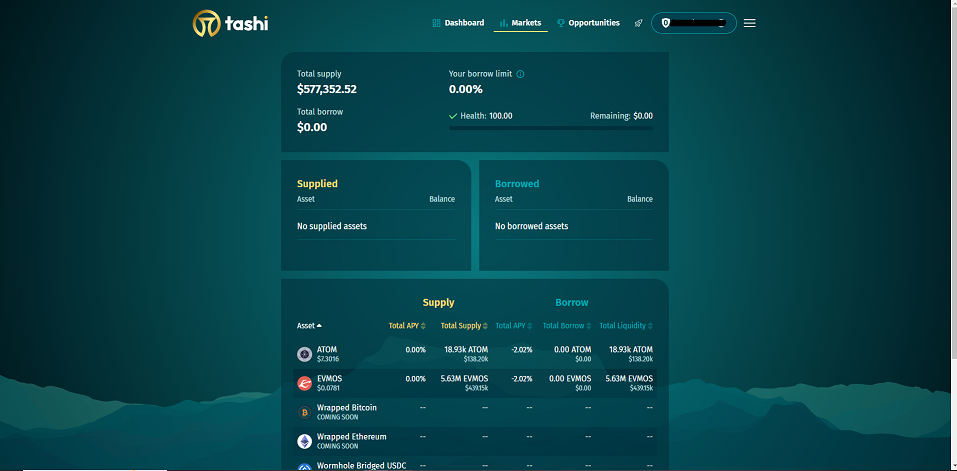 Caption: Tashi user interface. Source: Tashi.
Representatives from both Swing and Tashi indicated that the integrations are prepared to go live and are merely awaiting the approval and implementation of the Wormhole proposal. The voting period for the proposal will conclude on September 24, suggesting that the new liquidity system should be operational shortly thereafter.
Related Posts
Related: DYdX to launch decentralized order book exchange on Cosmos: KBW 2023
In a discussion with Cointelegraph, Tashi co-founders Lindsay Ironside and Kristine Boulton asserted that the new system is essential to remedy a “crisis” in liquidity within the Cosmos ecosystem. “We’ve got this chain that continues to deliver these amazing opportunities, but nobody’s using it because they can’t get liquidity there,” Boulton remarked. However, “[Wormhole], they’re on, I think it’s 29 different chains right now […] so it is an opportunity to fix that crisis.”
Ironside expressed that she recognized the necessity for a new system after her initial experience with the Cosmos ecosystem. She encountered difficulties when she first tried to swap USDC for Cosmos (ATOM) and transfer it to Evmos. To acquire the ATOM, she had to first bridge her USDC to Cosmos Hub. However, once the USDC was on the network, she lacked the ATOM needed to cover the gas fee for the swap.
Ironside noted that this experience led her to understand that the team needed to concentrate on this issue. “Coming in as new users […] and trying to figure out where the solutions to these problems were, [that] was a big deal,” she commented.
In a separate discussion, Swing CEO Viveik Vivekananthan concurred that the new system could potentially resolve these issues. If a user wishes to exchange USDC for another coin on Evmos, Swing will convert a small fraction of the coins sent into the Evmos native coin, which will then be utilized for gas to facilitate the swap. This will enable users to onboard into Evmos using any supported coin, Vivekananthan clarified.
Initially, Swing will only be able to bridge tokens primarily from non-Cosmos networks into Evmos, he mentioned, but the team intends to broaden its compatibility to enable bridges between various Cosmos networks in the future.
The Cosmos community has been actively working to attract users with new features in 2023. The Cosmos-based chain Noble launched a native version of the USDC stablecoin on March 28, and Cosmos Hub introduced liquid staking on September 13. However, the ecosystem also faces competition from the Optimism Superchain, which is striving to create an interconnected network of blockchains with features similar to those of Cosmos.
