Disclaimer: Information found on CryptoreNews is those of writers quoted. It does not represent the opinions of CryptoreNews on whether to sell, buy or hold any investments. You are advised to conduct your own research before making any investment decisions. Use provided information at your own risk.
CryptoreNews covers fintech, blockchain and Bitcoin bringing you the latest crypto news and analyses on the future of money.

Crypto data scientist warns that the number of active blockchain users may not be a reliable indicator.

The count of active users may not accurately reflect the condition of a crypto ecosystem, as a limited number of users can produce a considerable amount of activity across various wallets, asserts the co-founder of a blockchain analytics firm.
Philip Torres, co-founder and chief data scientist of 0xScope, informed Cointelegraph at the Bitget EmpowerX Summit that due to monopolistic founding entities, bots, exploiters, and airdrop hunters, as much as 80% of blockchain activity can stem from a small group of entities, even if the ecosystem appears robust externally.
“These projects claim ‘we have 10,000 active users’ — however, our entity model reveals that you actually have around 10 to 20 distinct users managing 10,000 different addresses,” he remarked.
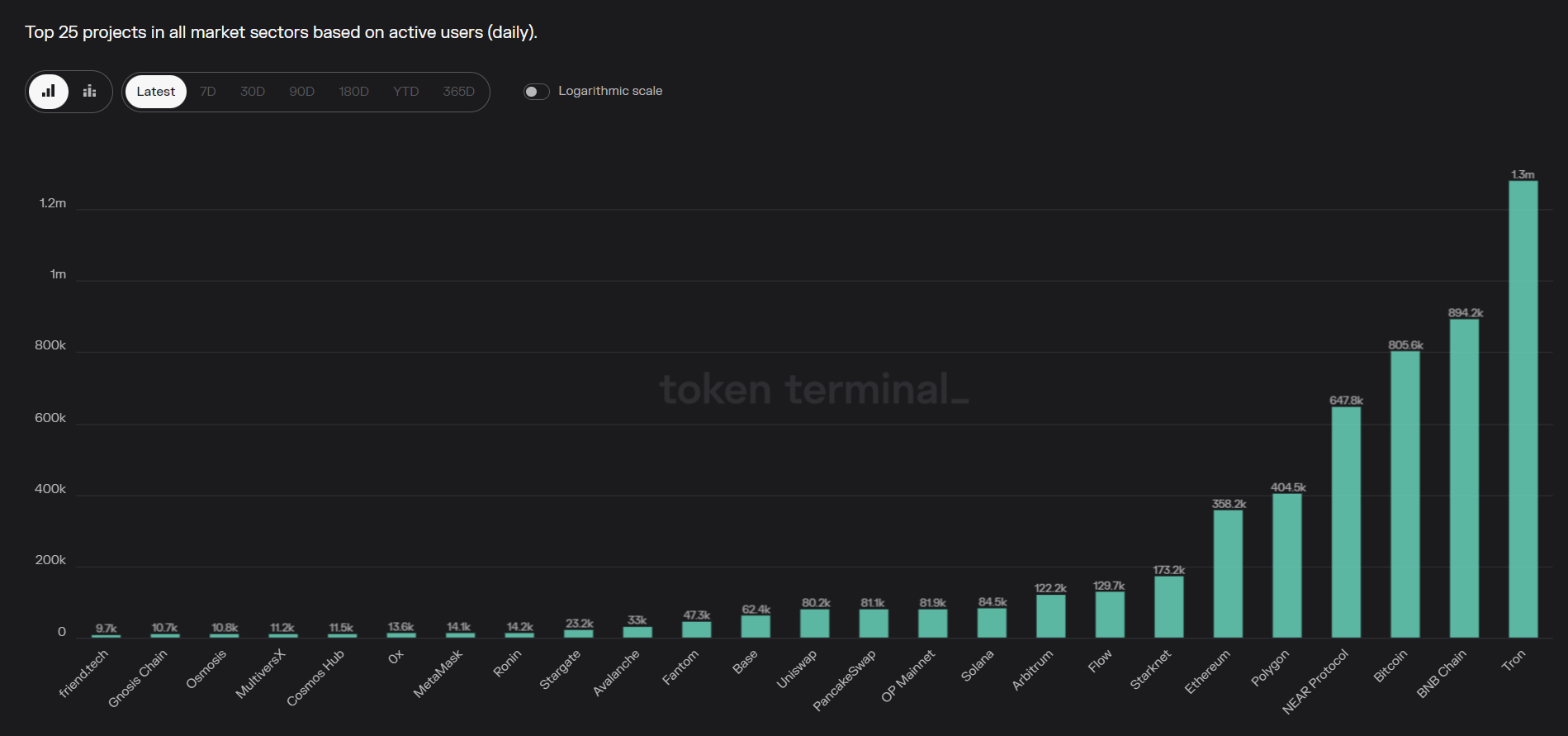 Top 25 projects based on active users (daily). Source: Token Terminal
“The way they function on-chain is that a single individual can possess 10,000 addresses or more, which can create the illusion to an outside observer that those are 10,000 separate individuals,” Torres clarified.
This occurrence is not limited to smaller ecosystems, Torres asserted — in fact, all blockchain ecosystems exhibit varying degrees of such activity.
He discovered that the average Ethereum user holds at least 10 addresses, adding that “everything that transpires on-chain is not as it appears.”
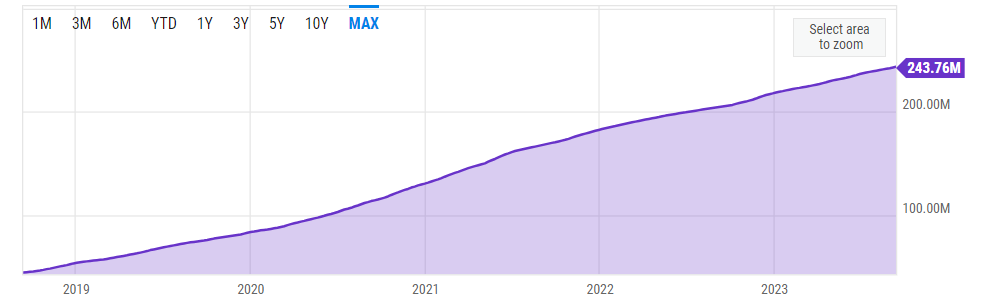 Ethereum Cumulative Unique Addresses. Source: YCharts
Torres pointed out that there are valid reasons for a user to maintain multiple wallet addresses.
“One reason can be simply explained as ‘privacy concerns.’ Individuals prefer to have various addresses to avoid leaving a significant footprint,” he elaborated.
This could also result from automated traders implementing multiple strategies on-chain.
Related Posts
“When we observe automated trading on-chain, typically each address is focused on a specific protocol or swap, or trading different coins using various strategies.”
Nonetheless, it can also be exploited for nefarious purposes, such as artificially inflating a project’s active user count to mislead potential investors, creating a Sybil attack, also referred to as a 51% attack, or users attempting to manipulate an upcoming token airdrop.
An instance occurred during the anticipated Arbitrum (ARB) airdrop on March 23, where two wallets accumulated 2.7 million ARB from 1,496 wallets in a tactic known as “airdrop farming.” In contrast, the median airdrop size was only projected to be 1,250 ARB tokens, according to CoinMarketCap.
We identified 2 super airdrop hunters of $ARB.
0xe1e2 received 1.4M $ARB($1.92M) via 866 addresses and added all 1.4M $ARB to #Uniswap to provide liquidity.https://t.co/sncsZTHrP2
0xbd4e received 933,375 $ARB($1.28M) via 630 addresses.https://t.co/p5vbqXMYxD pic.twitter.com/yK3LzbeC8t— Lookonchain (@lookonchain) March 24, 2023
“On blockchain, it’s quite simple to manage multiple public addresses,” Torres observed.
Related: Shibarium hits 1M wallets amid meteoric growth, SHIB yet to catch up
Torres explained that, unlike email addresses, creating and managing multiple crypto wallets is not overly complex for those who are knowledgeable.
Some individuals utilize what are known as HD wallets — hierarchical deterministic wallets — which generate a new key pair from a master key pair. In simpler terms, it’s a method to create multiple public addresses from a master set of mnemonic words.
“It’s quite straightforward for one person to control several wallet addresses compared to how, typically, individuals do not possess more than a few email accounts,” he added.
Collect this article as an NFT to preserve this moment in history and show your support for independent journalism in the crypto space.
Magazine: Big Questions: What’s with all the crypto deaths?
