Disclaimer: Information found on CryptoreNews is those of writers quoted. It does not represent the opinions of CryptoreNews on whether to sell, buy or hold any investments. You are advised to conduct your own research before making any investment decisions. Use provided information at your own risk.
CryptoreNews covers fintech, blockchain and Bitcoin bringing you the latest crypto news and analyses on the future of money.


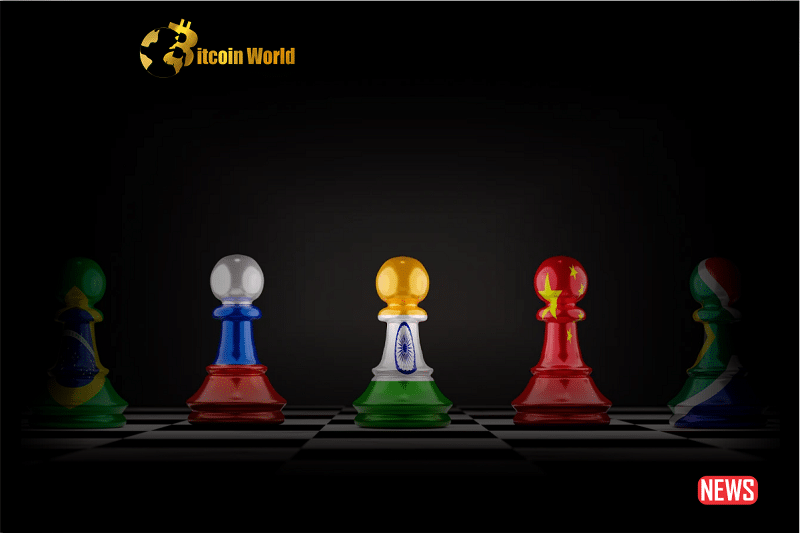
Leslie Maasdorp, the Chief Financial Officer of the New Development Bank (NDB) associated with the BRICS economic coalition, disclosed in a recent interview the coalition’s “medium to long-term ambition” to create a new global currency that could potentially compete with the US dollar. The BRICS alliance, which includes Brazil, Russia, India, China, and South Africa, seeks to promote direct trade using their national currencies.
With a collective population exceeding 3 billion, accounting for over 40% of the global population, the BRICS nations wield significant influence in international matters. Their total GDP is around $56.6 trillion, establishing them as a formidable economic entity.
While Maasdorp noted that the coalition is still in the process of preparing to launch a new fiat currency to contest the US dollar’s dominant reserve status, he suggested that this situation could evolve over time. He recognized that the Chinese Renminbi still has considerable ground to cover before it can effectively challenge the dollar’s supremacy. Additionally, he pointed out the NDB’s current reliance on the US dollar as its primary currency and for operational needs.
Related Posts
This year, the BRICS coalition has garnered significant interest, with numerous countries indicating a desire to join the group. As stated by African Ambassador Anil Sooklal, 13 nations from Africa, Latin America, and Asia have either submitted applications or have formally approached BRICS leadership regarding membership.
The initiative for a new global currency arises amid a report from HSBC Asset Management, which cautions about economic challenges facing the United States later this year, potentially resulting in a global recession. The report also anticipates a turbulent 2024 for Europe, which is dealing with economic contraction, while the US economy is projected to experience a downturn in the final quarter of this year.
Critics contend that the US government has weaponized the US dollar in response to Russia’s invasion of Ukraine. Sanctions, which include limiting Russia’s access to foreign currency reserves, excluding it from the Swift network that facilitates international payments, and targeting its banks and energy sectors, aim to isolate Russia and weaken its economy. However, some analysts caution that the weaponization of the dollar could inadvertently erode its status as the world’s reserve currency and heighten the demand for alternative payment systems and safe-haven assets.
Among these safe havens are gold, a precious metal historically regarded as a refuge for millennia, and Bitcoin, the leading cryptocurrency. Larry Fink, CEO of BlackRock, the largest asset manager globally, recently expressed his belief that Bitcoin is “digitizing gold” and has the potential to transform the financial system.
The post BRICS Economic Coalition Eyes New Global Currency as US Dollar Rival appeared first on BitcoinWorld.
