Disclaimer: Information found on CryptoreNews is those of writers quoted. It does not represent the opinions of CryptoreNews on whether to sell, buy or hold any investments. You are advised to conduct your own research before making any investment decisions. Use provided information at your own risk.
CryptoreNews covers fintech, blockchain and Bitcoin bringing you the latest crypto news and analyses on the future of money.

BNB Chain undergoes hard fork to enhance security and interoperability with EVM-compatible chains.

Binance’s BNB Chain is scheduled to experience two hard forks in August 2023, aimed at minimizing the risk of a malicious blockchain reorganization and enhancing compatibility with other Ethereum Virtual Machine (EVM) blockchain networks.
The Plato and Hertz upgrades are planned for Aug. 10 and Aug. 30, respectively, after thorough testing. The Plato upgrade, which has already been implemented, introduces BEP-126. This latest evolution proposal incorporates a fast finality mechanism designed to eliminate the possibility of block reversion.
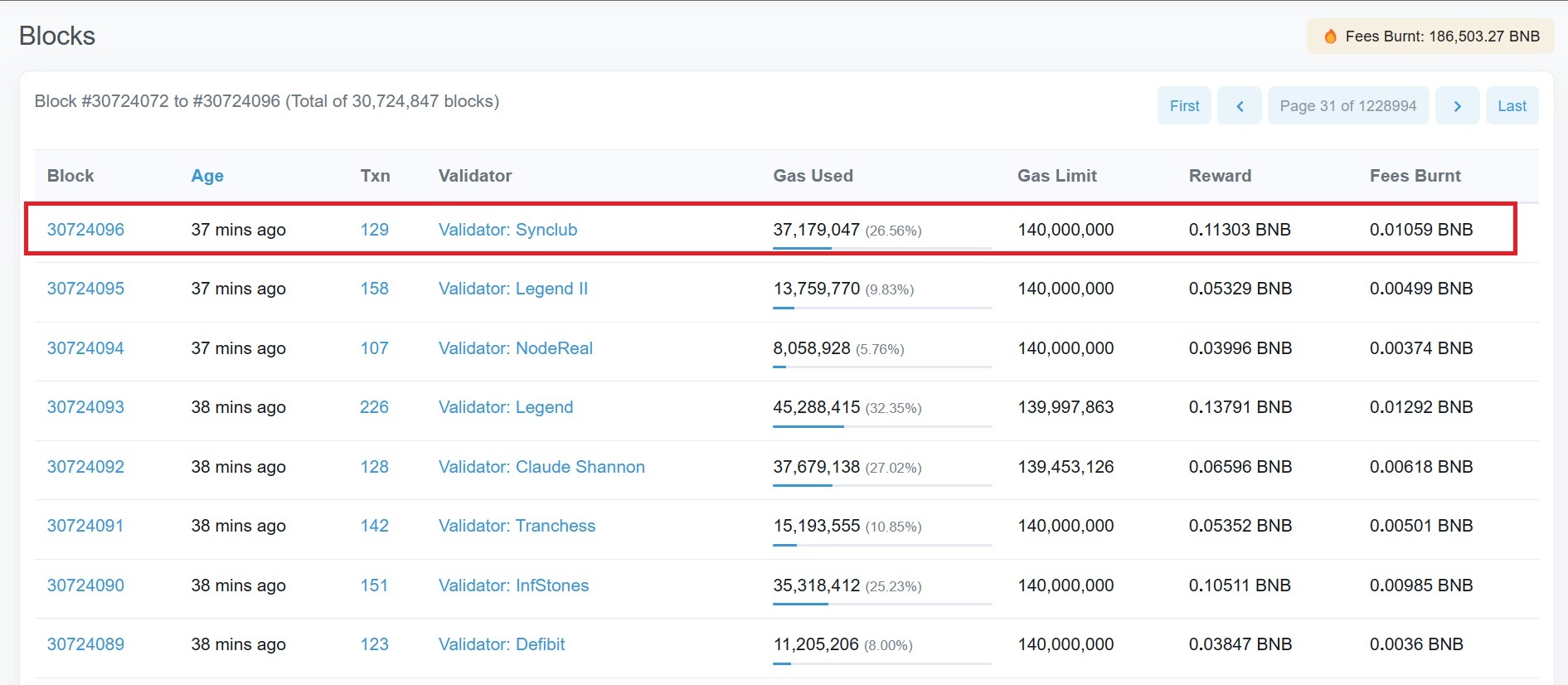 The Plato upgrade was executed on Aug. 10 at block height 30724096. Source: BscScan
Arno Bauer, senior solution architect at BNB Chain, detailed the network upgrades in an interview with Cointelegraph. The fast finality mechanism is anticipated to lower the likelihood of chain reorganization and stabilize block production, enabling users to access accurate data from the most recently finalized block without delay. Bauer stated:
“Overall, BEP-126 aims to enhance blockchain security and efficiency on the BNB Smart Chain by introducing a fast finality mechanism.”
Bauer further explained that finality is a fundamental principle of blockchain technology, indicating the moment when a transaction or block of transactions can no longer be modified or undone. Finality is essential for maintaining trust and preventing double-spending within blockchain systems.
BEP-126 achieves fast finality through a series of processes. Validators start by proposing a block to the network, which is then disseminated to other validators. Validators subsequently sign the block using their private key, generating a vote message. Voting aggregation occurs next, with validator votes collected into a pool and aggregated if the direct parent block has sufficient votes.
Related Posts
Related: Binance Smart Chain and Binance Chain become BNB Chain
Validators are required to adhere to specific guidelines when voting for blocks, such as refraining from publishing two separate votes for the same height. The finality rules also indicate that a block is ‘justified’ if there’s an attestation in the header of the child block, while it is finalized if it is justified and its direct child is also justified.
The fork that includes the highest justified block is regarded as the longest chain, even if other chain forks possess a greater difficulty sum. The requirements for producing blocks and finalizing blocks differ in terms of the number of validators needed.
Finally, BNB Chain validators receive rewards for their voting, and those who breach the voting rules face slashing penalties similar to those in Ethereum’s proof of stake protocol.
The Hertz hard fork is scheduled for Aug. 30 and aims to keep the BNB Chain aligned with the latest advancements in Ethereum Virtual Machine (EVM) blockchains. As Bauer notes, the BSC must maintain its block and transaction structures, as well as its base EVM, to correspond with Ethereum’s recently executed Berlin and London forks.
“Therefore, for compatibility reasons it is important that those EIPs are also enabled on BSC to ensure a smooth development and ecosystem growth.”
Bauer mentioned that the fast finality mechanism should create a more secure environment for decentralized applications (DApps), while quicker transaction finality is expected to enhance the responsiveness and efficiency of DApps operating on BSC.
Magazine: Deposit risk: What do crypto exchanges really do with your money?
