Disclaimer: Information found on CryptoreNews is those of writers quoted. It does not represent the opinions of CryptoreNews on whether to sell, buy or hold any investments. You are advised to conduct your own research before making any investment decisions. Use provided information at your own risk.
CryptoreNews covers fintech, blockchain and Bitcoin bringing you the latest crypto news and analyses on the future of money.


Blockchain security technology company BlockSec has unveiled a new toolkit that facilitates collaborative testing on private chains “forked from arbitrary (transaction) positions” and block numbers on the Ethereum mainnet.
The toolkit, aimed at developers and security researchers, is named “Phalcon Fork” and was introduced by BlockSec on April 14.
We’re excited to present Phalcon Fork, an innovative toolkit for Web3 developers & security researchers! It allows collaborative testing with private mainnet states, enabling the creation of private chains forked from any mainnet position. #Web3 #DeFi pic.twitter.com/TlK169GeLP
— BlockSec (@BlockSecTeam) April 14, 2023
Phalcon Fork is designed to enhance control over activities performed on test nets, such as transaction testing, analysis, and debugging.
According to the user manual, BlockSec emphasizes that this increased control is achieved by easily “forking arbitrary (transaction) positions and block numbers” while retaining specific “services and states” from the Ethereum mainnet.
“In comparison to traditional solutions like Goerli […] Phalcon Fork offers the following benefits: retaining services and states from the mainnet, which aids in quick integration and debugging with other DeFi contracts. [And maintaining] complete control over block information (e.g., Timestamp, BaseFee, MixDigest),” the Phalcon Fork user manual states.
With this toolkit, users can also take advantage of features such as snapshots, which allow them to save specific blockchain positions and revert to them at any time during their testing activities. The snapshots effectively document the transactions being executed and deployed by the user at a particular moment.
“The snapshot feature is especially beneficial in the following two situations: When a user wishes to execute a testing script multiple times, they simply need to revert to the original snapshot and rerun the script. [Or] When a user wants to preserve certain states and return to them later, they can create a snapshot and then revert to this snapshot at a later time,” the manual explains.
Related Posts
Phalcon Fork also includes an integrated faucet, allowing users to obtain free fork network Ether (ETH) for conducting transactions on the private chains.
To interact directly with the chains and perform transactions, Phalcon Fork offers a Remote Procedure Call (RPC) node known as Fork RPC, which can be integrated with Ethereum Virtual Machine compatible development frameworks such as Hardhat, Foundry, and Remix, or added to MetaMask.
Currently, users can only fork from the Ethereum mainnet, but future support for additional blockchains like the Binance Smart Chain and Arbitrum has been hinted at.
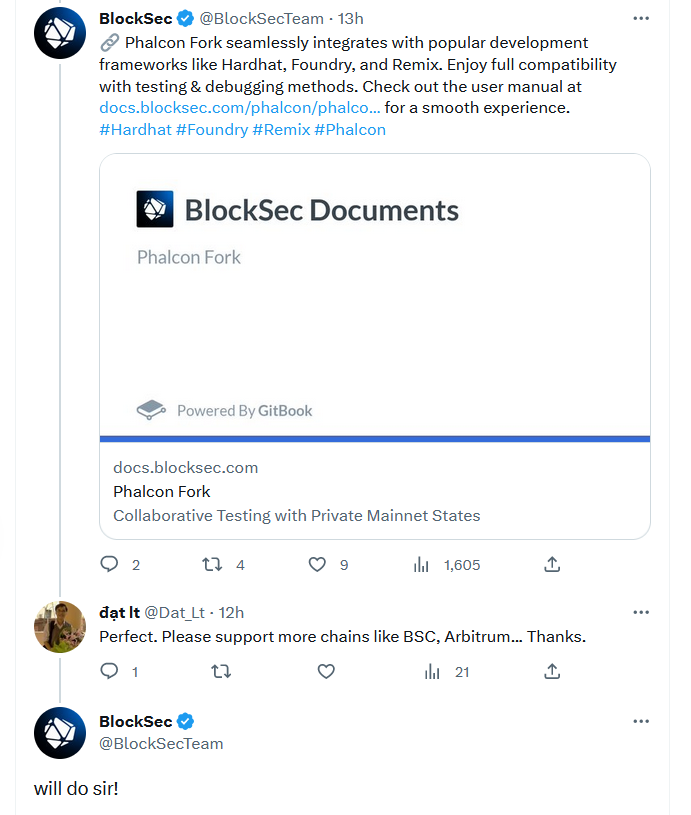 Teased blockchain support additions. Source: Twitter
April has proven to be a pivotal month for Ethereum developers, particularly with the successful launch of the highly anticipated Shapella hard fork on the Ethereum mainnet on April 12. A key feature of this upgrade allows Ethereum validators to withdraw staked ETH from the Beacon Chain.
Related: Less than 1% of staked ETH estimated to be sold after Shapella: Finance Redefined
This development has been accompanied by positive price movement for Ether (ETH), with the asset appreciating approximately 12% since April 12, reaching $2,092 at the time of this report.
 Seven-day ETH price chart. Source: CoinGecko
Magazine: ZK-rollups are ‘the endgame’ for scaling blockchains, Polygon Miden founder
