Disclaimer: Information found on CryptoreNews is those of writers quoted. It does not represent the opinions of CryptoreNews on whether to sell, buy or hold any investments. You are advised to conduct your own research before making any investment decisions. Use provided information at your own risk.
CryptoreNews covers fintech, blockchain and Bitcoin bringing you the latest crypto news and analyses on the future of money.

Bitcoin’s market share reaches 54% — the highest level in 2.5 years as BTC halving nears.

Bitcoin’s (BTC) market dominance has climbed to 54%, marking its highest level in the past 30 months, which suggests that the leading cryptocurrency is gaining strength ahead of the halving event set for April 2024.
The Bitcoin halving is an occurrence where the mining reward for each block is halved, thereby reducing the asset’s supply in the face of increasing demand, which typically results in positive price momentum. This event takes place every four years, and the upcoming halving in 2024 will decrease the BTC mining reward from the current 6.25 BTC to 3.125 BTC. Given that the total supply of Bitcoin is capped at 21 million, the halving of BTC mining rewards generates a supply-demand imbalance that diminishes the flow of new BTC into the market.
Bitcoin market dominance serves as an indicator of the cryptocurrency’s market capitalization in relation to the entire digital asset market, showcasing the asset’s strength. A market dominance exceeding 50% is regarded as very bullish and represents its peak since the previous bull run in April.
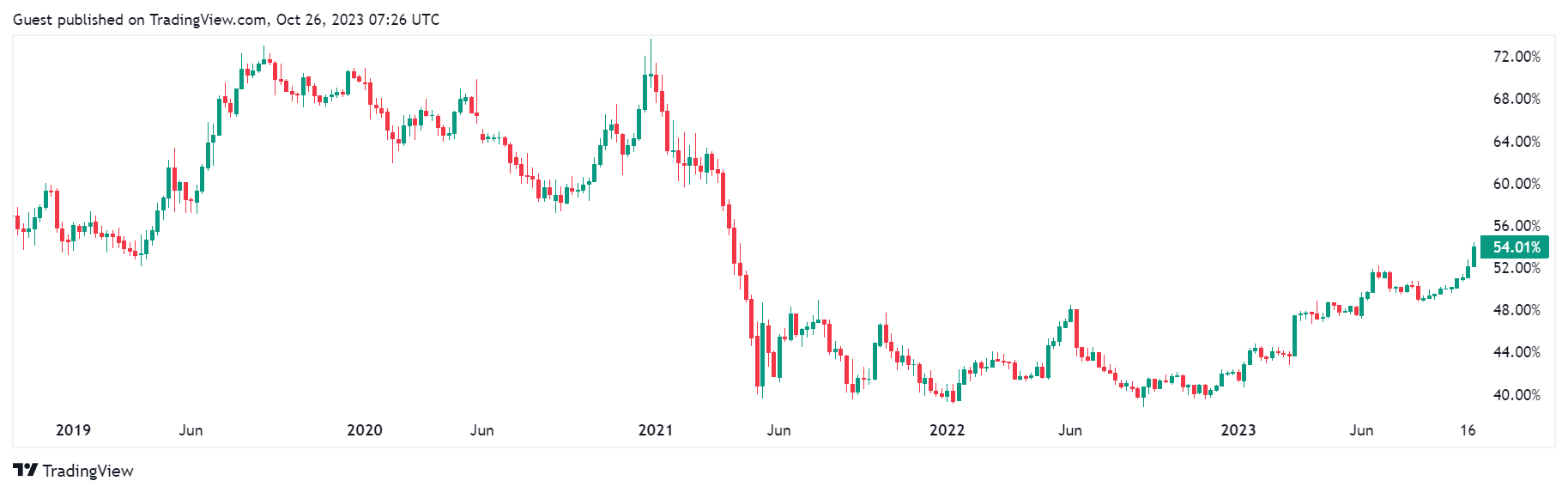 Bitcoin market dominance chart. Source: TradingView
Related Posts
Bitcoin’s market dominance began to recover at the beginning of October, rising from below 49% to achieve this new two-and-a-half-year peak. Historically, October has been viewed as a bullish month for cryptocurrencies, earning the nickname “Uptober.” This was reflected in Bitcoin’s double-digit percentage increase over recent weeks, propelling BTC from just under $27,000 at the start of October to a new yearly high of $35,000.
Uptober has been great, but the party may not be over just yet.
November is historically #Bitcoin’s best performing month. pic.twitter.com/kaMMt7pgZz— Miles Deutscher (@milesdeutscher) October 25, 2023
In 2017, Bitcoin sustained a market dominance of over 80%, while Ether (ETH) held nearly 10%–17% in market dominance. Over time, Bitcoin has experienced a significant decline in its market dominance due to the proliferation of cryptocurrencies and the emergence of numerous new tokens during the last bull run in 2021.
Collect this article as an NFT to preserve this moment in history and show your support for independent journalism in the crypto space.
Magazine: Can you trust crypto exchanges after the collapse of FTX?
