Disclaimer: Information found on CryptoreNews is those of writers quoted. It does not represent the opinions of CryptoreNews on whether to sell, buy or hold any investments. You are advised to conduct your own research before making any investment decisions. Use provided information at your own risk.
CryptoreNews covers fintech, blockchain and Bitcoin bringing you the latest crypto news and analyses on the future of money.

As Friend.tech thrives, decentralized social platforms face challenges with user retention — Executives

Despite the recent excitement surrounding riend.tech, several decentralized social networks continue to struggle with attracting and retaining users on their platforms.
Two leaders in the decentralized social (DeSo) media sector informed Cointelegraph that up to 99% of individuals entering DeSo for the first time are likely to abandon the platform, either due to cumbersome onboarding processes or a lack of familiar connections.
Ed Moss, the growth head for layer-1 blockchain company DeSo, stated that the journey of acquiring cryptocurrencies from an exchange, transferring them to a wallet with a Chrome extension, and incurring high gas fees for on-chain or cross-chain transactions is both tedious and costly for newcomers.
“We’ve found that 99% of mainstream users will drop off at that first step, so simplifying this flow is mission critical.”
Thus, ensuring that the onboarding experience is as seamless as possible is paramount, according to Moss.
Imagine if you had to mint everything we share on social media and pay gas fees for it. How would you allocate your time, money, and energy? This is what you should be focusing on.
— Ruben Cress #HIVE (@RubenCress) October 21, 2022
However, challenges can arise even before this stage, as noted by Suhail Kakar, the developer of the DeSo application Onboard.
Users often hesitate to take the initial step because they need to understand blockchain, smart contracts, and wallets prior to signing up, Kakar explained.
“A party where you don’t know anyone.”
Competing with the extensive network effects of web2 social platforms like Facebook, Instagram, and X (formerly Twitter) will also prove to be a significant challenge.
Kakar mentioned that DeSo applications must invest more effort into community building, as establishing a presence in these platforms is “a bit like going to a party where you don’t know anyone.”
He posits that as more prominent creators and influencers transition to on-chain platforms, it could serve as a turning point, as users will ultimately gravitate towards high-quality content.
Data from April indicates that Facebook, Instagram, and Twitter had approximately 2.98 billion, 2 billion, and 372.9 million monthly active users, respectively. In contrast, one of the most frequented decentralized social media platforms, Odysee, averaged merely 5.3 million unique monthly users from January to April, according to CoinGecko.
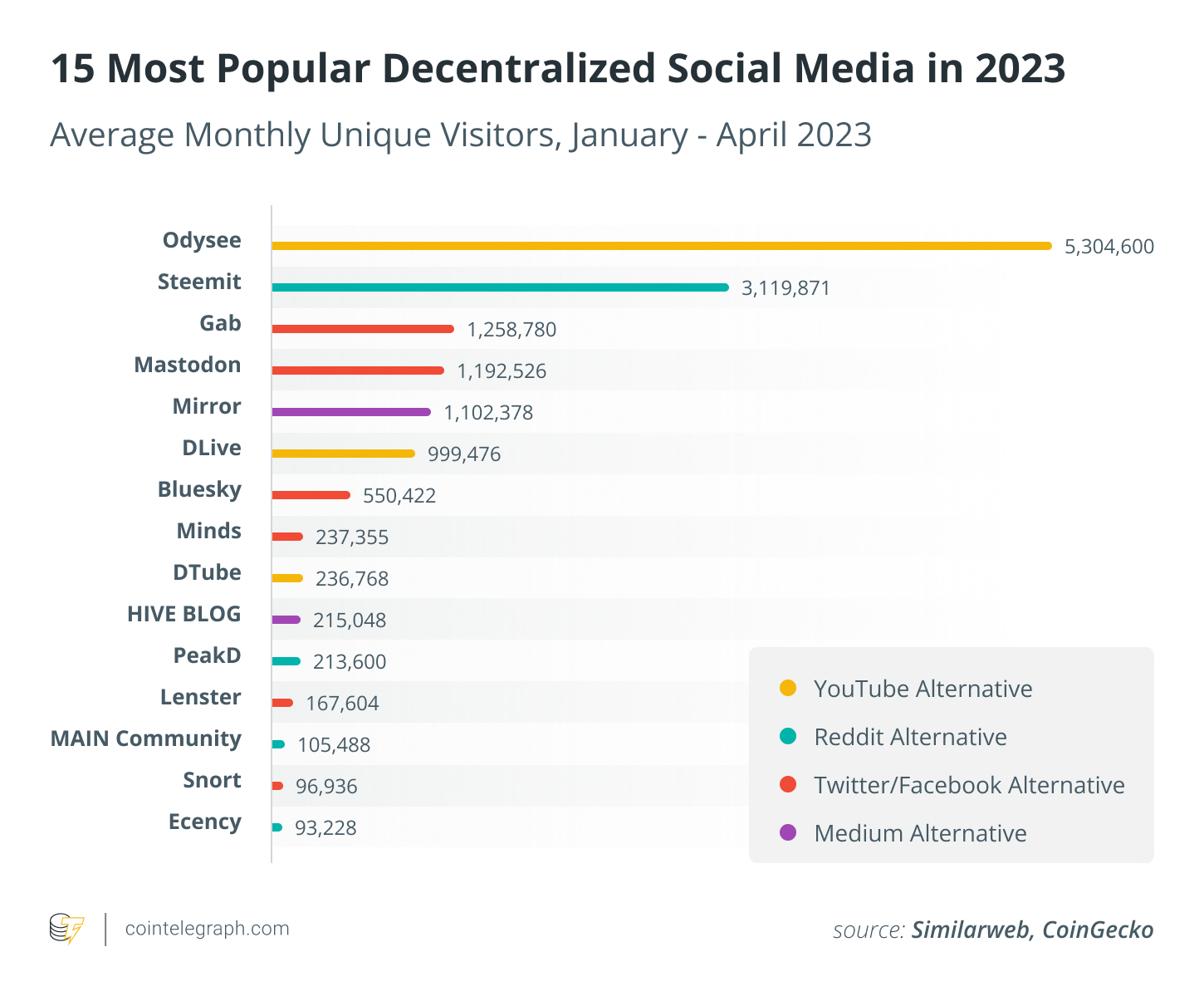 Average number of monthly active users on decentralized social media platforms between January and April. Source: CoinGecko
Related Posts
Moss contends that another factor hindering the mass adoption of decentralized social media is that Ethereum and other smart contract platforms are not specifically designed to support social media applications at scale.
Thus, we believe the future of crypto does not consist of a single general-purpose blockchain that rules them all, but rather a series of dominant, specialized blockchains, each tailored to a particular category of applications. This is the way crypto will see mass adoption.
— DeSo (@desoprotocol) December 29, 2021
The optimal solution would involve creating a “storage-heavy” or “infinite-state” blockchain capable of storing and indexing vast amounts of data at minimal cost, he elaborated:
“This is what a social application would require in order to store actions like ‘posts,’ ‘likes,’ ‘follows,’ ‘comments,’ and ‘social graphs’ directly on-chain to enable full decentralization from any corporate entity or centralized government.”
Without such a framework, Moss believes that end-users may never genuinely possess their content, identity, and social graph.
Friend.tech bucks trend?
In the meantime, the Base-powered social platform Friend.tech has experienced significant growth over the past week.
This platform enables creators to engage with their audience through tokenized attention, where a creator’s influence is symbolized by shares, or keys that can be exchanged for access to exclusive private chat rooms.
Friend.tech has attracted over 85,000 users from more than 127,000 wallets, which have collectively submitted over 630,000 requests to the network since its launch earlier this month, according to CoinGecko.
Related: Decentralized social media a game changer for creator monetization — Web3 exec
However, some industry experts speculate that the model may prove to be a temporary trend lasting six to eight weeks.
Sales revenue from decentralized social media networks is anticipated to reach $12.1 billion in 2023 and is projected to exceed $101 billion by 2033, reflecting a compounded annual growth rate of 23.6%, according to Future Markets Insights.
Other decentralized social media platforms include Jack Dorsey’s Bluesky — a decentralized alternative to Twitter, Mastodon, and Lens Protocol.
Collect this article as an NFT to preserve this moment in history and show your support for independent journalism in the crypto space.
Magazine: Decentralized social media: The next big thing in crypto?
