Disclaimer: Information found on CryptoreNews is those of writers quoted. It does not represent the opinions of CryptoreNews on whether to sell, buy or hold any investments. You are advised to conduct your own research before making any investment decisions. Use provided information at your own risk.
CryptoreNews covers fintech, blockchain and Bitcoin bringing you the latest crypto news and analyses on the future of money.

A New Exhibit Featuring Hito Steyerl at Esther Schipper Gallery in Berlin Examines Cryptocurrencies Critically

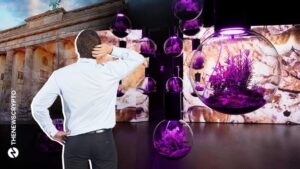
- An upcoming exhibition at Esther Schipper Gallery in Berlin delves into various prominent cultural narratives arising from cryptocurrency and its social, economic, and aesthetic ramifications.
- The displayed works are by artist and philosopher Hito Steyerl, whose creations investigate subjects such as globalization, capitalism, and the influence of technology on society, showcased at significant institutions globally, including the Museum of Modern Art (MoMA) in New York, the Venice Biennale, and the Tate Modern in London.
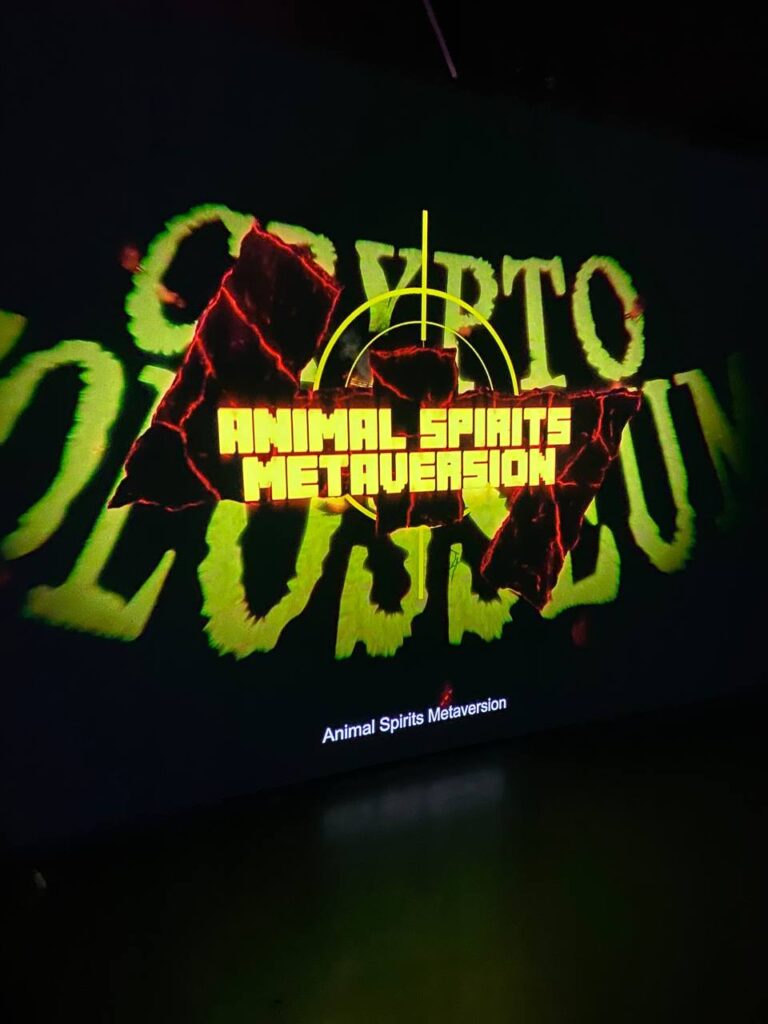
Hito Steyerl’s Animal Spirits at Esther Schipper during Berlin Gallery Weekend presents a stimulating examination of cultural production in light of several recent micro-epochs. The exhibition derives its title from economist John Maynard Keynes’ notion of human instincts and emotions that shape consumer behavior, analyzing it in relation to the emergence of NFTs and cryptocurrency.
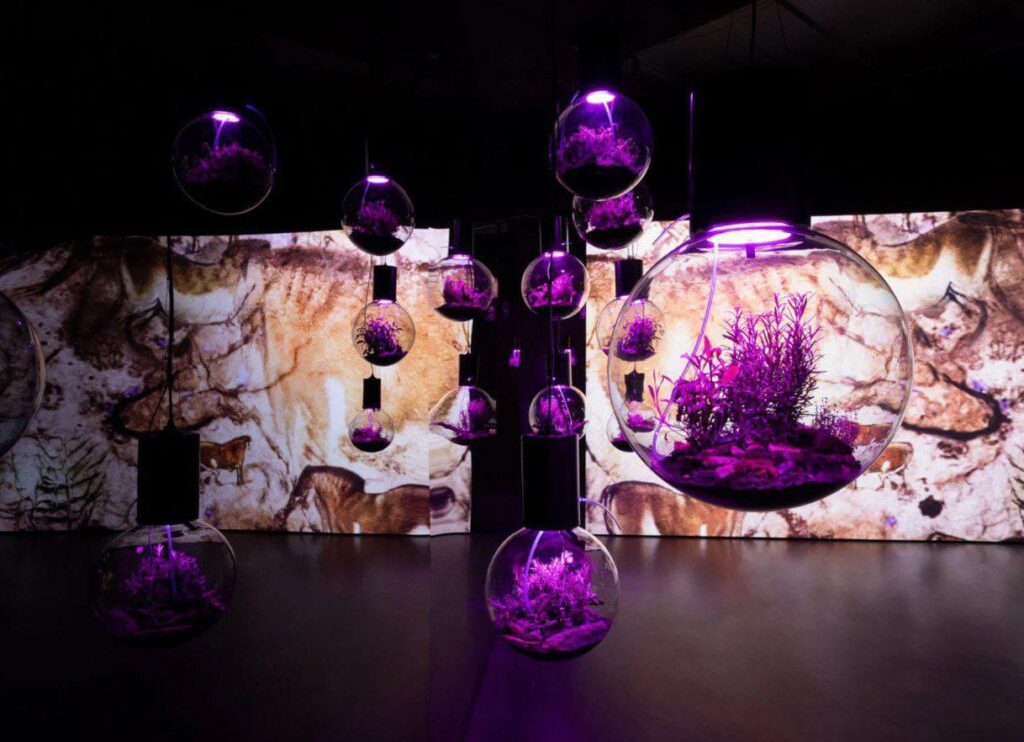
The focal point of the exhibition is a film and AI-animated paleolithic cave paintings displayed on surrounding screens, creating an immersive cave-like atmosphere. The animations react to the audience’s presence, changing in real-time, resulting in a distinctive and engaging experience. The 24-minute film investigates the relationship between corporate aesthetics and sheep herders in Spain, which Steyerl filmed on-site. This intriguing blend of themes is certainly noteworthy, with the collective impact surpassing the individual elements.
Within the exhibition, living plants encased in glass spheres hang from the ceiling, illuminated by colored LEDs. These plants are equipped with sensors that monitor essential parameters for their health, responding to the audience and modifying the animations in real-time.
As a philosopher and educator at UdK in Berlin, Steyerl has extensively written on subjects such as machine learning, AI, technology, and economics. In her book Duty-Free Art, particularly in an essay titled “Is the Internet Dead?” Steyerl questions the extent to which technology has misled us as it increasingly permeates our lives.
The essay poses a straightforward and literal inquiry: what has transpired with the internet since it transitioned from a mere possibility to a tangible reality? Steyerl contends that the previously limitless immateriality of the internet has become intertwined with the physical realm, leading to a perplexing situation. Images, in particular, harbor new cultural codes that we are just beginning to comprehend.
In The Wretched of the Screen, published in 2012 by Sternberg Press, Steyerl states:
“The poor image thus constructs anonymous global networks just as it creates a shared history.” She examines the speculative nature of image creation, as images incite “translation or mistranslation, and create new publics and debates.”
Steyerl further posits that images generate “visual substance” and “political punch,” which bestows a new aura upon them. “This aura is no longer founded on the permanence of the ‘original,’ but on the transience of the copy. It is no longer rooted within a classical public sphere mediated and supported by the frame of the nation-state or corporation, but floats on the surface of temporary and dubious data pools.”
Steyerl remarks, “a nail polish clip becomes an Instagram riot. An upload becomes a shitstorm. An animated GIF materializes as a pop-up airport transit gate.”
Steyerl’s central philosophical argument is thus quite compelling: consider the emoticon as a Matryoshka Basarian paradox, the protest banner as the stylized language of traditional mimicry. Memes as the flags of the 21st century.
Related Posts
In a direct message, writer and theorist Shumon Basar commented on the various contextualities surrounding Steyerl’s work: “Is it not the case that every ‘contra—’ is duly swallowed up by the thing the contra— was supposedly against? Thus, Capitalist Realism is less of a neo-Marxist doctrine a la Mark Fisher now, but rather, the basis for a duvet cover design for boys who don’t own bed frames?”
Few images today are more wretched than that of Pepe. The small green anthropomorphic frog with a humanoid body who often appears wryly grinning was appropriated by far-right groups on 4chan; Pepe is now arguably the most Steyerlian image of the post-modern era. $PEPE serves as the ultimate symbol of a new prompt reality, representative of what Steyerl describes as “circulationism” that “feeds into both capitalist media assembly lines and alternative audiovisual economies.”
Consider Pepe today as the ideal metaphor for the meme economy, with major tokens dictating new crypto-economic flows based on aggregated data and access to economic information; $PEPE has evolved from a niche internet meme into a cryptocurrency with a market cap of $1 billion.
Writers and theorists Caroline Busta and Lil Internet have a metaphor for this complexity: clearnet versus the dark forest. This metaphor differentiates the space beneath the surface web from a web that is more intricate and challenges the cultural expectations surrounding authenticity and self-promotion that prevail on major social media legacy platforms like Facebook and Instagram, but whose insights would also aptly apply to an analysis of significant trends within cryptocurrency markets and aesthetics.
“Media is no longer linear. Legacy outlets fade into noise, and communities have become screens through which all platforms are diffracted,” Busta and Lil Internet write in a 2023 Outland article.
“Already in the mid-2010s, dark-forest groups had devised ways of finding each other across constellations of platforms (whether by including key emojis in one’s bio—a pine tree, a frog, a black fist, a rainbow flag—or through sharing content from certain meme pages so members of an enclave can sync their clearnet feeds).”
Were not ancient Roman Coins the original memes, profile pictures that became currency by virtue of the armies and systems they represented?
Uncovering the holographic realities imposed upon us, Steyerl’s documentary films, writings, and reflections form a body of work untethered to any single medium. The collective result is a tapestry of complexities and multi-layered storytelling narratives that arise from non-linear systems that mimic the protocol aesthetics that have become emblematic of the contemporary condition.
From pump and dump culture to rug pulls, to the ways in which the biological complexities of the earth have been compromised by extractive technologies, Steyerl’s work reconstructs the embryonic prototypes of these conditions into a mass of clear glass spheres illuminated by LED lights.
Ultimately, Steyerl’s work prompts us to look beyond the overwhelming influx of online images to the constant and pervasive surveillance we endure, urging us to reconsider how social and economic engineering have become fundamental aspects of 21st-century existence, embedded not only in the forms in which we gather and herd sheep but also in the ways we circulate images and attribute meaning to them.
