Disclaimer: Information found on CryptoreNews is those of writers quoted. It does not represent the opinions of CryptoreNews on whether to sell, buy or hold any investments. You are advised to conduct your own research before making any investment decisions. Use provided information at your own risk.
CryptoreNews covers fintech, blockchain and Bitcoin bringing you the latest crypto news and analyses on the future of money.

Mastercard’s $1.8 billion agreement ‘a definitive response’ to a significant transformation in the global payment landscape.

Analysts indicate that the $1.8 billion acquisition reflects a transition of stablecoins from a niche application to essential components of global settlement systems.

What to know:
- Mastercard’s $1.8 billion acquisition of London-based BVNK indicates that stablecoins are transitioning from a specialized crypto resource to a fundamental component of global payment infrastructure.
- Experts suggest that this acquisition will allow Mastercard to integrate 24/7, blockchain-enabled stablecoin networks into its current system, enhancing cross-border transactions while considering stablecoins as supplementary rather than rivaling card payments.
- Although BVNK’s approximate $40 million revenue suggests limited immediate financial impact, Wall Street perceives the acquisition as a strategic investment in the anticipated surge of stablecoin adoption and a defensive measure to safeguard Mastercard’s core payment operations.
Mastercard’s intended $1.8 billion purchase of BVNK, a stablecoin infrastructure firm, reinforces the prevailing sentiment on Wall Street that stablecoins are evolving from a specialized crypto asset to an essential part of global payment systems.
Analysts assert that this deal marks a change in how conventional financial networks view blockchain-based monetary transactions. “Stablecoins are vital to the future of payments,” stated Mizuho analyst Dan Dolev, characterizing the acquisition as proof that digital currencies are becoming integrated into mainstream financial frameworks.
On Tuesday, Mastercard announced that it would acquire BVNK, a London-based company that facilitates businesses in sending, receiving, storing, and converting stablecoins across over 130 nations, for $1.8 billion. The firm processed more than $30 billion in stablecoin transactions in 2025, according to analyst projections.
For investors, this initiative addresses ongoing uncertainties regarding Mastercard’s approach to cryptocurrency.
“BVNK provides a clear solution,” wrote analysts from TD Cowen, who rate the company as a Buy with a price target of $671, noting that the acquisition links on-chain payment networks with Mastercard’s existing infrastructure. The firm indicated that this acquisition illustrates that stablecoins can function as an additional layer of infrastructure rather than a direct competitor to card networks.
This differentiation has become crucial to the investment rationale. Previous concerns that stablecoins might circumvent traditional payment processors have shifted to a perspective that they could enhance the efficiency of monetary transfers behind the scenes.
Cantor Fitzgerald, which has an Overweight rating and a $650 price target on the stock, noted that this acquisition positions Mastercard for an impending “stablecoin adoption wave,” especially as the demand from financial institutions and fintech companies for quicker and more cost-effective cross-border payments increases.
Recently, this “wave” of demand has become evident as numerous established financial entities seek to incorporate stablecoins as their settlement systems. Even Bitcoin enthusiasts, such as Jack Dorsey, who once envisioned a world of payments through the Bitcoin blockchain, are reluctantly accommodating consumer demand for stablecoins.
Such applications are already emerging.
Stablecoins are increasingly being utilized for business-to-business transactions, international payroll, and remittances, where conventional systems may take several days to settle. In contrast, blockchain-based transfers can complete transactions in minutes and operate continuously.
BVNK’s platform integrates this capability directly into Mastercard’s ecosystem, facilitating 24/7 settlements and minimizing dependency on intermediaries in international transactions.
A long-term bet
Although the financial benefits for Mastercard from this acquisition might be limited, the credit card company is focused on a larger objective.
Related Posts
From a financial perspective, the acquisition is not anticipated to significantly impact near-term results. BVNK generated around $40 million in revenue by late 2024, indicating that its contribution to Mastercard’s earnings will likely be minor.
Instead, the transaction will allow Mastercard to make a strategic long-term investment to position itself at the forefront of a rapidly changing industry that is set to transform how money is transferred.
Stablecoin transaction volumes have already reached an estimated $350 billion annually and are projected to rise as regulatory clarity improves and more entities enter the sector.
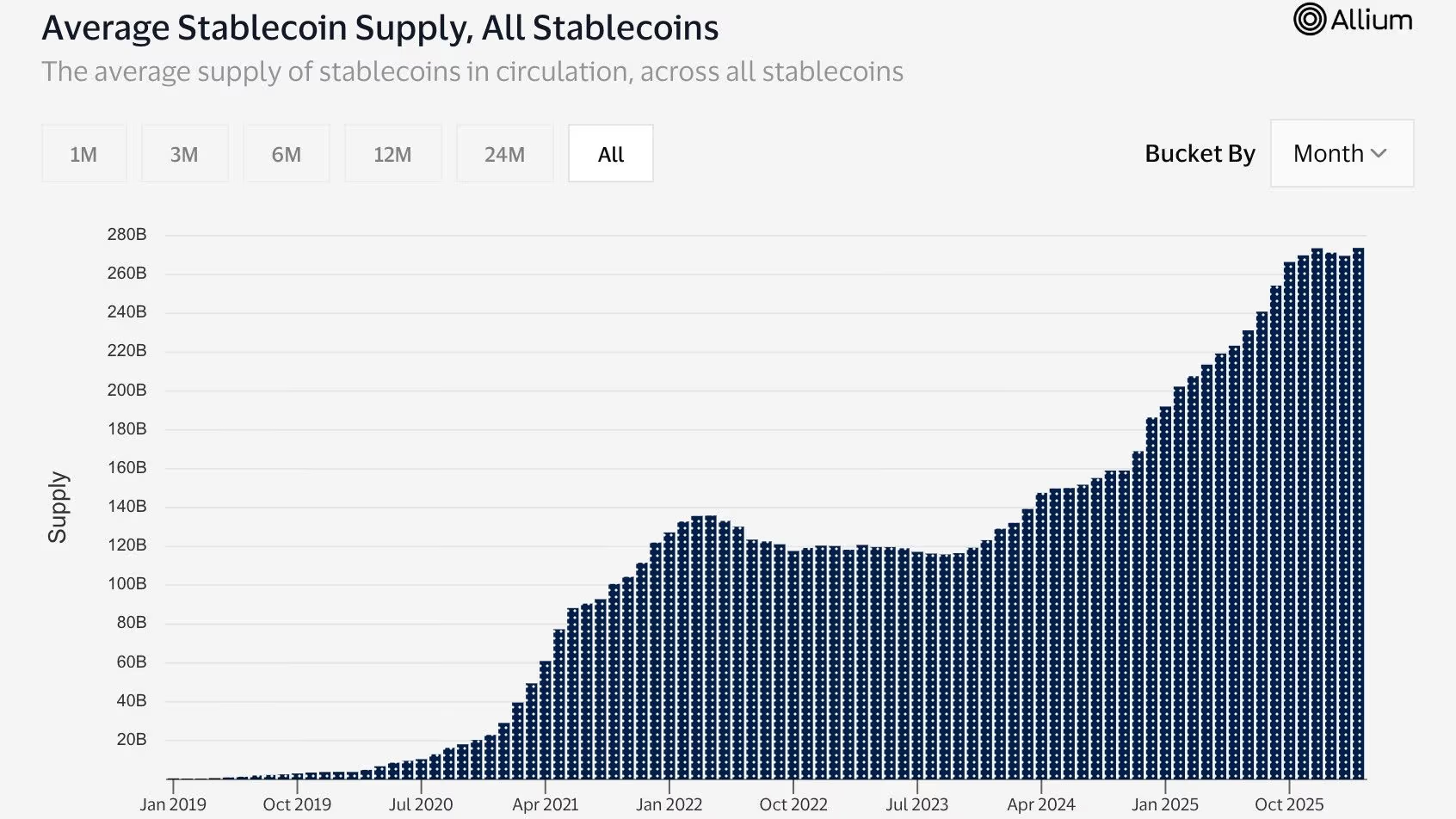 Stablecoin supply since 2019 (Visa/Allium)
For payment leaders like Mastercard, the move into stablecoin infrastructure is primarily about safeguarding fundamental business areas rather than merely experimenting with cryptocurrency frameworks, according to Harvey Li, founder of Tokenization Insight.
“Card networks are the most vulnerable payment rails to disruption by stablecoins,” he stated in a note on Tuesday.
Meanwhile, analysts at Oppenheimer, who hold an Outperform rating and a $683 price target, mentioned that the acquisition enhances Mastercard’s capacity to facilitate end-to-end digital asset transactions, including conversions between fiat currencies and stablecoins. It also aligns with the firm’s broader strategy toward interoperability between conventional finance and blockchain networks.
William Blair analysts, led by Andrew Jeffrey, remarked: “We view Mastercard’s acquisition of BVNK as further confirmation of the stablecoin market’s relevance for cross-border commerce, rather than B2C payments, which are well catered to by card systems.” The bank maintains an outperform rating on the stock.
More deals to come?
As stablecoins facilitate quicker, more economical, and continuously available transfers, they pose a risk of circumventing traditional card-based settlement systems. This pressure is compelling established companies to adapt swiftly—often through acquisitions instead of internal development.
Prior to Mastercard’s BVNK acquisition, payments giant Stripe purchased stablecoin infrastructure and issuer startup Bridge last year for $1.1 billion. Global Morgan Stanley was among the leading investors in crypto infrastructure provider Zerohash’s $104 million fundraising round last year.
The overarching objective behind these transactions is to integrate stablecoins into existing payment processes, enable large-scale conversions between fiat and digital currencies, and expand card products into 24/7 programmable payment frameworks.
“It’s about restructuring how money flows through their network,” Li from Tokenization Insight noted.
BVNK occupies a pivotal position in this evolution. It manages the transfer of stablecoins across blockchains, wallets, and traditional accounts, making it essential for linking crypto and fiat systems. In fact, the acquisition illustrates that BVNK is a vital participant in the forthcoming stablecoin expansion, as both Mastercard and Coinbase were in discussions last year to purchase the firm at a valuation of up to $2.5 billion. Coinbase withdrew from the negotiations last year, allowing Mastercard to proceed with the acquisition at the $1.8 billion valuation.
If the momentum behind stablecoin growth and this acquisition are any indicators, it reflects how swiftly stablecoins have transitioned from the periphery to the forefront of financial infrastructure and may pave the way for additional deals in the sector.
Mastercard and its competitor Visa’s shares were trading approximately unchanged on Tuesday.
Read more: Stablecoin market hits $312 billion as banks, card networks embrace onchain dollars
