Disclaimer: Information found on CryptoreNews is those of writers quoted. It does not represent the opinions of CryptoreNews on whether to sell, buy or hold any investments. You are advised to conduct your own research before making any investment decisions. Use provided information at your own risk.
CryptoreNews covers fintech, blockchain and Bitcoin bringing you the latest crypto news and analyses on the future of money.

Galaxy reports that Bitcoin faces genuine risks from quantum computing, though it is not an immediate existential threat.

Developers are actively addressing quantum risks, and investors should not confuse a long-term issue with an immediate danger, as stated by Alex Thorn, head of research at Galaxy Digital.
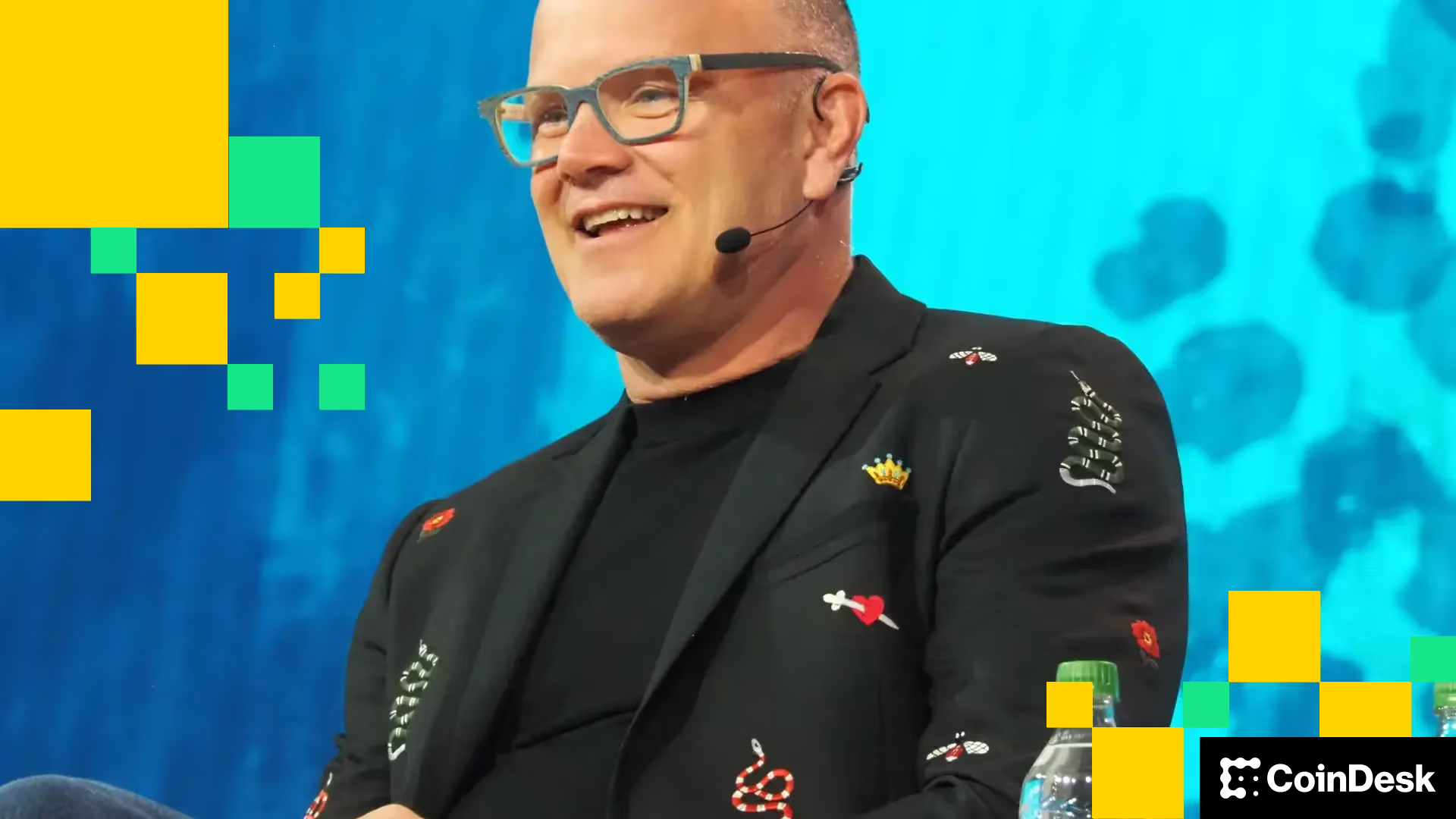 Galaxy Digital CEO Mike Novogratz. (CoinDesk)
What to know:
- Galaxy’s Alex Thorn indicated that while the quantum threat to Bitcoin is genuine, it is currently limited, impacting only specific exposed wallets rather than the overall network security.
- Developers are actively pursuing various solutions, such as quantum-resistant addresses and phased upgrade proposals.
- Thorn advised investors to perceive quantum risk as a long-term technical challenge, rather than a deterrent to investing in bitcoin today.
Concerns that quantum computing might eventually undermine Bitcoin’s cryptography have ignited a significant discussion within the crypto sector.
However, Alex Thorn, Galaxy Digital’s head of research (GLXY), asserts that the notion of Bitcoin being unprepared or that investors should steer clear due to this risk is exaggerated.
The risk itself is not fictitious. An advanced quantum computer could theoretically derive private keys from exposed public keys, enabling an attacker to create signatures and seize funds. Nevertheless, Thorn contends that characterizing this as an urgent or Bitcoin-specific crisis overlooks crucial context regarding the technology and the proactive measures already in progress.
“The risk is real but acknowledged,” Thorn remarked during an interview with CoinDesk. “And those best equipped to tackle it are actively engaged.”
Quantum computing represents a fundamentally different computational approach that leverages the principles of quantum mechanics instead of classical physics. Unlike traditional bits that are either 0 or 1, quantum computers utilize “qubits,” which can exist in multiple states simultaneously, a phenomenon known as superposition, enabling them to process numerous possibilities at once.
When combined with another characteristic called entanglement, this allows quantum machines to tackle certain intricate problems much more efficiently than classical computers, especially tasks like factoring large numbers that underpin contemporary encryption.
Analysis from Project Eleven, a security firm concentrating on quantum risks in digital assets, indicates that approximately 7 million bitcoin , valued at around $470 billion at recent prices, might be susceptible under a “long exposure” definition, meaning their public keys have already been disclosed on-chain. Other estimates fluctuate significantly based on the criteria for exposure.
It is crucial to note that the majority of bitcoin today is not immediately at risk. Funds are only endangered in situations where public keys are exposed on-chain, either due to users reusing addresses, certain custodians utilizing operational shortcuts, or coins residing in older address formats. While some estimates suggest millions of BTC fall into these categories, they remain secure under the current, publicly known quantum capabilities.
Related Posts
This distinction is pivotal to Galaxy’s argument. The discussion has polarized between those who regard quantum computing as decades away and those who caution against imminent threats. Thorn’s perspective finds a middle ground. The likelihood of a future threat is substantial enough to justify action, yet not so pressing that it outstrips Bitcoin’s capacity to respond.
And that response is already in motion.
A growing array of technical efforts is concentrated on rendering Bitcoin “quantum-resistant” over time. A notable initiative involves the introduction of new address types based on post-quantum cryptography. These would enable users to transfer funds away from potentially vulnerable formats, significantly alleviating long-term exposure.
“There’s significantly more work being undertaken than many realize,” Thorn stated. “Developers are actively establishing pathways to upgrade the system.”
Other proposals address edge cases, such as inactive coins with permanently exposed public keys. One concept, sometimes referred to as an “hourglass” approach, would gradually limit how such coins can be utilized, reducing systemic risk without outright confiscation or interruption.
More broadly, developers are investigating phased upgrade strategies that would permit Bitcoin to adjust even under more extreme scenarios, such as a future where quantum systems can swiftly dismantle existing cryptographic methods. This could involve modifications to how transactions disclose public keys in the first place, thereby minimizing attack surfaces entirely.
Although these initiatives are intricate, both from a technical and governance perspective, Thorn underscores that Bitcoin’s open development model is an asset, not a drawback. The ecosystem possesses the time, talent, and strong motivations to effectively address the problem well before it becomes critical.
Importantly, the number of individuals capable of initiating a so-called “Q-day,” when quantum computers can breach modern cryptography, is still exceedingly limited. Even optimistic forecasts suggest that only a small group of highly specialized researchers could reach such a breakthrough in the foreseeable future.
In this context, Thorn perceives the escalating wave of quantum-related fear, uncertainty, and doubt as disproportionate.
“Quantum computing is a powerful, potentially disruptive technology, but that does not imply every risk is immediate or unmanageable,” he remarked.
For investors, the conclusion is clear. Quantum risk should be monitored, but it should not serve as a blanket rationale to avoid bitcoin exposure. The network has a history of adapting in response to credible threats, and the foundation for quantum resilience is already being established.
"It’s not definite that quantum is an existential issue for bitcoin, but the possibility that it is warrants concern,” Thorn noted. “However, what is evident today is that Bitcoin developers are not overlooking it. Instead, many are diligently working on it,” he added.
Read more: Cathie Wood’s Ark Invest says quantum computing is a long-term risk for bitcoin, not an imminent threat
