Disclaimer: Information found on CryptoreNews is those of writers quoted. It does not represent the opinions of CryptoreNews on whether to sell, buy or hold any investments. You are advised to conduct your own research before making any investment decisions. Use provided information at your own risk.
CryptoreNews covers fintech, blockchain and Bitcoin bringing you the latest crypto news and analyses on the future of money.

Crypto Long & Short: Prediction Markets Not Only Anticipate Power Dynamics but Also Influence Them

In this week’s Crypto Long & Short Newsletter, Ryan Kirkley discusses the potential risks associated with crypto prediction markets, including the possibility of encouraging manipulation and spreading misinformation on a large scale.
 (Georgi Kalaydzhiev/ Unsplash)
What to know:
You are currently reading Crypto Long & Short, our weekly newsletter that provides insights, updates, and analysis tailored for professional investors. Subscribe here to receive it every Wednesday in your inbox.
Welcome to our institutional newsletter, Crypto Long & Short. This week:
- Ryan Kirkley explores the risks of crypto prediction markets potentially incentivizing manipulation and enhancing misinformation on a large scale.
- Key headlines of interest for institutions, presented by Francisco Rodrigues.
- Geodnet’s decoupling indicates a fundamental re-rating in the Chart of the Week.
Thank you for joining us!
-Alexandra Levis
Expert Insights
Prediction Markets Don’t Just Forecast Power – They Reshape It
By Ryan Kirkley, Co-Founder and CEO of Global Settlement Network
Prediction markets are frequently promoted as unbiased forecasting instruments: effective means to consolidate information and transform collective belief into a price. This assertion is not entirely incorrect. Academic research has consistently shown that prediction markets can yield forecasts that exceed many traditional benchmarks. However, as someone who advocates for the role of crypto in modernizing market infrastructure, I believe we must be transparent about what this sector is developing. The crypto iteration of prediction markets transcends mere forecasting; it is concerned with financializing real-world instability.
This distinction is significant. On Polymarket, for instance, users can transfer assets from Ethereum, Solana, Bitcoin, and other networks; these deposits are converted into USDC.e on Polygon, where fully collateralized yes/no positions are traded and settled on-chain as tokenized claims. In essence, crypto does not simply host these markets. It provides them with global accessibility, cross-chain funding, and streamlined settlement. This is an impressive market design, but it also heightens the associated social risks.
When war, political violence, public disorder, or institutional failure are transformed into tradable crypto instruments, new incentives for malicious actors emerge. The first is apparent: individuals with insider information might seek to profit from it. U.S. regulators have long acknowledged that not every incident should be included in a financial market. CFTC Regulation 40.11 prohibits event contracts related to terrorism, assassination, and war, among other categories considered against public interest. This is not an instance of moralizing against markets; rather, it acknowledges that some contracts do more than simply convey information; they can alter behavior regarding the underlying event.
Related Posts
The second issue is even more severe: prediction markets can benefit those who are not only informed about an outcome but also capable of affecting it. Academic studies have indicated that when traders possess external motivations or can take actions that influence the underlying event, the aggregation of information can deteriorate. A market is meant to assess probability. However, when the market itself offers incentives, it begins to reshape the probability it claims to measure.
This concern is no longer hypothetical. Reuters reported this month that markets concerning strikes in Iran and the ousting of Ayatollah Ali Khamenei faced ethical and insider-trading scrutiny after unusually well-timed bets were identified; in a separate report, Reuters noted that Polymarket removed bets on a nuclear explosion following public backlash. Even if only a small fraction of traders act on nonpublic information, the corrosive message to all others is clear: access, rather than insight, may be what is rewarded.
There exists a third risk, which is inherently crypto-specific: these platforms increasingly operate as media engines as much as they do markets. Axios reported in February that prediction-market accounts were disseminating false, misleading, or contextually lacking claims to millions on social media, transforming market odds into viral narratives before facts were established. When screenshots of minimal or sensational markets circulate as “truth,” malicious actors do not need to influence the event itself; they only need to sway the information ecosystem surrounding it.
For advisors and allocators, the error is to regard every liquid market as legitimate simply because price discovery is present. Crypto has significant work ahead: modernizing settlement, enhancing transparency, and making capital markets more programmable. However, constructing the most efficient infrastructure for speculating on war, regime change, or civic instability is not financial innovation; it is moral hazard at internet scale. Prediction markets do not merely forecast power; in their current crypto form, they reshape it by rewarding those most inclined to exploit instability.
Headlines of the Week
Francisco Rodrigues
This week has demonstrated notable advancements on the regulatory front, but market apprehension combined with AI disruption has begun to impact the crypto sector.
- SEC approves Nasdaq’s initiative to facilitate tokenized securities trading: The U.S. Securities and Exchange Commission (SEC) has given the green light to Nasdaq’s plan to allow specific securities to be traded in a tokenized format after the firm sought regulatory approval in September.
- Senators announce a compromise on yield to progress crypto market bill: Potentially paving the way for the approval of the crypto Clarity Act, two prominent senators have stated they have reached an agreement that could advance the bill to its next stage.
- U.S. SEC releases first-ever definitions for what crypto assets qualify as securities: The guidance, issued in collaboration with the Commodity Futures Trading Commission, does not yet carry the weight of a formal new rule.
- Bitcoin options indicate extreme fear as downside protection premium reaches all-time high, according to VanEck: Traders are paying record amounts for downside protection, with the put/call open interest ratio hitting its highest level since June 2021 and put premiums achieving a new record relative to spot volume.
- Crypto.com reduces workforce by 12% as it integrates AI across the organization for greater efficiency: While Crypto.com’s layoffs were the largest in the crypto sector over the past week, the Algorand Foundation also reduced its staff by 25%. Last week, OP Labs let go of 20 employees to narrow its focus, while the team behind Story Protocol dismissed 10% of its workforce.
Chart of the Week
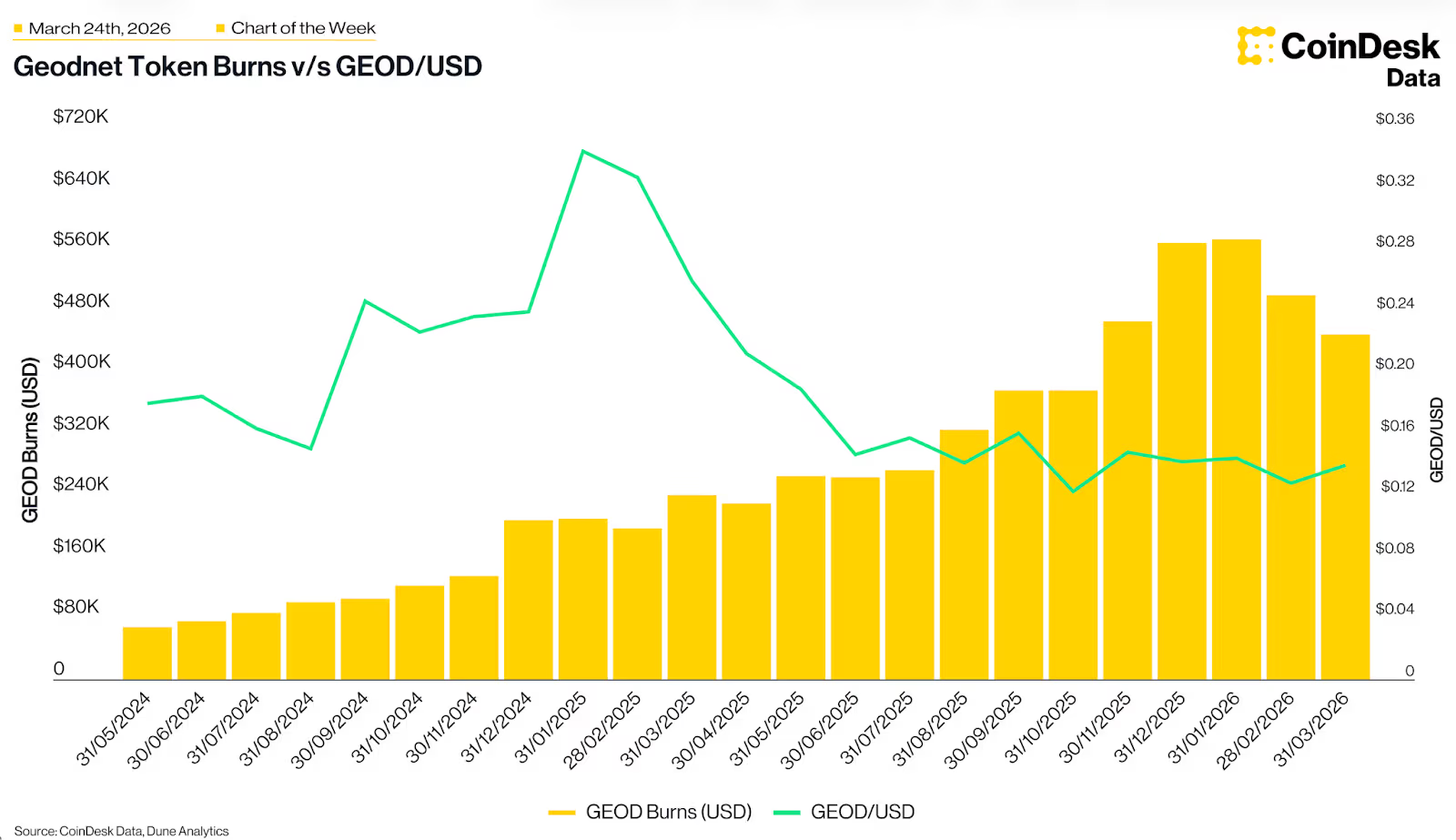
Geodnet decoupling suggests potential fundamental re-rating
Geodnet, a Decentralized Physical Infrastructure Network (DePIN) protocol providing high-precision positioning for Robotics and Physical AI, exhibits a clear fundamental decoupling. While its price has trended sideways alongside a lagging DePIN index (down 3% relative to BTC, according to CoinDesk Data), monthly token burns have reached $500,000, currently neutralizing approximately 60–80% of new emissions. This divergence is driven by the increasing data revenue from autonomous drone fleets and humanoid robot developers. As the network shifts from infrastructure development to a high-margin data layer for the machine economy, the existing supply-demand imbalance suggests a potential fundamental re-rating.
Listen. Read. Watch. Engage.
- Listen: Have you heard? Wealth Management Day is making a comeback at Consensus Miami! If you are a qualified advisor, join us for a closed-door, one-day forum designed to provide all the information you need regarding digital assets.
- Read: In Crypto for Advisors, Dumpling Bullish, an independent commentator on digital assets, discusses the increasing impact of bitcoin’s derivatives market on its pricing. Additionally, Leo Mindyuk from ML Tech responds to queries about the evolution of bitcoin investment products in Ask an Expert.
- Watch: Discover why Circle (CRCL) has risen 100% and the implications of Middle Eastern tensions for risk assets on CoinDesk’s Public Keys from the NYSE floor. Leif Abraham, Richard Shorten, and Ryan Rasmussen join Jennifer Sanasie to discuss crypto and other topics.
- Engage: Have you purchased your tickets for Consensus Miami yet? Early bird pricing ends Friday at 4 p.m. ET. Check out the agenda and register today!
Looking for more? Stay updated with the latest
