Disclaimer: Information found on CryptoreNews is those of writers quoted. It does not represent the opinions of CryptoreNews on whether to sell, buy or hold any investments. You are advised to conduct your own research before making any investment decisions. Use provided information at your own risk.
CryptoreNews covers fintech, blockchain and Bitcoin bringing you the latest crypto news and analyses on the future of money.


Recent news reports have highlighted how China’s faltering economy poses a considerable threat to global growth. Economic activity and credit flow in the region are declining, and analysts remain skeptical that the Chinese government’s interventions can adequately address what seem to be fundamental issues.
For example, industrial production in July rose by 3.7% year-over-year, which is a slowdown compared to June’s growth rate of 4.4%. Additionally, Chinese banks granted 89% fewer new loans in July compared to June, marking the lowest level since late 2009.
In addition to its effects on global economic expansion, investors are worried that the instability in China’s real estate sector could create a ripple effect impacting the U.S. dollar and commodities. This scenario could lead to adverse conditions for Bitcoin (BTC).
On August 28, the Shanghai Shenzhen CSI 300 Index, a significant gauge of the Chinese stock market, initially jumped by 5.5% before closing the day with a 1.2% increase. Despite this uptick, Chinese stocks remain among the weakest performers globally in equity indexes monitored by Bloomberg.
Bitcoin traders are understandably concerned about the potential impacts stemming from fluctuations in the Chinese stock market. This apprehension is rooted in historical price patterns and a broader trend of investors steering clear of riskier markets during times of macroeconomic instability.
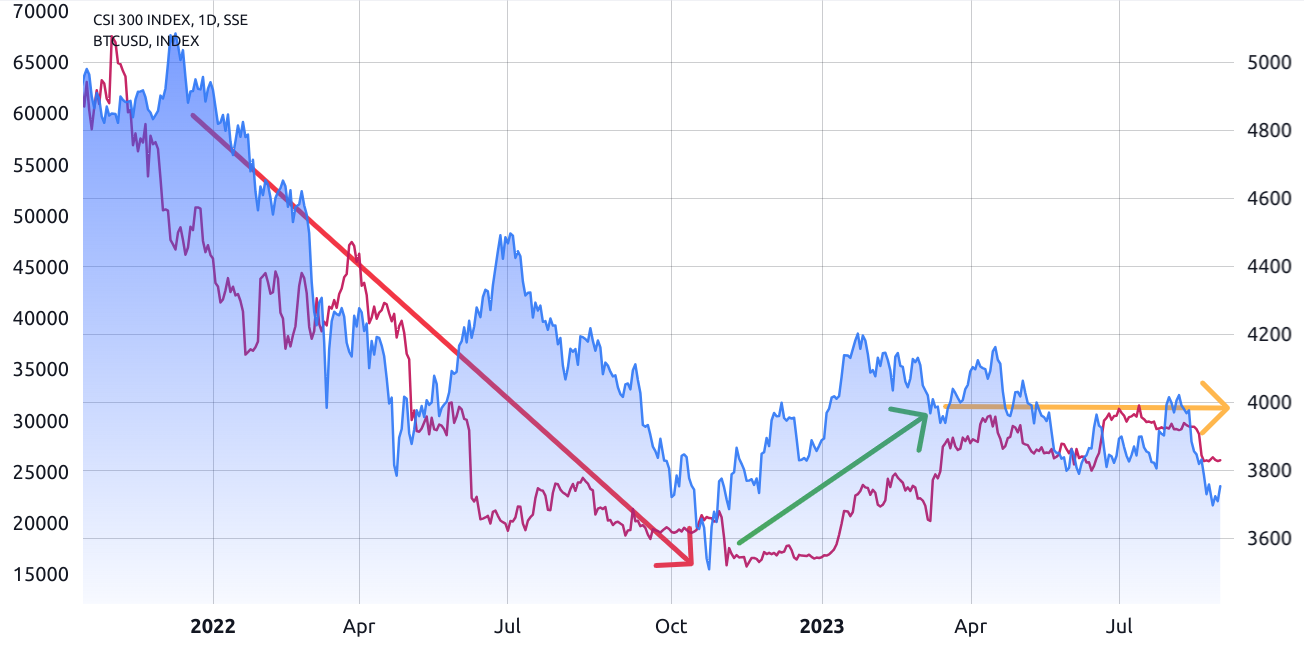 Bitcoin/USD index (purple, left) vs. China CSI 300 Index (blue, right). Source: TradingView
The chart above illustrates that Bitcoin’s price movements often correlate with the overall trends of China’s stock market, although these correlations may be predictable or occur with a time lag. Notably, the 30-day correlation between the CSI 300 Index and Bitcoin/USD reached a notably high level of 70% on August 28.
Can China instill confidence in investors?
Interestingly, the recent rise in the stock market seems to be largely influenced by measures announced by China on August 27. According to Bloomberg, these measures reportedly included:
- Special refinancing options for the real estate sector, aimed at helping companies navigate challenges and maintain economic stability.
- Reduced fees to incentivize companies to repurchase shares, potentially enhancing stock prices and boosting investor confidence.
- Selected trading firms lowering leverage margins, making it easier for investors to trade with borrowed funds.
- New stock offerings are expected to undergo increased regulatory scrutiny, which may lessen competition for existing companies.
- Restrictions on selling below the initial public offering price for a designated period to mitigate excessive volatility and safeguard investors from immediate losses.
Related Posts
However, it quickly became apparent that the measures, initially presented as economic stimulus, did not achieve the desired effect, according to Ting Lu, chief China economist at Nomura Holdings. He remarked that these measures “fall short in halting the downward trend and their impact will be short-lived unless accompanied by support for the actual economy.”
In addition to the CSI 300 Index’s significant 23.8% decline since July, there are evident signs of foreign capital exiting Chinese stocks. Global funds sold approximately $1.1 billion worth of shares on August 28 alone, contributing to August’s outflows surpassing $11 billion, potentially reaching a record high, as reported by Bloomberg.
The pressing question revolves around why China is not implementing effective economic stimulus packages. The answer may be linked to the value of the country’s currency. The yuan’s value against the U.S. dollar has been consistently declining, as shown in the yuan price chart. This trend raises concerns, as it suggests the currency is approaching historically low levels.
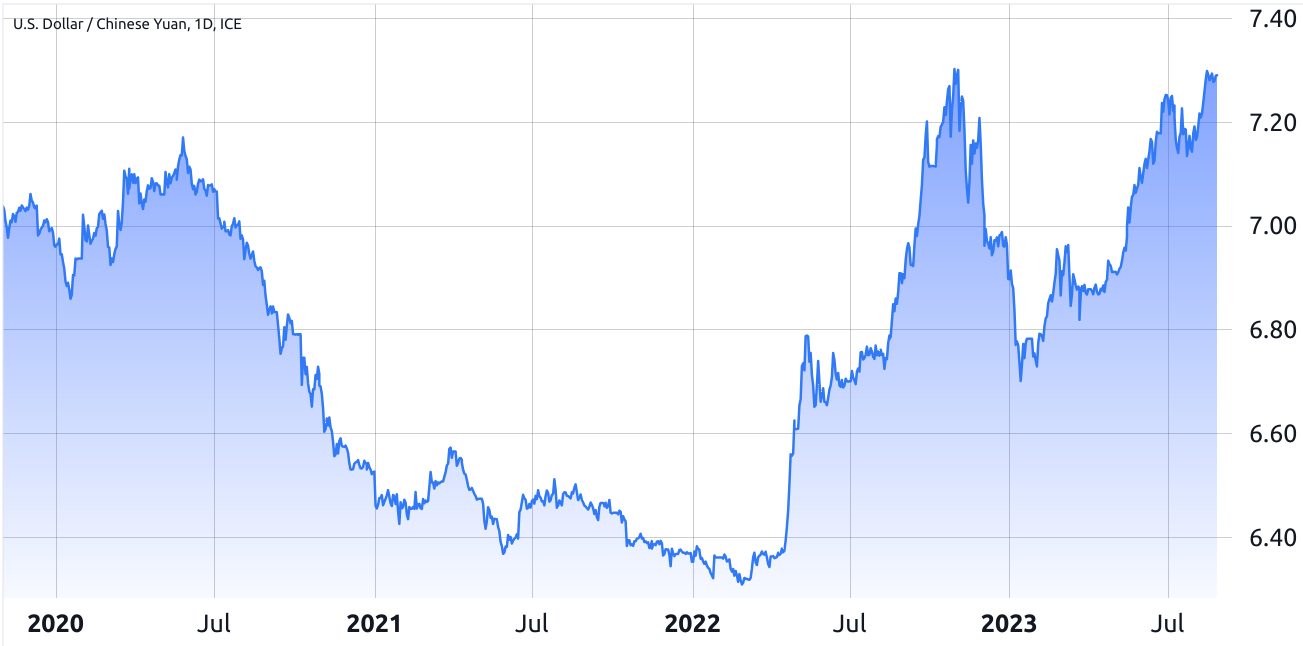 Chinese yuan vs. U.S. dollar. Source: TradingView
Despite incentives such as tax breaks, government bond buybacks, and monetary distributions to the populace, which can lead to increased money circulation and rising debt, there is a detrimental effect on the purchasing power of the yuan. The situation is intricate and lacks straightforward solutions, potentially resulting in China experiencing significantly slower economic growth.
A strong U.S. dollar is bad news for Bitcoin’s price
Interestingly, the primary beneficiary of the capital outflow from the Chinese stock market appears to be the U.S. stock market, ultimately bolstering the U.S. dollar. As capital shifts away from Chinese equities, it tends to weaken the local currency, as investors gravitate toward lower-risk options such as the S&P 500 index or U.S. money market funds.
This scenario could pose challenges for Bitcoin, given that it is priced in dollars and competes as an alternative store of value. For those expecting a cryptocurrency rally due to a global economic downturn, it is crucial to recognize that the U.S. dollar does not need to be perfect; it only needs to outperform other competing fiat currencies.
Nevertheless, market dynamics can change rapidly once investors identify potential overvaluation in the U.S. stock market or when signs of an impending moderate recession in the U.S. emerge, regardless of the relative strength of the U.S. dollar against its peers. Consequently, Bitcoin’s value as an independent and alternative hedge remains relevant, even if it is currently unable to reclaim the $29,000 support.
This article is for informational purposes only and is not intended to serve as legal or investment advice. The views, thoughts, and opinions expressed herein are solely those of the author and do not necessarily reflect or represent the views and opinions of Cointelegraph.
