Disclaimer: Information found on CryptoreNews is those of writers quoted. It does not represent the opinions of CryptoreNews on whether to sell, buy or hold any investments. You are advised to conduct your own research before making any investment decisions. Use provided information at your own risk.
CryptoreNews covers fintech, blockchain and Bitcoin bringing you the latest crypto news and analyses on the future of money.

New Bitcoin quantum initiative provides Satoshi Nakamoto with a method to demonstrate control without transferring BTC.

A novel design suggested by the venture fund Paradigm would enable holders to privately timestamp proof of their control over vulnerable keys before the advent of quantum computing, potentially providing a means of rescue if Bitcoin phases out old addresses.
Key points:
- A new initiative named Provable Address-Control Timestamps, or PACTs, seeks to safeguard aging bitcoin wallets from prospective quantum-computing threats without necessitating immediate movement of funds by their owners.
- PACTs enable holders to privately timestamp cryptographic proof of ownership now and subsequently employ quantum-resistant STARK proofs to access their assets if the network halts vulnerable addresses.
- This system would necessitate Bitcoin to implement new STARK verification infrastructure via a soft fork and can only secure Satoshi Nakamoto’s coins if the individual controlling those keys takes action prior to quantum theft or a community-enforced freeze happening.
Concerns regarding quantum computing in Bitcoin have always involved a challenge related to Satoshi.
Billions of bitcoin held in outdated wallets with exposed public keys could be at risk of theft should sufficiently advanced quantum computers become operational. This includes approximately 1.1 million bitcoin linked to the pseudonymous creator Satoshi Nakamoto, currently valued at around $84 billion.
The clear defense strategy is a soft fork (or an enhancement to existing network protocols) that would eventually prevent spending from those legacy address types, compelling holders to transition to quantum-secure formats before adversaries can deduce their private keys.
Notable developer Jameson Lopp and five other developers suggested precisely that in mid-April through BIP-361, which would eliminate quantum-vulnerable addresses over a five-year timeline and freeze any coins that do not migrate.
This proposal, however, introduced a different issue. Satoshi, along with every other long-inactive holder, would need to become active publicly or risk losing access to their funds.
Dan Robinson, a general partner at Paradigm, presented a proposal on Friday for an alternative solution that centers on the notion of Provable Address-Control Timestamps, or PACTs.
The fundamental premise is to avoid relocating coins while timestamping proof of ownership on a particular date, keeping the information hidden from the public until the wallet owners actually need to make a transaction.
Related Posts
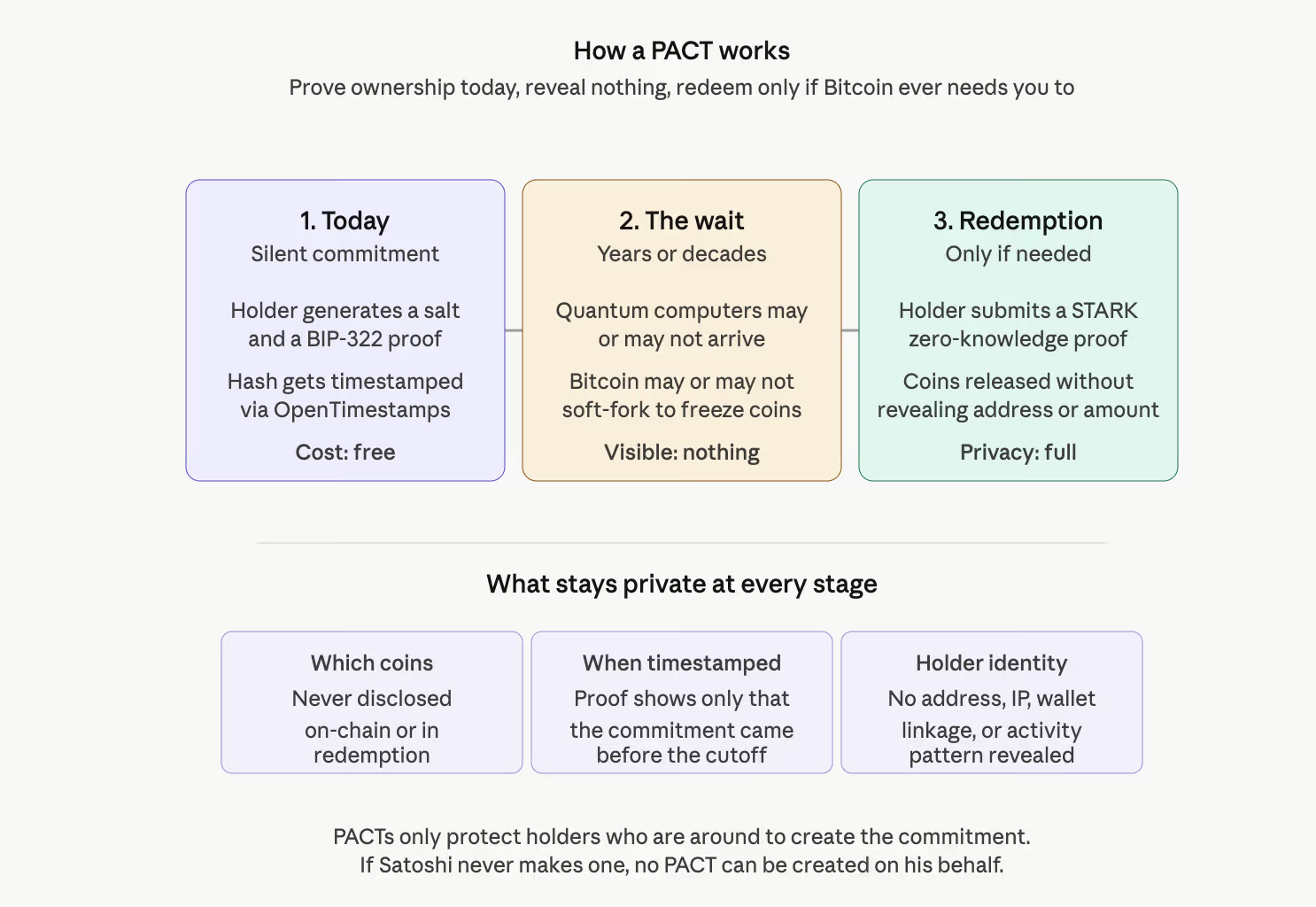
A holder generates a random salt, a piece of secret data that is utilized to create a unique and unpredictable cryptographic commitment, and employs BIP-322, a standard for signing messages from a Bitcoin address without making a transaction, to generate proof of ownership.
The salt and proof are then combined into an on-chain commitment and timestamped using OpenTimestamps, a free service that anchors data onto the Bitcoin blockchain through a single aggregated transaction. The salt, proof, and timestamp files remain confidential.
If Bitcoin later implements a soft fork that freezes coins vulnerable to quantum threats, the protocol could incorporate a rescue mechanism that accepts a STARK proof, a form of zero-knowledge proof that remains secure against quantum threats, demonstrating that the holder established their commitment prior to the existence of quantum technology.
The holder submits that proof when they wish to transact, prompting the network to release the funds. The redemption process reveals no information about the specific address, amount, or even the timestamp of the original commitment.
These PACTs also fill a specific gap in BIP-361 by providing a rescue option for wallets generated through BIP-32, the deterministic key generation standard introduced in 2012. Wallets created before 2012, including most of Satoshi’s known addresses, do not utilize BIP-32 and cannot be saved through that method.
Consequently, Robinson indicated that the implementation of PACTs necessitates Bitcoin to eventually adopt a STARK verification protocol, which would itself require a separate soft fork with wide community agreement.
The current infrastructure for verification does not exist in Bitcoin and would require what Robinson refers to as “substantial new plumbing,” including multisig wallets, intricate scripts, and hardware wallet support that would all need careful standardization.
This last limitation is one that PACTs cannot circumvent.
The protocol only safeguards Satoshi if he or the current key holder makes the commitment. If Satoshi is indeed absent, no PACT can be created retroactively. The coins will remain susceptible to whichever scenario occurs first, quantum theft or community freeze.
What PACTs provide is a method to render the BIP-361 discussion less dichotomous. The existing freeze proposal compels a decision between defending against quantum theft and honoring dormant property rights.
Whether Satoshi will utilize it remains an unanswered question for PACTs.
