Disclaimer: Information found on CryptoreNews is those of writers quoted. It does not represent the opinions of CryptoreNews on whether to sell, buy or hold any investments. You are advised to conduct your own research before making any investment decisions. Use provided information at your own risk.
CryptoreNews covers fintech, blockchain and Bitcoin bringing you the latest crypto news and analyses on the future of money.


Bitcoin (BTC) broke below its 55-day support level at $27,000 on May 12. This two-day, 7% correction to $26,155 resulted in the liquidation of $100 million worth of long BTC futures contracts.
However, Bitcoin’s margin and futures markets demonstrated resilience during the downturn, fueling hopes of a recovery toward $28,000.
Regulatory Headwinds and a Stronger U.S. Dollar
Regulatory uncertainty in the United States intensified after Bitcoin miner Marathon Digital received another subpoena. The publicly traded mining company informed investors on May 10 that it had received a subpoena from the U.S. Securities and Exchange Commission (SEC) regarding potential violations of federal securities laws, among other issues, related to related-party transactions.
Additionally, there is ongoing risk concerning the 627,522 Bitcoins held by the Grayscale GBTC Trust Fund. The fund has traded at a steep discount for over a year while Grayscale’s holding company, Digital Currency Group (DCG), struggles with failing subsidiaries. DCG’s crypto lending and trading arm, Genesis Capital, filed for Chapter 11 bankruptcy protection in January.
Although Genesis Capital has a separate corporate structure from DCG, it had “intercompany obligations” with the holding company, leaving the consequences for the administration of Grayscale’s funds uncertain. Furthermore, the group reportedly owes Gemini’s clients approximately $900 million, and the U.S. SEC charged Genesis and Gemini in January.
Bitcoin’s 7.2% correction coincided with strength in the U.S. Dollar Index (DXY), which measures the U.S. currency against a basket of foreign exchanges. The indicator reached 101 on May 8, nearing its 12-month low, signaling low confidence in the government’s ability to curb inflation while simultaneously managing to increase the debt limit.
Historically, there has been an inverse correlation between the DXY index and risk-on assets such as Bitcoin, as a weaker dollar tends to drive demand for alternative stores of value and scarce assets.
Let us examine derivatives metrics to better understand how professional traders are positioned in the current market environment.
Bitcoin Margin Market Traders Slightly Less Optimistic
Margin markets provide insight into the positioning of professional traders, as they allow investors to borrow cryptocurrency to leverage their positions.
Related Posts
OKX, for instance, provides a margin lending indicator based on the stablecoin/BTC ratio. Traders can increase their exposure by borrowing stablecoins to buy Bitcoin. Conversely, Bitcoin borrowers are betting on a decline in the cryptocurrency’s price.
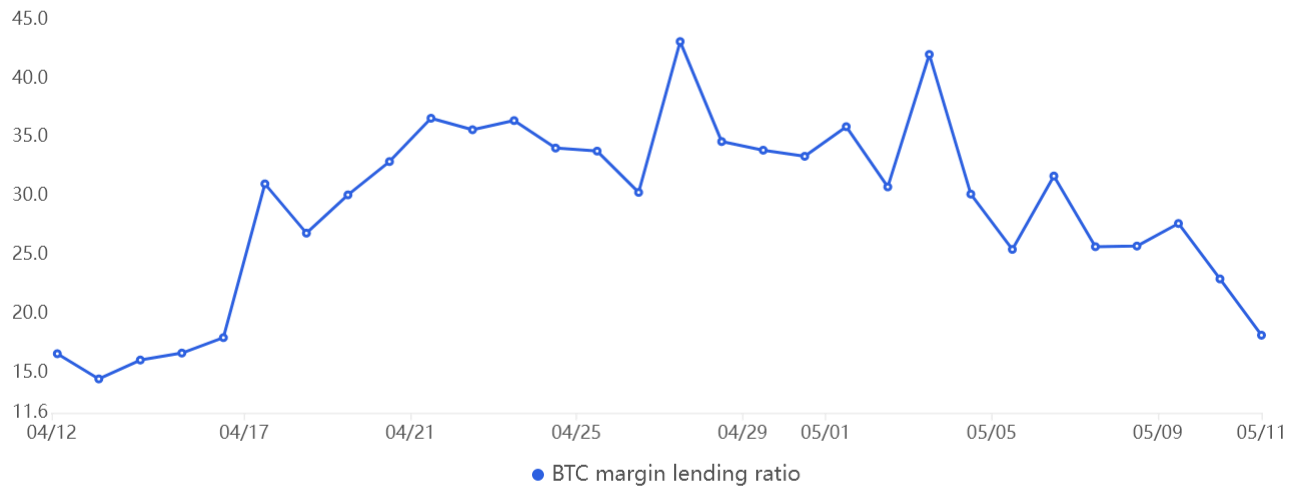 OKX stablecoin/BTC margin lending ratio. Source: OKX
The chart above shows that OKX traders’ margin lending ratio decreased between May 8 and May 11. This is not concerning, given that traders still favor bullish strategies, as stablecoin (long) demand currently surpasses BTC (short) demand by a factor of 18 times, which is considered healthy.
Related: Texas votes to add crypto to state’s Bill of Rights
No Signs of Panic Selling Following Bitcoin Price Crash
To exclude externalities that might have solely impacted the margin markets, traders should analyze the long-to-short metric. This metric aggregates data from exchange clients’ positions on spot, perpetual, and quarterly futures contracts, offering better insight into how professional traders are positioned.
There are occasional methodological discrepancies between different exchanges, so readers should monitor changes rather than absolute figures.
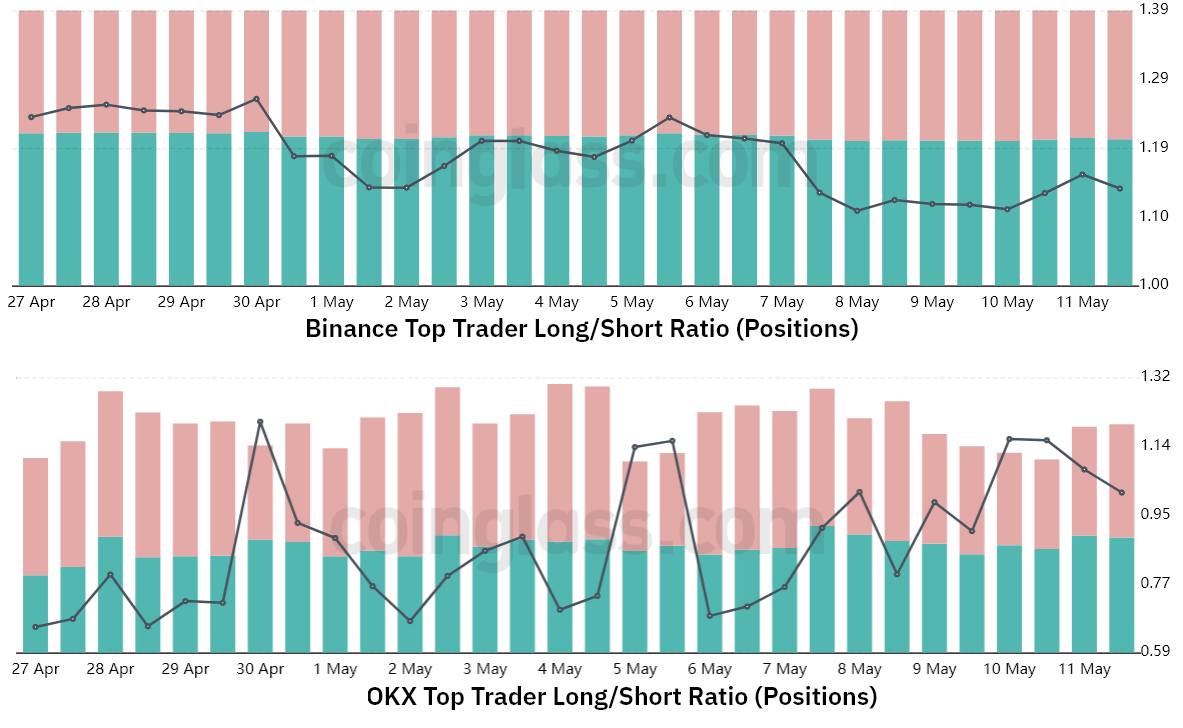 Exchanges’ top traders Bitcoin long-to-short ratio. Source: Coinglass
Even though Bitcoin broke below the $28,000 support level, professional traders have increased their leveraged long positions using futures, according to the long-to-short indicator.
At the crypto exchange OKX, the long-to-short ratio increased from 0.92 on May 8 to 1.01 on May 12. Meanwhile, at Binance, the long-to-short ratio stabilized at 1.13, indicating no shift to a bearish position among whales and market makers.
Therefore, despite the 12% price decline from a high of $29,865 on May 6, traders using margin and futures contracts have not abandoned their bullish stance. This movement indicates confidence that Bitcoin is more likely to reclaim $28,000 than succumb to the next support level near $24,500.
This article is for general information purposes and is not intended to be and should not be taken as legal or investment advice. The views, thoughts, and opinions expressed here are the author’s alone and do not necessarily reflect or represent the views and opinions of Cointelegraph.
