Disclaimer: Information found on CryptoreNews is those of writers quoted. It does not represent the opinions of CryptoreNews on whether to sell, buy or hold any investments. You are advised to conduct your own research before making any investment decisions. Use provided information at your own risk.
CryptoreNews covers fintech, blockchain and Bitcoin bringing you the latest crypto news and analyses on the future of money.

Bitcoin maintains its lead over Warren Buffett’s investment portfolio, with expectations for the disparity to increase.

Warren Buffett, the esteemed investor and chairman of Berkshire Hathaway, marked his 93rd birthday on August 30. Throughout his extensive career, he has consistently adhered to a value investing strategy that shares similarities with the “buy and hold” method often linked to cryptocurrencies.
Nonetheless, Buffett concentrates on assets with robust earnings potential, investing in companies and sectors where he and his team have a profound understanding of the related risks, competition, and advantages.
The question arises whether such a focused strategy can surpass Bitcoin (BTC) in the long term. Furthermore, investors should consider why one of the most successful stock pickers of all time currently maintains cash and short-term bonds as the second largest component of his portfolio.
A noteworthy example of this strategy is Berkshire Hathaway’s largest holding, Apple (AAPL) shares. The company first acquired these shares in early 2016 when Apple was already valued at over $500 billion, indicating they were not early investors. Importantly, Berkshire Hathaway continued to increase its AAPL investment in 2022, despite the stock having surged over 500% since their initial acquisition. This demonstrates Buffett’s dedication to long-term investment strategies, irrespective of recent price fluctuations.
Buffett minimizes non-productive commodities as a store of value
In a February 2012 shareholder letter, Berkshire Hathaway expressed apprehensions regarding the devaluation of paper currency and examined the limitations of gold as a store of value. They contended that gold lacks practical utility, with demand for industrial and jewelry applications falling short of production, and its price is predominantly influenced by fear-driven sentiment, leading to only temporary price spikes. In contrast, investments in productive companies yield significant dividends and returns.
Berkshire Hathaway also pointed out that regardless of whether future currency is based on gold, seashells, or paper, individuals will always be willing to exchange a portion of their income for goods and services.
Unfortunately for Buffett, Bitcoin’s price soared by 683% in the 12 months following his critical remarks on the viability of non-productive commodities as a store of value. Additionally, over a 4-year period, Bitcoin’s gains reached an astonishing 9,014%.
To compare the performance of Berkshire Hathaway’s stock holdings with Bitcoin, considering Buffett’s emphasis on earnings and yield, which fundamentally differs from the characteristics of commodities like gold or Bitcoin, we calculated Berkshire Hathaway’s stock performance using a factor of 3 to simulate a leveraged position.
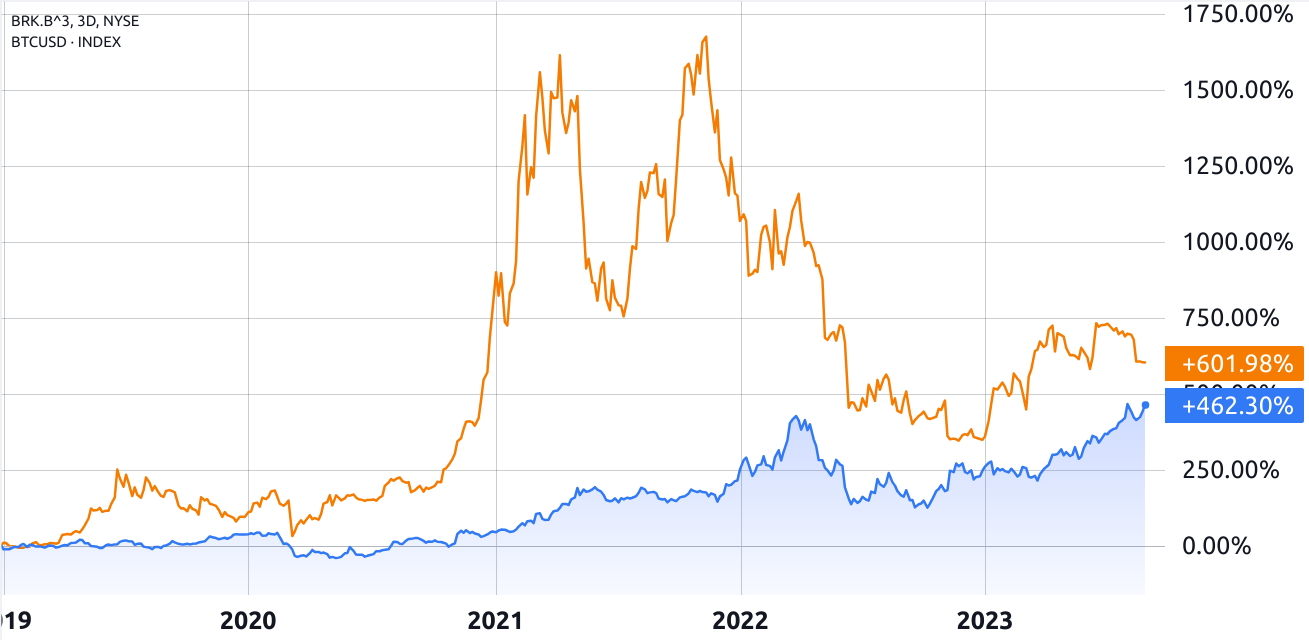 Berkshire (BBRK.B) by a factor of 3 vs. Bitcoin/USD index (orange). Source: TradingView
Related Posts
If an individual had invested $1,000 in Bitcoin (spot) and initiated a leveraged long position in Berkshire Hathaway shares in early 2019, they would have seen a return of $7,020 in BTC compared to $5,623 in Buffett’s holding company.
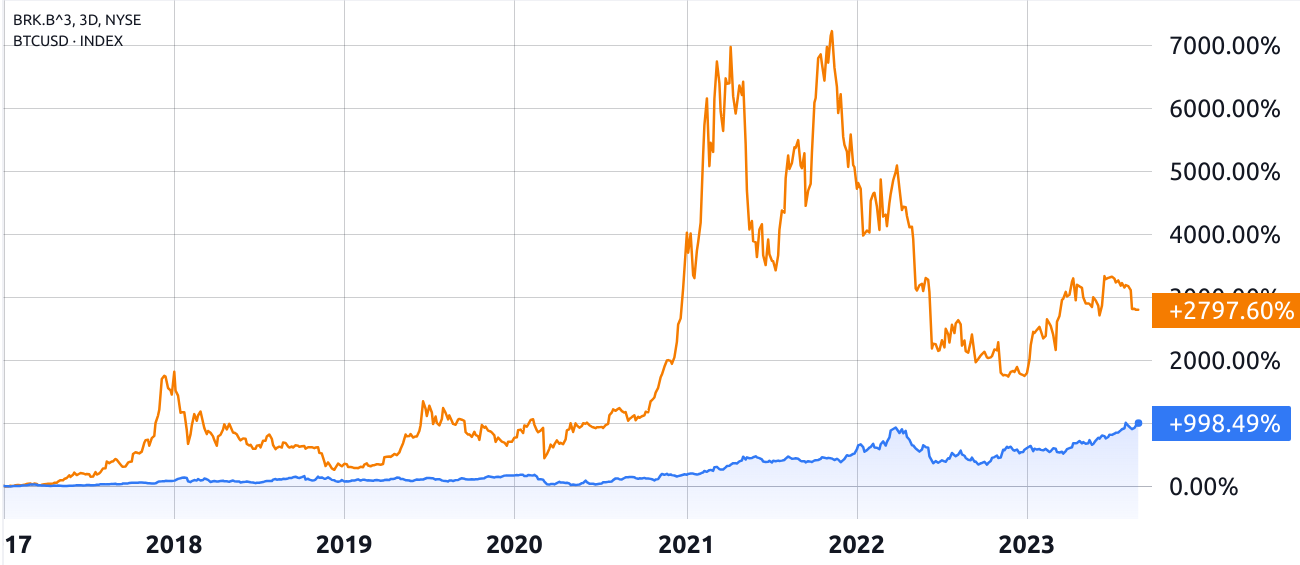 Berkshire (BBRK.B) by a factor of 3 vs. Bitcoin/USD index (orange). Source: TradingView
Similarly, for an investment commencing in 2017, it would have yielded $3,798 in BTC, as opposed to $1,998 using the leveraged long strategy in Berkshire Hathaway’s shares.
The apparent inconsistency in Buffett’s strategy is bullish for Bitcoin
It is crucial to highlight a potential gap in Buffett’s investment thesis: Berkshire Hathaway is currently holding a record-high $147 billion in cash equivalents and short-term investments, which constitutes 18.5% of the company’s total market capitalization. This raises questions about whether they are awaiting more favorable entry points into selected stocks or if they consider the 5.25% returns on fixed-income investments to be adequate.
This situation underscores that even the most accomplished stock market investor may have hesitations about deploying their cash. It also raises inquiries about whether some of the funds currently on the sidelines, including the $5.6 billion in money market funds, might explore alternative forms of protection if inflation resurfaces.
Bitcoin may not be an ideal store of value, and its volatility has been a topic of concern. However, it is important to recognize that Bitcoin has yet to encounter a global economic recession, making it premature to render a definitive judgment.
Moreover, the consistent outperformance of Bitcoin’s price relative to Berkshire Hathaway shares indicates that investors are increasingly perceiving it as a viable alternative store of value.
In this context, Berkshire Hathaway’s substantial cash position serves as a potential cautionary note for those skeptical about Bitcoin. With Bitcoin’s market capitalization currently at $500 billion, it signifies a considerable and untapped potential for its role in the financial landscape.
This article is for informational purposes only and is not intended to be and should not be construed as legal or investment advice. The views, thoughts, and opinions expressed here are solely those of the author and do not necessarily reflect or represent the views and opinions of Cointelegraph.
