Disclaimer: Information found on CryptoreNews is those of writers quoted. It does not represent the opinions of CryptoreNews on whether to sell, buy or hold any investments. You are advised to conduct your own research before making any investment decisions. Use provided information at your own risk.
CryptoreNews covers fintech, blockchain and Bitcoin bringing you the latest crypto news and analyses on the future of money.


Bitcoin’s price is currently fluctuating within a constricted range of $25,500 to $26,500, leaving traders uncertain about the asset’s potential next move.
Nonetheless, Charles Edwards, the founder of Capriole Investments, asserts that Bitcoin’s (BTC) present price offers a low-risk opportunity for long-term investment. Edwards’ perspective is grounded in Bitcoin’s production cost and energy value.
According to Capriole Investments’ energy value theory, a fair value price is estimated at $47,200. Edwards reaffirmed his optimistic outlook by stating that Bitcoin’s production cost suggests a floor price of approximately $23,000, with a 100% accuracy rate.
The trade presents a risk-reward ratio of 1:5, with the possibility of even higher price targets; however, Edwards noted that this is predicated on the assumption that the rally price “would stop at fair value, which it never has.”
My favorite Bitcoin chart right now. The relative distance between Bitcoin’s price, the historical price floor (Bitcoin Electrical Cost) and fair value (Bitcoin Energy Value). That’s a 5:1 risk-reward assuming no-hype and that price would stop at fair value, which it never has. pic.twitter.com/J2yuGcNX9q
— Charles Edwards (@caprioleio) September 7, 2023
Bullish energy value theory
Edwards introduced Bitcoin’s energy value theory in December 2019. This theory posits that the fair value of Bitcoin can be assessed based on the energy required for its production.
The model suggests that the more effort invested in something, the greater its value.
In 2023, the energy expended in Bitcoin mining has been increasing as mining firms have expanded their capacity and share of hash rate through the deployment of new ASICs and preparations for the halving scheduled for April 2024.
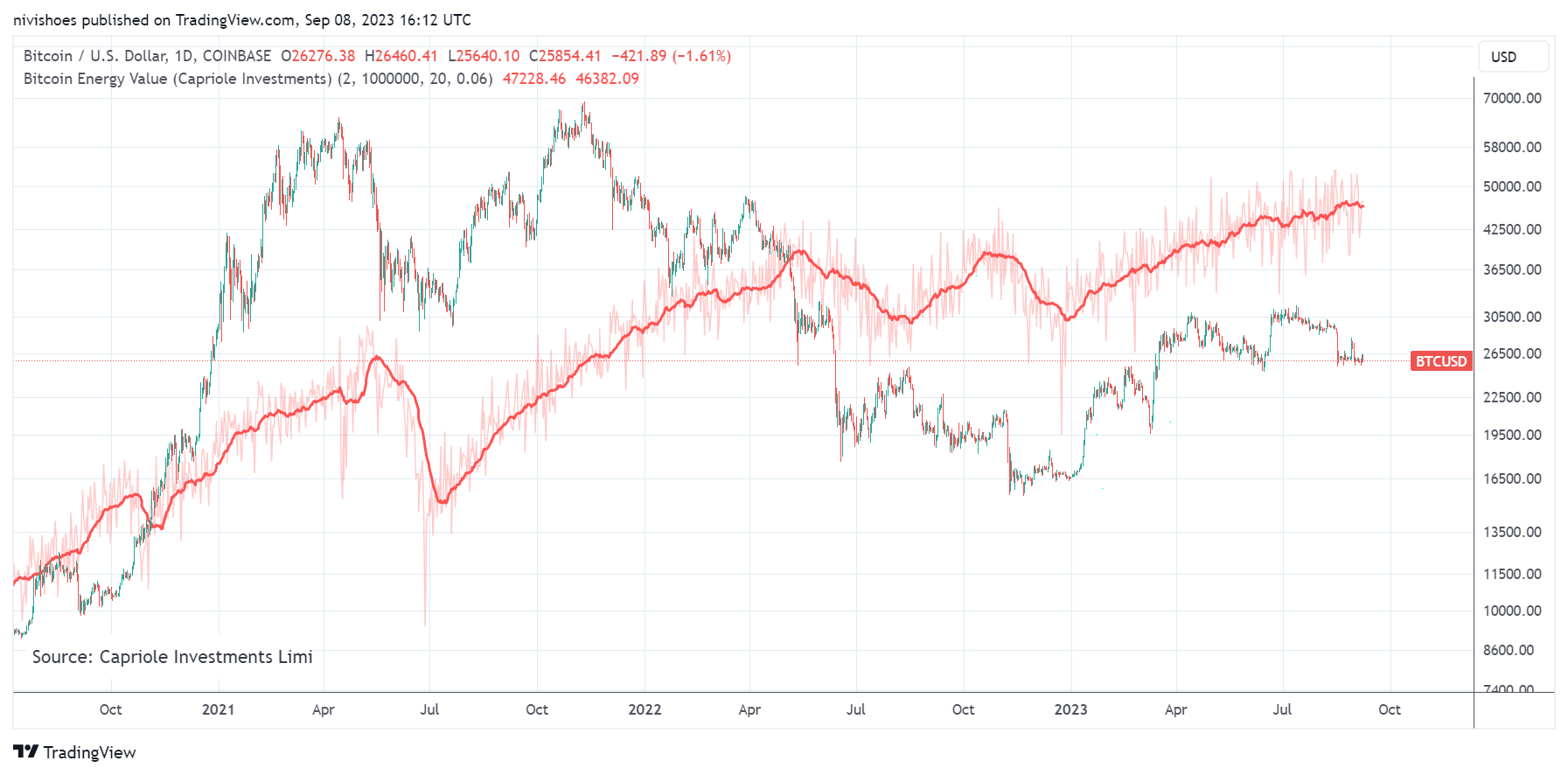 Bitcoin price chart with energy value indicator. Source: TradingView
Edwards indicates that Bitcoin’s energy value mirrors its fair value.
Related Posts
Bitcoin’s energy value has demonstrated a strong correlation with its spot price, suggesting that the theory holds some validity. However, there are limitations to this theory.
One drawback is that Bitcoin’s energy value may not always be precise, as mining energy efficiency can fluctuate over time.
Related: Cambridge Bitcoin Electricity Consumption Index updated to reflect hardware distribution and hash rate increases
Furthermore, the theory does not account for other elements that may influence Bitcoin’s price, such as current market demand and supply dynamics, as well as the actions taken by miners in anticipation of the upcoming halving.
Bitcoin looks primed for further downside
Bitcoin’s spot liquidity data on Binance suggests that buyers are targeting the $24,600 level for support. However, bullish momentum seems to be diminishing as many traders are clustering around the yearly low levels, hoping these will hold.
The liquidation levels of futures orders from CoinGlass indicate that buyers are anticipating a decline to $24,600, with smaller liquidations extending toward $23,000.
Significantly, the price range between $25,000 and $25,500 has the highest volume of leveraged orders, making them prime targets for traders.
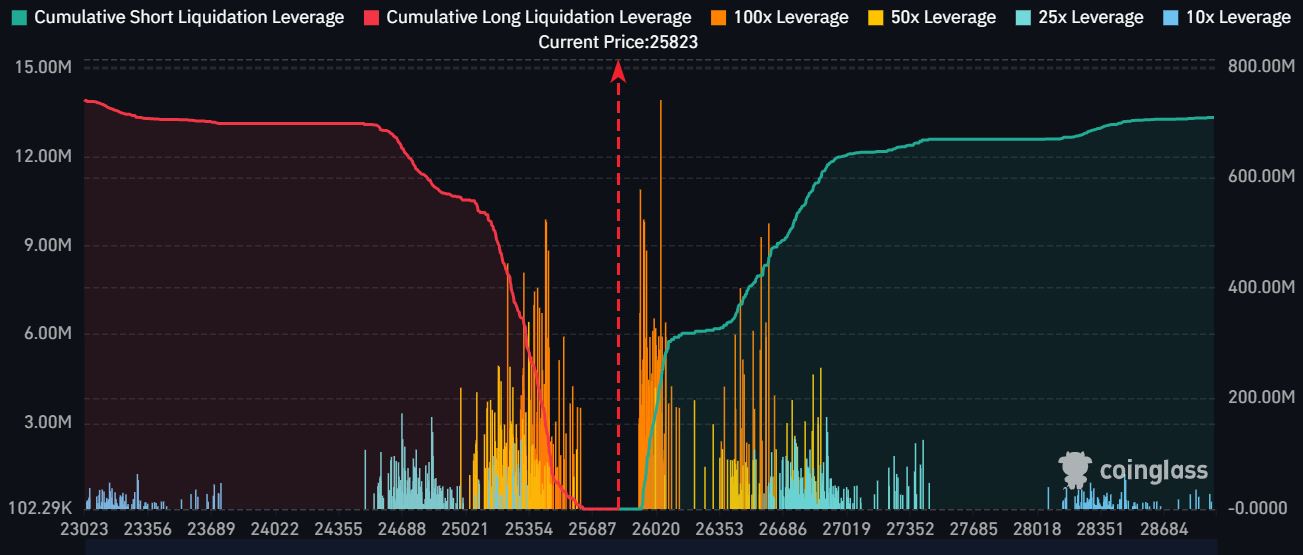 Bitcoin futures liquidation heatmap. Source: CoinGlass
If the price falls to the $23,000 level, buyers’ conviction will be put to the test. A decline below $23,000 would aim for the $21,451 and $19,549 levels from 2022.
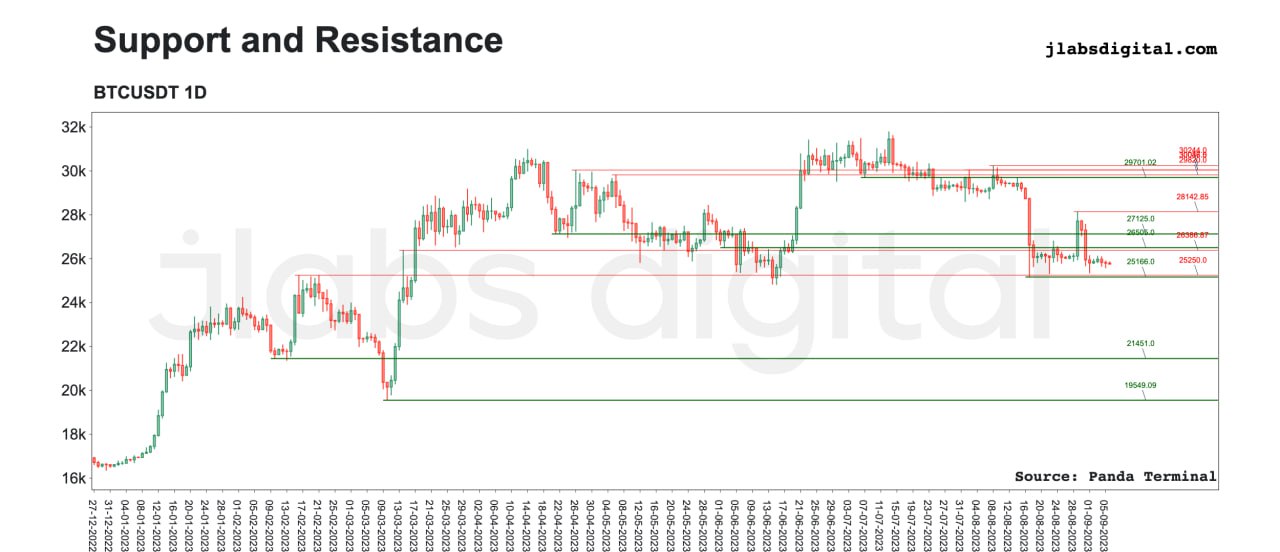 Bitcoin support and resistance levels. Source: Jarvis Labs
This article does not provide investment advice or recommendations. Every investment and trading decision carries risk, and readers should perform their own research before making any decisions.
