Disclaimer: Information found on CryptoreNews is those of writers quoted. It does not represent the opinions of CryptoreNews on whether to sell, buy or hold any investments. You are advised to conduct your own research before making any investment decisions. Use provided information at your own risk.
CryptoreNews covers fintech, blockchain and Bitcoin bringing you the latest crypto news and analyses on the future of money.

XRP declines are driving late investors away, converting each rebound into a fresh selling opportunity.

XRP’s recent price difficulties are beginning to resemble capitulation rather than mere underperformance, as long-term investors who purchased above $2 in the past year are now facing substantial losses.
Data from Glassnode indicates that this group has been realizing losses ranging from approximately $20 million to $110 million daily, coinciding with the digital asset’s 55% drop over the last six months to around $1.30.
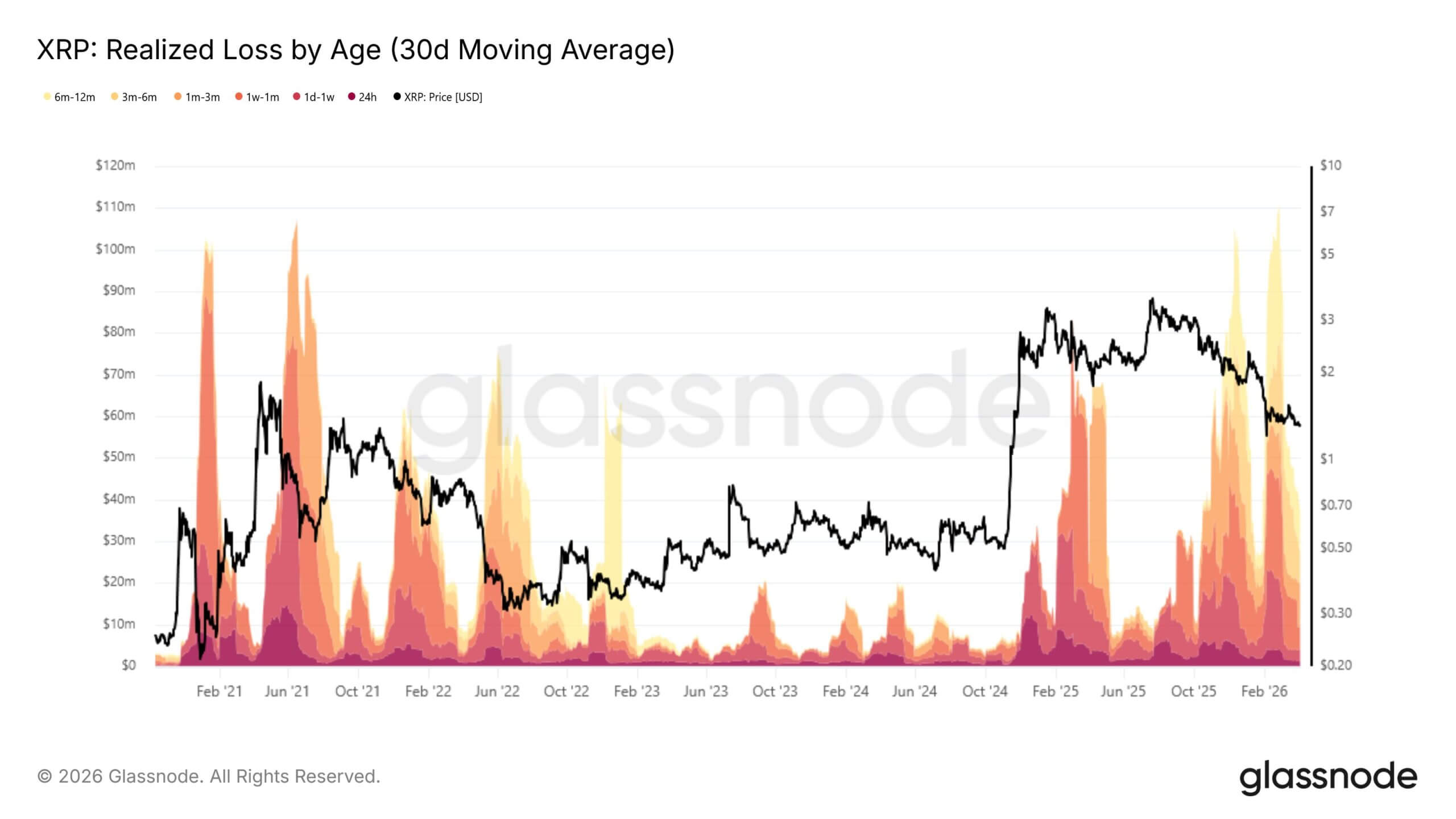 XRP Realized Losses (Source: Glassnode)
This trend implies that the current selling pressure on XRP is primarily due to investors reducing risk in a declining market rather than taking profits during a rally.
Consequently, the market is filled with late buyers under strain, while earlier investors from the sub-$1 accumulation phase still have the capacity to reduce their holdings.
Why this matters
XRP is experiencing pressure from the least favorable type of selling. Recent purchasers are being forced out due to losses, while earlier holders still possess enough profit to sell during price increases. This situation renders the token susceptible to brief recoveries unless demand sufficiently increases to accommodate both groups.
This has resulted in XRP enduring its longest losing streak since 2014, creating a market structure that is top-heavy, where any price recoveries struggle to maintain momentum.
Selling pressure is coming from the wrong part of the market
The significance of this latest downturn lies in the origin of the selling.
In previous cycles, XRP holders typically sold during price increases as profits became more apparent. However, this time, the selling is occurring as the market weakens.
Market analysts have described this shift as “distribution into weakness,” a trend that indicates diminishing confidence in the token’s short-term trajectory.
This helps clarify why the decline has become increasingly difficult to halt. Recent buyers are now facing losses, while earlier holders remain profitable and can still reduce their exposure during rallies.
A market in this condition tends to struggle during upward movements because each bounce provides one group an opportunity to cut losses and another a chance to realize gains. The outcome is a more fragile setup than the headline price decline alone would suggest.
Santiment data supports this view. According to the blockchain analytics firm, wallets active on the XRP Ledger over the past year have seen an average decline of 41% in their positions, marking the weakest mean-to-realized value reading for XRP since the FTX collapse in November 2022.
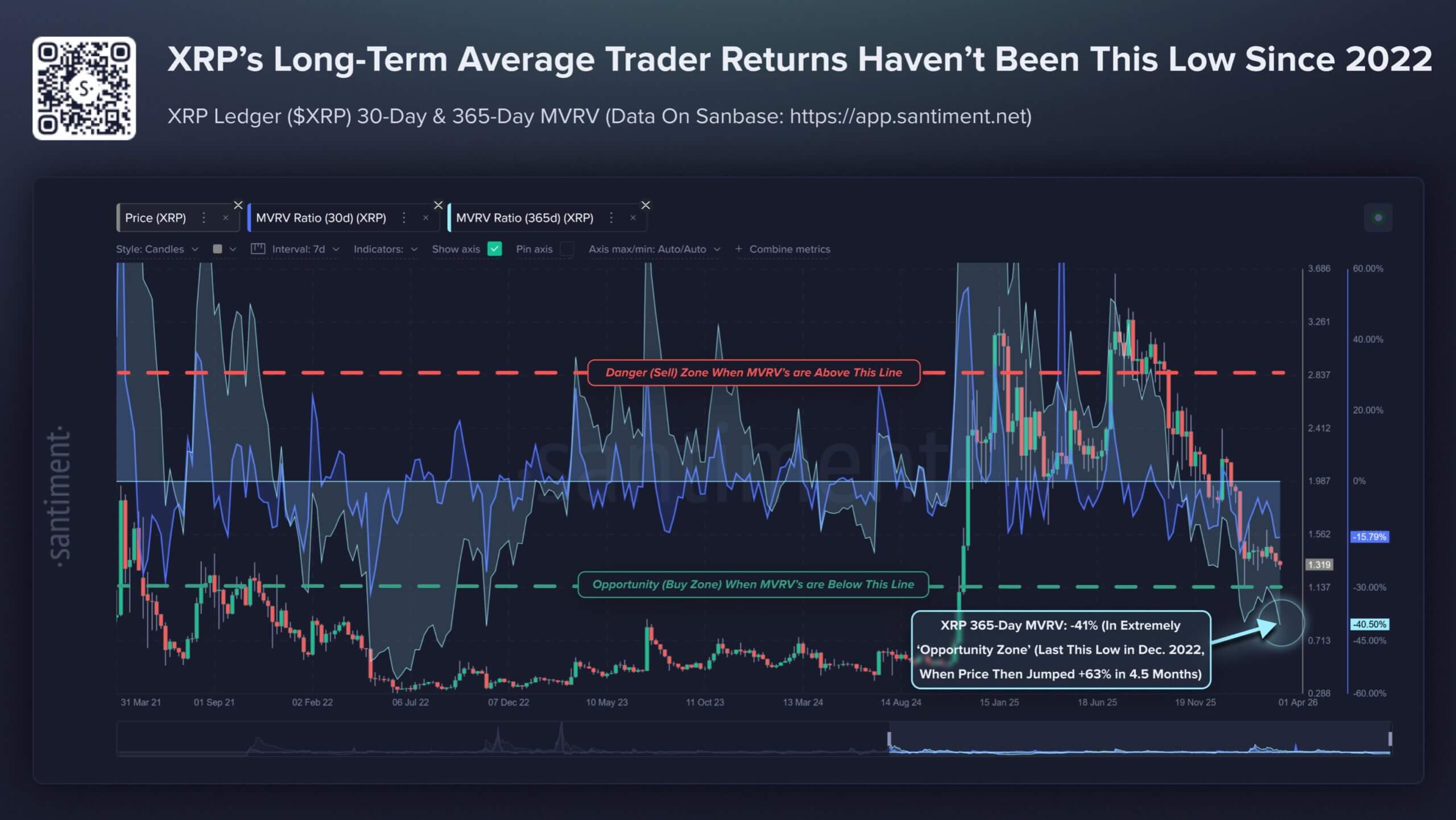 XRP’s Average Returns (Source: Santiment)
This effectively illustrates the extent to which the selloff has impacted recent positioning and why the market has struggled to establish a sustainable recovery.
Meanwhile, the broader cryptocurrency market context has not alleviated the situation. The XRP downturn has occurred during a wider risk-off phase across digital assets, with Bitcoin declining from above $126,000 to around $66,000.
In this environment, traders have shown less inclination to pursue assets without a clear near-term catalyst, particularly when holder behavior is already deteriorating.
Spot buyers are still present, but futures traders are not buying the turn
However, the XRP market is not entirely bearish.
CryptoQuant data reveal that the spot cumulative volume delta on Binance has risen to approximately $520.2 million, suggesting that buyers are still entering the market.
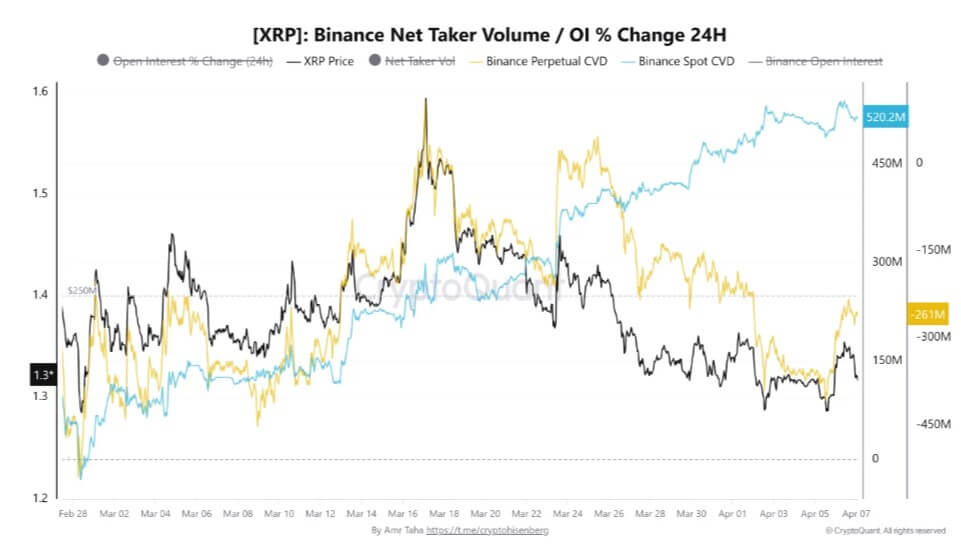 XRP Spot Demand on Binance (Source: CryptoQuant)
Related Posts
Simultaneously, the perpetual cumulative volume delta remains negative by about $261 million, indicating that leveraged traders have not significantly altered their positions.
This demonstrates that XRP continues to attract demand in the cash market, but the derivatives market has yet to validate that interest with the kind of aggressive repositioning that typically accompanies a stronger move.
This divergence helps clarify why XRP may appear supported yet remain weak. Spot demand can cushion prices and slow the rate of decline, but if futures traders continue to adopt a defensive stance, rallies often lack follow-through.
While the market can stabilize under these conditions, it frequently requires a new catalyst to transition into a more decisive trend.
Whale activity indicates a similar trend. CryptoQuant reported that daily whale inflows into Binance have decreased to about 12.6 million XRP, while the 30-day cumulative flow has dropped to around 1.44 billion XRP, down from approximately 2.6 billion XRP in March.
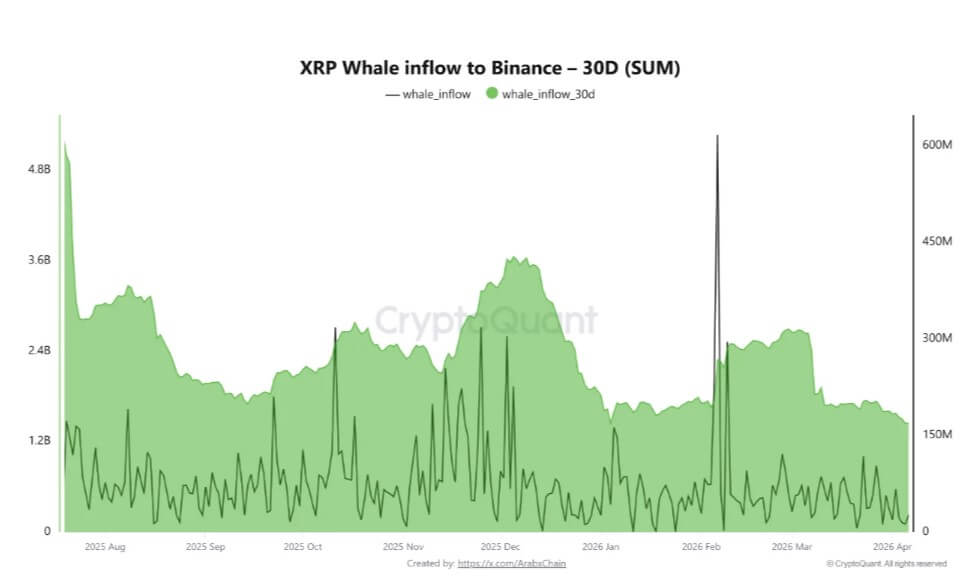 XRP Whale Inflow (Source: CryptoQuant)
Consequently, large holders are supplying less to exchanges, which diminishes one source of near-term selling pressure.
However, the reduced inflows do not automatically generate demand. They merely leave XRP in a market with less aggressive supply and still insufficient conviction.
This is why XRP continues to appear as an asset in limbo. The pressure from large holders has lessened. Genuine buyers remain active in spot markets.
Yet the token remains constrained by defensive leverage and a broader market that has not fully shifted back toward risk.
Ripple keeps building, but the token is still being priced like a stressed asset
The market’s reluctance is notable given that Ripple’s overall operational environment has improved.
The company, led by Brad Garlinghouse, concluded its multiyear legal battle with the US Securities and Exchange Commission (SEC) with a settlement following a series of favorable rulings, an outcome that has spurred renewed accumulation and provided XRP with its strongest performance in years.
Additionally, Ripple has pursued various acquisitions and licenses to broaden its product offerings and global presence.
Proponents of XRP contend that these developments should eventually have a more significant impact on price.
Asheesh Birla, CEO of XRP treasury firm Evernorth, noted that institutional momentum surrounding XRP is building at a rate not seen 18 months ago and described the financial framework around the asset as still being developed.
He highlighted regulatory advancements and increasing real-world blockchain activity as indicators that the structural environment is improving.
Nevertheless, the market has yet to reward XRP as if that re-rating has occurred. Data from SoSoValue indicates that XRP exchange-traded funds experienced their first monthly net outflow of over $31 million in March.
This breaks a period that had fueled a $1.2 billion inflow streak, making them one of the most successful early crypto product launches outside of Bitcoin.
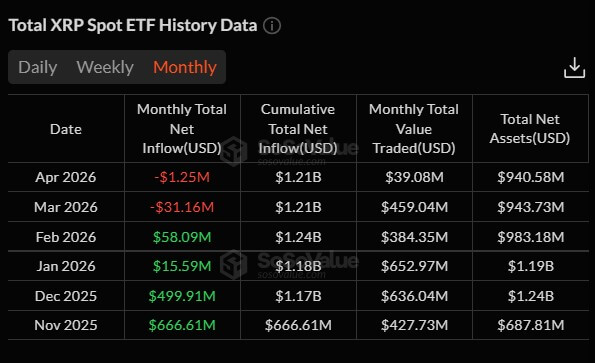 XRP ETFs Monthly Flows (Source: SoSoValue)
This outflow does not negate Ripple’s long-term progress, but it does indicate that investors remain cautious about assigning a near-term premium to the token.
This leaves XRP caught between two realities. Ripple’s legal clarity, capital raising, and institutional efforts provide a more constructive long-term outlook.
In the short term, however, XRP continues to trade like a crowded and distressed position, burdened by holders selling into weakness, a significant number of underwater buyers, and a derivatives market that has yet to confirm a turnaround.
The post XRP losses are forcing late buyers out, turning every bounce into a new sell zone appeared first on CryptoSlate.
