Disclaimer: Information found on CryptoreNews is those of writers quoted. It does not represent the opinions of CryptoreNews on whether to sell, buy or hold any investments. You are advised to conduct your own research before making any investment decisions. Use provided information at your own risk.
CryptoreNews covers fintech, blockchain and Bitcoin bringing you the latest crypto news and analyses on the future of money.

US inflation rises to 3.3%, marking the steepest increase since 2021 – yet Bitcoin shows minimal fluctuation.

The inflation data for March has produced a mixed outcome with one immediate effect. US consumer prices increased significantly enough to keep the Federal Reserve constrained, while the softer core figure maintains the focus on the upcoming month as a critical evaluation point.
This tension extends beyond macroeconomic schedules. Bitcoin has been navigating through interest rates, liquidity, and monetary pricing for much of 2026. When inflation rises due to increased fuel costs, the resulting chain reaction flows from the gas station to bond yields, impacting risk appetite, and subsequently affecting the cryptocurrency market.
The March statistics indicate that the headline CPI rose by 3.3% year-over-year, up from 2.4% in February, while the monthly CPI recorded an increase of 0.9%. Core CPI increased by 2.6% year-over-year and 0.2% month-over-month.
This surge marks the largest single-month rise since March 2021.
This situation presents two concurrent realities. Inflation has surged, and the increase appears concentrated enough that the data for April and May will determine whether this is merely a sharp energy shock or the onset of a broader trend.
For Bitcoin, this distinction influences liquidity dynamics, the likelihood of interest rate relief, and the potential for any recovery rally to continue its ascent.
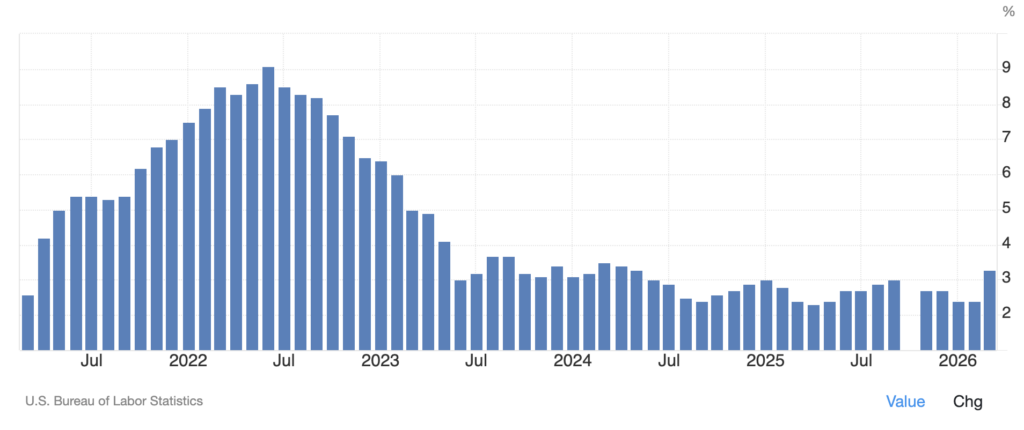 US inflation over the last 5 years (Source: Trading Economics)
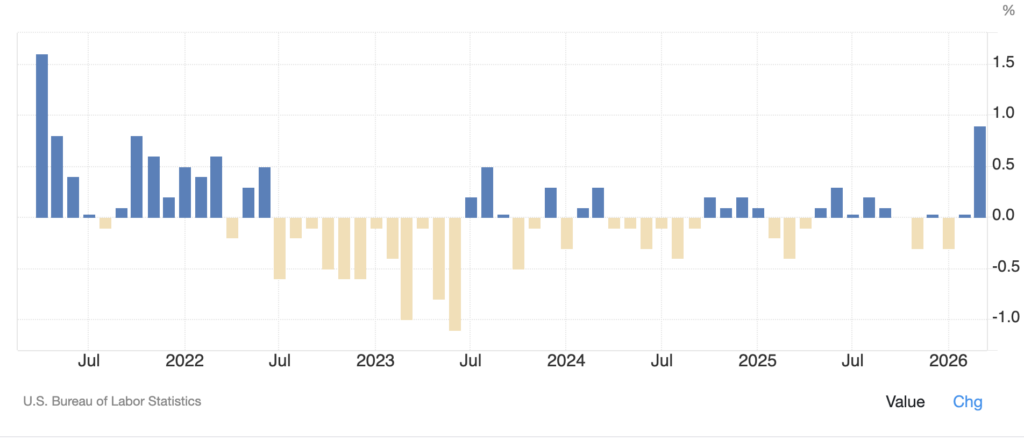 US inflation change over the last 5 years (Source: Trading Economics)
Inflation surged where households experience it first, and Bitcoin feels the impact subsequently
The simplest way to interpret this data is to begin outside the financial realm. US gasoline prices climbed back above $4 per gallon in early April, following the March energy shock triggered by disruptions around the Strait of Hormuz. OECD estimates already reflect this broader energy shock, with G20 inflation now anticipated to be 4.0% in 2026, which is 1.2 percentage points higher than the group’s earlier forecast.
In straightforward terms, households experienced rising fuel costs first, and the CPI report eventually aligned with what drivers had already recognized.
This transmission mechanism is where cryptocurrency comes into play. Bitcoin can appreciate in value during inflationary periods when the market is focused on fiat currency dilution, limited supply, and the worth of tangible assets. In this cycle, the market has navigated through a different process.
Bitcoin has acted much more like a risk asset sensitive to interest rates, as noted by CryptoSlate, after job revisions and softer inflation data shifted market attention back to discount rates and financial conditions.
A strong CPI report, particularly one influenced by fuel prices, raises the threshold for easier monetary policy. This increases the cost of patience for every asset reliant on looser policies and improved liquidity conditions.
The March report intensifies that tension. Headline inflation was notably high, precisely where households feel the impact. Core inflation remained softer, leaving the possibility open for a one-time shock.
For the markets, the next consideration revolves around the Federal Reserve and the forthcoming inflation data. For Bitcoin holders, the practical implications are even more straightforward.
A rally reliant on easier monetary conditions becomes more challenging to maintain when inflation surges back into the economy through energy, transportation, and the cost base that influences everything else.
This also clarifies why consensus offers limited reassurance in this context. The concern lies with both the level and the trajectory. Inflation has re-accelerated. The increase was substantial enough to maintain pressure on real yields and the overall cost of capital, even if economists had already anticipated a strong report.
CryptoSlate’s coverage in March highlighted a similar dynamic during the oil crisis, when Bitcoin declined instead of functioning as a safe haven. The market perceived the shock primarily as a liquidity issue, and the March CPI adds another layer of evidence supporting that view.
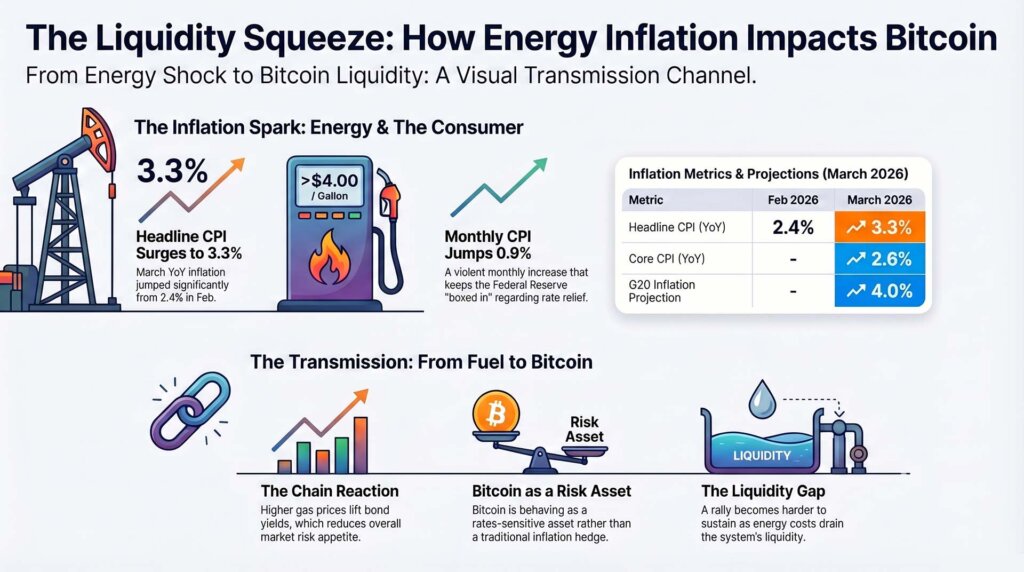 Infographic showing how an energy-driven inflation spike could tighten liquidity and pressure Bitcoin through higher CPI, rising oil prices, and reduced market risk appetite.
The Fed has already adopted a hawkish stance, and this report maintains the burden of proof on disinflation
Related Posts
The Federal Reserve entered April with a constrained path. In the March Summary of Economic Projections, officials raised their inflation outlook for 2026 while still indicating a year-end fed funds median of 3.4%, with PCE inflation at 2.7% and core PCE also at 2.7%.
This forecast conveyed a clear message. Inflation was expected to remain above target, and any policy relief would be gradual, if it occurred at all. The March CPI report adds pressure to that framework as it heightens the risk that energy keeps inflation elevated long enough to solidify the Fed’s position.
This risk is central to Bitcoin’s macroeconomic challenges. When policymakers are concerned that energy shocks will influence broader price levels, they are reluctant to ease monetary policy. When they hesitate to ease, real yields remain stable, and the threshold for risk stays elevated.
Consequently, Bitcoin must navigate with less support from the macroeconomic environment. CryptoSlate’s recent stagflation analysis has already framed this dilemma after markets shifted from anticipating cuts to considering a much more restrictive trajectory. The March CPI keeps that pressure ongoing.
Core inflation serves as the only immediate counterbalance. A 0.2% monthly core reading and a 2.6% annual core reading indicate that the shock has not yet fully permeated the entire inflation basket. This creates a live divide between the household distress of headline inflation and the narrower policy question of persistence.
The Fed will focus on whether services, wage-sensitive categories, and the broader core complex begin to re-accelerate. Bitcoin holders should be concerned for the same reason. If March proves to be a temporary spike, the market can start to rebuild a case for easier financial conditions later in the year. If April continues the trend, the path tightens once more.
This is where the upcoming checkpoints carry greater significance than the March report alone. Future BLS releases, the next PCE report, and the FOMC meeting on April 28-29 will determine whether this was a sharp energy spike or the onset of a more extensive price issue.
Oil prices have already reacted to ceasefire announcements and renewed skepticism regarding whether shipping disruptions will genuinely ease. Oil volatility surrounding the ceasefire keeps the data relevant, as every fluctuation in crude oil impacts the inflation trajectory the Fed is attempting to assess.
For the time being, Bitcoin remains affected by this process.
Bitcoin still has one buffer, and it now requires macro pressure to ease quickly
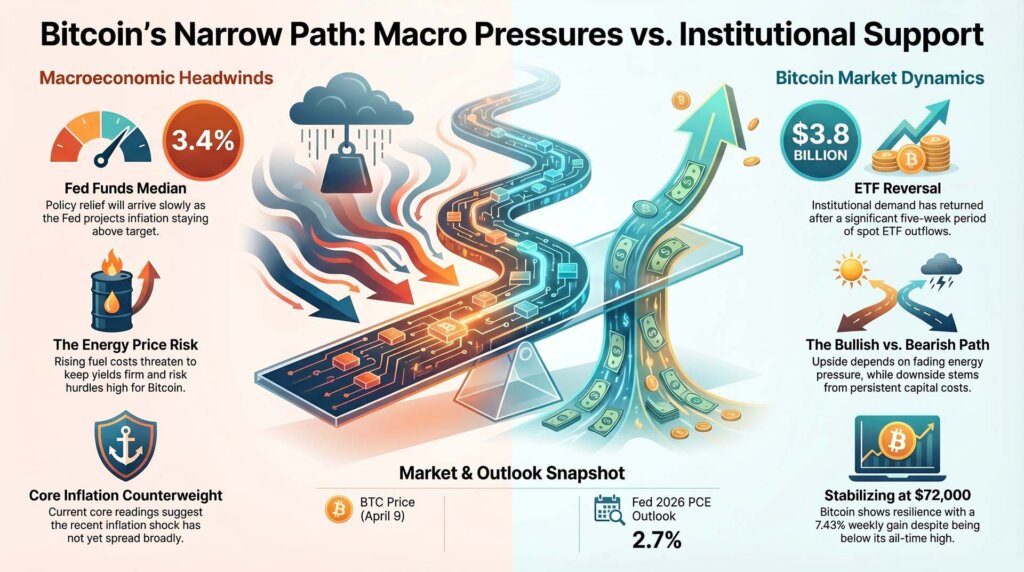 Illustration of Bitcoin caught between macro headwinds and institutional ETF support, showing inflation, energy-price pressure, and a split bull versus bear path.
Bitcoin entered April in a more favorable position than the first quarter suggested. On CryptoSlate’s Bitcoin price page, following the inflation data release, BTC was trading around $72,100, reflecting an increase of approximately 1% over 24 hours, 7% over 7 days, and 4% over 30 days, while remaining 43% below its all-time high of $126,198 reached in October 2025.
This profile conveys its own narrative. Bitcoin has stabilized, although the recovery still leaves limited capacity to absorb another macro headwind without assistance.
The primary support has stemmed from institutional demand, which has resurfaced after a challenging period for ETF flows. CryptoSlate documented around $3.8 billion in spot Bitcoin ETF outflows over five weeks, then tracked the reversal as buyers returned to regulated products.
This shift carries significant weight because the market structure surrounding Bitcoin now relies heavily on regulated capital flows and less on purely crypto-native speculation. When the ETF pipeline is active, Bitcoin can better withstand macroeconomic pressures. When that pipeline constricts, every inflation shock has a more profound impact.
This leaves Bitcoin precariously balanced within a narrow but understandable framework. The bullish trajectory begins with a reduction in energy pressure, stabilization of headline inflation, and core inflation remaining contained enough for markets to regain confidence in eventual policy relief.
The bearish trajectory begins with fuel costs further impacting transportation, services, and inflation expectations, maintaining firm yields and compelling risk assets to operate under tighter financial conditions for an extended period. CryptoSlate’s oil analysis outlined a similar structure weeks ago, when oil prices exceeding central bank assumptions raised the bar for any immediate recovery in Bitcoin.
The pressing question now revolves around the outcome. The March CPI has already informed the market that inflation has surged. The next layer inquires whether this surge remains concentrated enough to diminish or continues to spread throughout the economy.
For Bitcoin, this distinction determines whether April will serve as a reset month that paves the way for easier monetary conditions or another reminder that the asset remains tethered to the cost of capital and the discipline of macroeconomic data.
The forthcoming readings on inflation, oil, and Federal Reserve communications will dictate which path gains dominance.
The post US inflation soars to 3.3% in largest jump since 2021 – so why did Bitcoin barely move? appeared first on CryptoSlate.
