Disclaimer: Information found on CryptoreNews is those of writers quoted. It does not represent the opinions of CryptoreNews on whether to sell, buy or hold any investments. You are advised to conduct your own research before making any investment decisions. Use provided information at your own risk.
CryptoreNews covers fintech, blockchain and Bitcoin bringing you the latest crypto news and analyses on the future of money.

Falling GPU Rental Prices Threaten AI Infrastructure Providers as New Hedging Instruments Emerge

Companies developing AI applications can rent powerful computing resources rather than purchasing the hardware themselves, paying for access to the graphics processing units (GPUs) that run their software.
Lower rental prices reduce operational costs for these applications, but they can also create financial strain for the companies that purchased the machines and rely on rental income to service their debts.
If a company has financed a data center full of GPUs based on the assumption that customers will pay a specific hourly rate, a cheaper competitor can disrupt those projections long before the equipment is paid off. The machines may still function perfectly, and demand for AI may remain strong, but the revenue generated per hour could drop below the level required to sustain the business.
Financial contracts can provide a mechanism to protect a portion of this income by arranging payments when rental prices fall, in exchange for assuming corresponding obligations. This is the fundamental concept behind AI compute derivatives, which allow businesses to trade their exposure to computing prices independently of the physical rental of computers.
Luxor, a provider of services and financial products to Bitcoin miners, has integrated these contracts into its latest expansion into the AI sector. The company sees an opportunity to apply its experience in hedging mining revenue to another industry that incurs heavy upfront costs for machinery before revenue streams are established.
Luxor told CryptoSlate that it is already brokering agreements between owners of computing capacity and customers seeking to utilize it.
However, its cash-settled derivatives business remains in its early stages. The company stated it could not provide a specific customer hedge example or current derivatives trading volumes because a liquid market has not yet formed.
This presents a significant commercial challenge: persuading one party to accept losses that another business wishes to avoid.
While establishing these arrangements could help operators plan around more predictable income, the reliability of the protection depends entirely on the price used for calculations and the creditworthiness of the party responsible for making payments.
Locking in rental income without locking in a specific customer
The traditional method for stabilizing rental income is to secure customers with longer-term contracts at agreed-upon prices. This provides customers with guaranteed access to machines while giving operators a commitment they can use for business planning.
This approach works well when both parties desire the same arrangement, but customers may not know their computing needs far into the future. Operators may also prefer to maintain flexibility by selling capacity to various users.
Cash-settled derivatives offer an alternative. These contracts pay out money based on a price formula without requiring the exchange of computing capacity. An operator can continue renting its GPUs to customers while using a separate financial agreement to offset fluctuations in rental rates.
Consider an operator expecting to sell 1 million GPU-hours in a month, where one GPU-hour represents access to one processor for one hour. At $2 per hour, this would generate $2 million in rental income. The operator enters a hypothetical contract designed to protect this rate.
If the agreed market benchmark falls to $1.50, the contract pays the operator the 50-cent difference across the million hours, totaling $500,000. Assuming the operator’s actual rental income also drops to $1.5 million, this payment restores the combined total to $2 million, excluding fees and other costs.
The obligation works in both directions. If the benchmark rises to $2.50, the operator owes $500,000 while earning more from its customers. This sacrifices the benefit of higher rates in exchange for protection against lower ones, making revenue more predictable.
This is a simplified explanation; the actual result depends on the operator selling the expected hours at a rate that tracks the benchmark. Idle machines generate no rental income, so fixing the hourly price does not guarantee sales.
A counterparty must have a reason to accept the opposite payments. An AI business concerned about rising computing costs might find this attractive. Its financial contract would pay out when the benchmark increases, helping to cover higher rental bills, while a price drop would create a payment obligation alongside cheaper computing costs.
Dealers can facilitate these connections or assume some of the exposure themselves, charging for the risk they carry. However, customers must pay a price for the amount of protection they require, covering the period during which their business needs it.
CME Group is developing an exchange-traded version of this concept through its announced H100 and B200 rental-index futures. Its August 11 announcement targeted October 5, subject to regulatory review, for contracts tied to Silicon Data’s GPU rental benchmarks. However, listing a contract does not guarantee sufficient participation to ensure easy trading.
Related Reading
Bitcoin miners are getting a new AI hedge, but it may protect them from the wrong risk
Your GPU hour may differ from mine
Related Posts
Even with willing counterparties, the payment formula requires a price that both sides consider relevant to their business.
In the previous example, the hedge works perfectly because the operator’s rental income moved in exact lockstep with the benchmark. However, perfect conditions are difficult to replicate once actual customers enter the picture.
Suppose customers negotiate rates down to $1.25 while the benchmark only falls to $1.50, perhaps because the index covers a different service or type of equipment. The same $500,000 hedge payment would bring the $1.25 million in rental income to $1.75 million, leaving a gap even though the contract functioned as written.
This mismatch is known as basis risk, meaning the price protected against does not move exactly like the price actually received. Compute hedges can leave Bitcoin miners exposed, which is why a hedge must be evaluated against the specific business using it.
Luxor compared its AI ambitions to its history in Bitcoin mining, where publishing a reference price helped establish a foundation for financial contracts. Its “hashprice” metric estimates what a unit of computing power can earn from mining Bitcoin, providing operators with a shared revenue reference even when their individual operating costs differ.
Bitcoin miners perform the same network task, whereas AI customers may assign different values to access that appears similar on a specification sheet. Someone purchasing uninterrupted access for months is buying a different service from someone willing to have a short job interrupted whenever the provider needs the machines back.
Price providers already account for such differences. CCIR’s rental-data methodology treats interruptibility and commitment length as separate characteristics. It uses publicly advertised rates, which means the figures may not capture privately negotiated discounts.
The index Luxor provided in its response was its AI Hardware Price Index, which measures advertised prices for selected GPU systems. While this helps assess equipment purchases, buying a machine and earning rent from it involve different price dynamics, so the link does not establish how an AI rental hedge would settle.
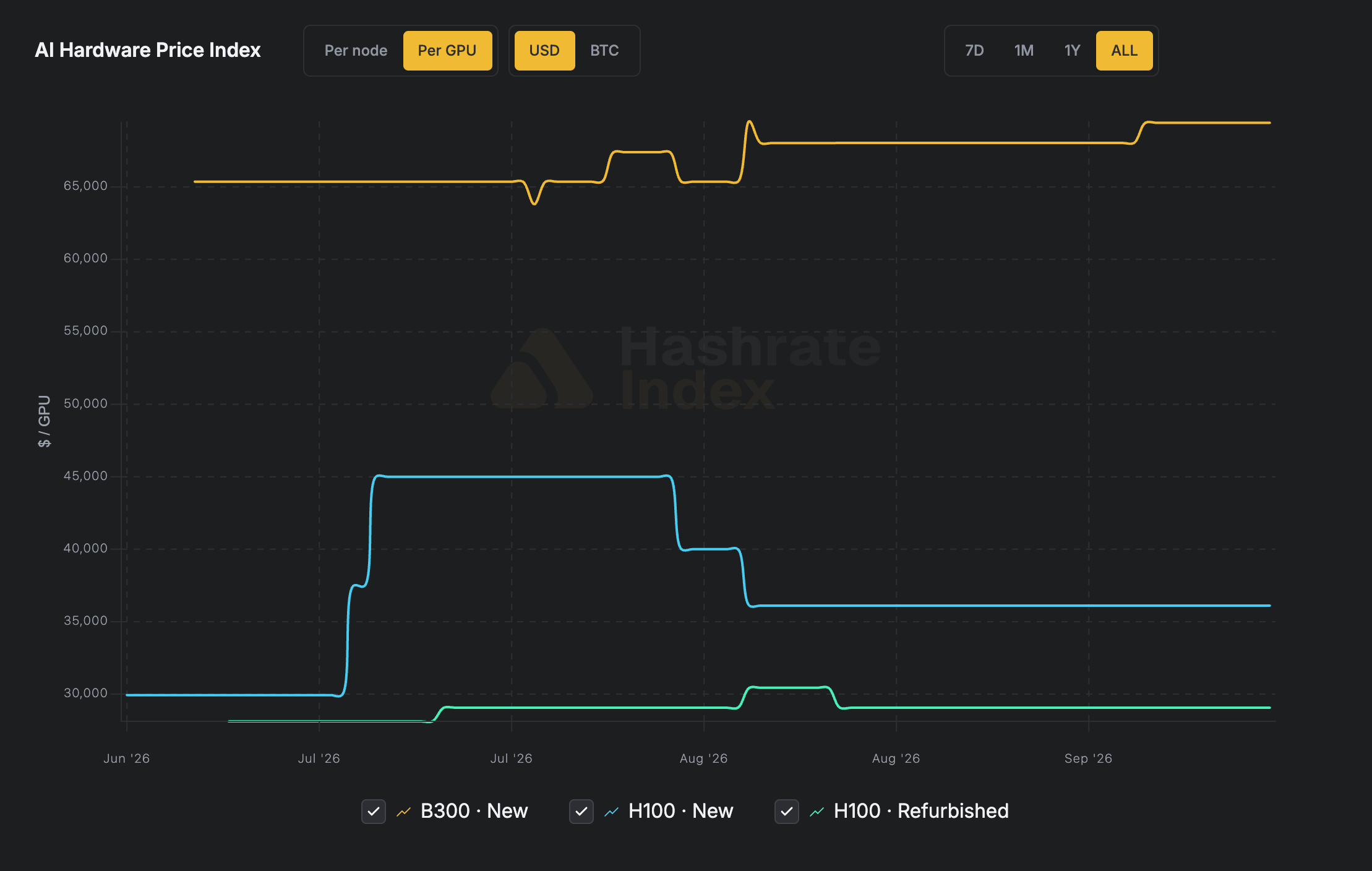
B300 prices climbed toward $69,000 as new and refurbished H100s settled near $36,000 and $29,000.
Luxor’s August data announcement indicated that expanded compute spot pricing would be forthcoming. Operators seeking to protect income would still need contracts that specify a rental benchmark and demonstrate that it tracks what customers actually pay.
Narrower benchmarks might offer better fits, but each additional contract divides potential trading among smaller groups. Building this market requires a compromise between closely matching each customer’s business needs and bringing enough participants together under a single contract to make trading affordable.
The protection must survive the bad month
Even a closely matched contract leaves the operator relying on the counterparty’s ability to pay when rental income declines.
If that counterparty also derives much of its revenue from AI infrastructure, cheaper computing could damage both businesses simultaneously, precisely when one expects support from the other.
Collateral can reduce this dependence by requiring money or eligible assets to be posted against obligations, giving the recipient assets to draw upon if the other party defaults. It also creates a financing requirement, as funds committed to the hedge cannot simultaneously be used to pay the operator’s other bills.
In the scenario where rental prices increase, the operator might need to pay its hedge obligation before customers settle their higher invoices.
The overall economics might still hold even if the bank account runs short, making the timing of cash flows a critical factor in the affordability of the protection.
Luxor did not provide the requested AI collateral terms or explain the procedures for a counterparty failing to pay. Its reply also left unanswered how it separates its own trading activities from the business it arranges for customers, a relevant distinction given that the launch announcement disclosed an internal compute trading fund.
More predictable rental income could give operators greater confidence in meeting debt payments, even when customers become less willing to pay previous rates.
Achieving this benefit requires a contract that tracks income closely enough, with payment obligations the operator can afford throughout the protection period.
Cheaper computing could enable more people to build and use AI, while leaving some machine owners with disappointing returns.
Financial contracts will not eliminate these losses, but they could transfer part of the risk to someone prepared to bear it, giving the operator more flexibility to continue serving customers when rents fall.
The post Plunging GPU prices threaten AI hosts, and new hedges step in appeared first on CryptoSlate.
