Disclaimer: Information found on CryptoreNews is those of writers quoted. It does not represent the opinions of CryptoreNews on whether to sell, buy or hold any investments. You are advised to conduct your own research before making any investment decisions. Use provided information at your own risk.
CryptoreNews covers fintech, blockchain and Bitcoin bringing you the latest crypto news and analyses on the future of money.

Investors injected $3 billion into Binance following Bitcoin’s rise to $72,734 amid ceasefire reports – what are their expectations?

Bitcoin surged back above $70,000 on Wednesday following reports that the United States and Iran had reached a Pakistan-mediated two-week ceasefire related to the reopening of the Strait of Hormuz.
As per data from CryptoSlate, the leading cryptocurrency increased by 5% to a high of $72,734 before pulling back to $71,477 at the time of reporting.
Why this matters
Bitcoin’s rise was not an isolated event. The ceasefire announcement impacted oil, inflation expectations, equities, and cryptocurrencies simultaneously. This indicates that the movement is more than just a price fluctuation; it serves as an initial test of whether alleviating macroeconomic pressures can facilitate capital flow back into risk assets, or if traders were merely responding to fear.
Data from CryptoQuant indicated that within two hours of the announcement, Bitcoin recorded approximately $3 billion in taker buy volume on Binance’s derivatives markets, reflecting how swiftly investors adjusted their positions, hoping for a positive evolution of the situation.
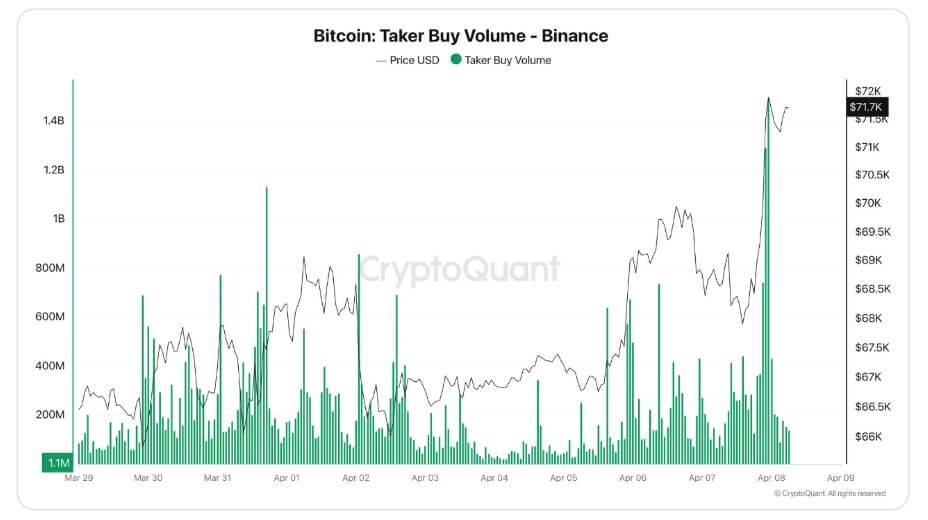 Bitcoin Taker Buy Volume (Source: CryptoQuant)
Simultaneously, the truce announcement also catalyzed a widespread relief rally across global markets. Brent crude oil prices fell by 13.8% to $94.25, while US crude dropped by 15.4% to $95.52. In contrast, Germany’s DAX rose by 4.7%, Japan’s Nikkei 225 increased by 5.4%, and South Korea’s Kospi surged by 6.9%.
 Related Reading
Why Bitcoin’s $72k breakout started before Trump’s ceasefire post in the craziest trading day in years
Trump issued warnings of disaster, yet oil and Bitcoin were already indicating a different narrative.
Apr 8, 2026 · Liam 'Akiba' Wright
Nonetheless, Bitcoin’s recent rise above $70,000 is not the first instance where the leading digital asset has surpassed this level following indications of peace in the US-Iran conflict.
Maksym Sakharov, co-founder and group CEO of WeFi, shared with CryptoSlate:
“Whenever there’s tension — geopolitics, macro, and even institutional or micro — the weak investors and traders are always shaken out. The fear is now partly gone with the ceasefire news, but holding onto the $70,000 mark would take more than just a ceasefire.”
This raises the question of whether the current rally can be maintained or if BTC will face another sell-off.
 Related Reading
Why Bitcoin briefly jumped above $70,000 on Iran deal hopes as Trump’s Hormuz threat keeps rally fragile
Oil prices near $112 and impending CPI and Fed decisions could determine whether this rebound endures or leads to a deeper decline.
Apr 6, 2026 · Oluwapelumi Adejumo
Oil is still the first link in the chain
The Strait of Hormuz remains pivotal in assessing whether BTC can maintain its current upward trajectory.
Approximately 20% of global oil exports transit through this waterway, making any disruption there a direct threat to energy prices, freight costs, and inflation expectations.
During the recent escalation, reports indicated that around 130 million barrels of crude and 46 million barrels of refined fuel were stranded on approximately 200 tankers in the Gulf due to disrupted traffic.
This led to Brent prices surging by 55% since February 28, with some physical oil markets pricing crude near $150 a barrel prior to the ceasefire announcement.
This context helps clarify why the market reaction was so pronounced once the truce was reported. A decrease in oil prices not only mitigates one source of headline risk but also alleviates one of the most immediate threats to the global macroeconomic outlook: a prolonged energy crisis could reignite inflation just as central banks were seeking to loosen monetary policy.
Related Posts
Notably, Chicago Fed President Austan Goolsbee had cautioned that the conflict was creating a stagflation shock, while research from the Dallas Fed suggested that a prolonged disruption in Hormuz could push US headline inflation above 4% by year-end.
However, with the new peace agreement, Josh Gilbert, market analyst at eToro, informed CryptoSlate that the decline in oil prices indicated that markets had begun to factor in a reopening of Hormuz.
He noted that this lower oil price is generally beneficial for global markets as it alleviates pressure on consumers, moderates inflation expectations, and removes one of the headwinds that had burdened equities in recent weeks.
For Bitcoin, this shift is critical. The leading asset did not rise as oil prices increased and war fears escalated. However, it reacted positively when oil prices fell, equities advanced, and investors began to anticipate a less severe inflation shock.
Related Reading
Why Bitcoin briefly jumped above $70,000 on Iran deal hopes as Trump’s Hormuz threat keeps rally fragile
Oil prices near $112 and impending CPI and Fed decisions could determine whether this rebound endures or leads to a deeper decline.
Apr 6, 2026 · Oluwapelumi Adejumo
Price is back above $70,000, but the support is uneven
Bitcoin’s recent ascent past the $70,000 mark was significant, yet the trading pattern indicates that conviction remains limited.
Earlier this month, Glassnode explained that Bitcoin was confined within a $60,000 to $70,000 range, with approximately 8.4 million BTC still underwater and a substantial supply cluster positioned above the market between $80,000 and $126,000.
This creates two simultaneous constraints. First, it implies that many holders are still seeking higher prices to mitigate losses or exit. Second, it suggests that any movement beyond $70,000 will encounter considerable overhead supply before it can evolve into a more sustained trend.
In addition, institutional interest in the leading cryptocurrency remains inconsistent as the digital asset continues to experience significant inflows and outflows.
US spot exchange-traded fund data compiled by SoSoValue has shown sharp fluctuations in recent weeks, with the nine funds recording a $173.7 million outflow on April 1, followed by a $471.4 million inflow on April 6, and then renewed outflows on April 7.
These figures indicate that the leading cryptocurrency is still not receiving robust institutional backing. A market that can sustain levels above $70,000 for weeks typically exhibits a more stable pattern of spot demand than one that alternates between large inflows and outflows over a few sessions.
Moreover, derivatives data also suggest that traders are not viewing the latest movement as a confirmed breakout.
Greeks.live reported that Bitcoin’s rise toward $72,000 improved sentiment primarily by alleviating fears of a black swan-style crash rather than fostering expectations for a sustained upward trend.
The firm noted that BTC’s implied volatility on major-expiry options continued to decline, while near-expiry implied volatility also fell.
It added that while the negative skew eased as the price increased, the broader message from options positioning was that traders had become less fearful of an immediate collapse, not convinced of a lasting upside trend.
What next for Bitcoin?
For Bitcoin to remain above $70,000 in the coming two to six weeks, the ceasefire must achieve more than just surviving the initial headline cycle. Tanker traffic through Hormuz would need to return to normal.
Oil prices would need to stay below the recent panic zone near or above $109. Inflation concerns would need to subside rather than reaccelerate. ETF flows would need to maintain a positive balance, rather than oscillate between one-day surges and one-day withdrawals.
If these conditions are met, Bitcoin could have a viable path to trade within a $70,000 to $78,000 range, with potential movement toward the low $80,000s if spot demand strengthens and derivatives positioning shifts away from a defensive stance.
Andre Dragosch, Bitwise’s head of research in Europe, stated that a sustainable break above $80,000 would likely shift market sentiment from bearish to bullish, as several key valuation and cost-basis markers converge around that level.
However, if the ceasefire collapses, shipping disruptions return, and crude prices rebound, the cryptocurrency could fall back into the $62,000 to $69,000 range that characterized the market prior to this week’s movement.
The post Traders poured $3 billion into Binance after Bitcoin hit $72,734 on ceasefire headlines – what are they betting on? appeared first on CryptoSlate.
