Disclaimer: Information found on CryptoreNews is those of writers quoted. It does not represent the opinions of CryptoreNews on whether to sell, buy or hold any investments. You are advised to conduct your own research before making any investment decisions. Use provided information at your own risk.
CryptoreNews covers fintech, blockchain and Bitcoin bringing you the latest crypto news and analyses on the future of money.


The small Himalayan nation of Bhutan has long been acquainted with Bitcoin. However, a recent explosive report from Forbes has revealed the extent of the Kingdom’s clandestine mining activities.
The Kingdom itself disrupted an inquiry into Bhutan’s purported mining initiative by confirming to a local publication that it was involved in the mining of digital assets. The CEO of Druk Holding & Investments (DHI), Bhutan’s state-owned holding entity, stated that the company ventured into the mining sector “a few years ago” when Bitcoin was valued at approximately $5,000.
This aligns with information disclosed by sources knowledgeable about the situation, who informed Forbes that the nation has been establishing sovereign mining operations since at least 2020.
Nonetheless, Bhutan’s engagement in the cryptocurrency sector extends beyond this.
Insights into Bhutan’s expanding mining operation
Initial suspicions regarding the country’s mining involvement arose in 2021 when the Department of Revenue and Customs reported importing $51 million worth of “processing units.” This marked a considerable increase from the $1.1 million worth of these units imported in 2020. In 2022, the nation imported $142 million worth of computer chips, accounting for just over 10% of its total inbound trade and 15% of its $930 million annual budget.
As per the Ministry of Finance’s 2022 macroeconomic report, total imports in 2022 rose by 35.8% compared to 2020. The main contributor to this growth was the “processing and storage units” that DHI imported for “special projects.”
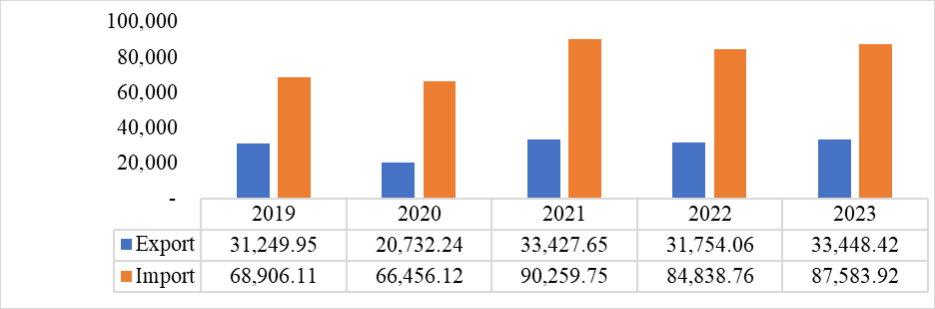 Chart illustrating Bhutan’s trade performance from 2019 to 2023 (Source: The Kingdom of Bhutan, Department of Macroeconomic Affairs)
Further examination revealed that Bhutan categorized these processing units under the same export classifications utilized by Bitcoin mining hardware manufacturers in Asia. Official data indicating that nearly all of these units were sourced from Hong Kong and China confirmed suspicions that these were, in fact, ASIC miners.
The nation’s involvement in mining was reaffirmed in Bitdeer’s recent SEC filing. The NASDAQ-listed firm disclosed that out of the planned 500 MW increase in power supply for this year, approximately 100 MW will be sourced from Bhutan.
“We anticipate generating 100 MW out of the 550 MW power supply from Bhutan, where the construction of the mining data center is expected to commence in the second quarter of 2023 and conclude in the third quarter of 2023.”
Bitdeer ranks among the largest Bitcoin miners globally, with its total hash rate comparable to that of Core Scientific, Riot, and Marathon. About 25% of Bitdeer’s hash rate capacity is allocated for self-mining, while the remainder is utilized for cloud mining. Neither Bitdeer nor Bhutan has provided comments on the situation, leaving it uncertain who will utilize and possess the additional hash rate.
Confidential sources have also indicated that Bhutan’s government has been in discussions with other mining firms aside from Bitdeer. Sources from other mining services and pools mentioned they held “advanced talks” with senior government officials, including representatives from DHI, regarding the establishment and operation of a hydro-powered mining facility in Bhutan. The country has also engaged consultants to advise on its mining strategy. They informed Forbes that Bhutan had been exploring “a 100 MW operation connected to a hydroelectric plant” prior to Bitdeer’s announcement.
Related Posts
Bhutan appears to have been actively working to attract more independent miners to the nation. The Singapore Bhutan Association, a consortium of several businessmen from China and Singapore supported by a member of the Bhutanese royal family, proposed a lucrative mining venture to external investors last year. The pre-installed containers would house 250 ASIC T17+ miners, generating around 700 kW of electricity. The return on an $800,000 investment for a single container was projected to take between 12 and 18 months, with the company retaining 10% of the mined coins to cover maintenance and foundational expenses.
Dasho Ugen Tsechup Dorji, vice chairman of the Singapore Bhutan Association and uncle of Bhutan’s king, informed Forbes that the project is currently on hold. He stated that the Bhutanese government has not authorized “the private sector to engage in this business.” Humphrey Chan, a board member of the Association, noted that the collapse of FTX and logistical challenges “had dampened investor interest.”
Funding the fourth industrial revolution in Bhutan
Despite Bhutan’s success in averting a widespread pandemic, the small landlocked nation faced severe economic repercussions following its two-year isolation. While it remains uncertain if this was the primary catalyst for its efforts to enhance mining, its engagement with the cryptocurrency sector has indeed intensified over the past two years.
Sources familiar with the situation informed Forbes that the pandemic served as a trigger for senior Bhutan officials to initiate discussions with miners and mining suppliers.
Court documents reviewed by Forbes indicated that Druk Holding & Investments was a client of BlockFi and Celsius. In February 2023, BlockFi filed a complaint against DHI, alleging the fund defaulted on a $30 million loan repayment. DHI reportedly borrowed 30 million USDC in February 2022, using 1,888 BTC as collateral. The complaint claims that DHI “failed and refused” to repay the loan even after BlockFi liquidated the collateral, which was valued at approximately $76.5 million at the time of the loan, leaving an outstanding balance of around $830,000.
In October 2022, Celsius released records indicating that DHI was one of its institutional clients. The documents revealed that DHI and another account known as the “Druk Project Fund” deposited, withdrew, and borrowed BTC, ETH, USDT, and other cryptocurrencies between April and June 2022. During the three months detailed in the Celsius filing, Forbes reported that Druk withdrew over $65 million and deposited nearly $18 million in digital assets.
Ujjwal Deep Dahal, the CEO of DHI, stated that the borrowed funds were utilized to “make certain investments” and that “everything has been paid back and settled with no dues.”
DHI asserts that it did not incur any losses on the loans from Celsius and BlockFi, with Dahal suggesting that the fund utilized revenues from its Bitcoin mining activities to offset losses.
Bhutan’s discreet entry into the cryptocurrency sector has faced criticism from various quarters. It appears that DHI did not disclose any of its dealings with Celsius and BlockFi, and the Ministry of Finance never clarified the purpose of the $142 million worth of computer chips it imported.
While some have criticized the lack of transparency, many seem more concerned about the volatility of the cryptocurrency market and its potential impact on the nation’s struggling economy.
Dahal stated that DHI maintains a diverse portfolio and does not perceive the risks associated with mining and managing cryptocurrencies to be greater than those linked to any other asset class. The company believes it has mitigated most of the risks associated with cryptocurrencies as it does not engage in trading but mines cryptocurrencies “at a relatively low cost using green energy.”
Mining is part of DHI’s “future-facing investment strategy” aimed at supporting what the country refers to as the fourth industrial revolution. Bhutan’s economic stagnation has triggered a significant wave of migration, prompting the government to intensify efforts to cultivate a competitive tech industry that could lead to economic self-sufficiency.
The post Inside Bhutan’s secretive Bitcoin mining operation appeared first on CryptoSlate.
