Disclaimer: Information found on CryptoreNews is those of writers quoted. It does not represent the opinions of CryptoreNews on whether to sell, buy or hold any investments. You are advised to conduct your own research before making any investment decisions. Use provided information at your own risk.
CryptoreNews covers fintech, blockchain and Bitcoin bringing you the latest crypto news and analyses on the future of money.

Hour by Hour: Oil Drops Below $100 a Barrel as Bitcoin Surpasses $71,000 in Unusual After-Hours Trading

Bitcoin, SPY, and crude oil followed a singular overnight pivot as Trump transitioned from existential rhetoric to a two-week Iran ceasefire
Markets spent the night adjusting to a singular geopolitical factor instead of focusing on growth, inflation, or crypto-specific risks.
After employing unprecedented and incendiary language earlier in the day, once Donald Trump indicated a two-week ceasefire with Iran, the war premium embedded in crude, equities, and Bitcoin unwound almost instantly, transforming what had appeared to be a disjointed macro session into a synchronized cross-asset reversal.
Why this is significant
This was not merely another volatile overnight session. Markets swiftly recalibrated the likelihood of a broader Middle East conflict, which first impacted oil, subsequently boosted equities, and allowed Bitcoin to function as a higher-beta relief asset rather than merely a crisis hedge.
 Related Reading
Bitcoin holds at $68,000 as Trump’s final Iran deadline expires at 8 PM EST and oil surges
With shipping chokepoints in play, the next escalation could transform this “stable” range into a sudden drop.
Apr 7, 2026 · Oluwapelumi Adejumo
Escalation rhetoric and infrastructure risk shaped the afternoon market structure
The journey from Tuesday morning in London to Wednesday morning traversed a narrow set of political signals, and markets reacted with notable clarity once that sequence concluded.
During the first half of April 7, investors were still holding a war premium associated with the Strait of Hormuz, the risk of additional strikes on energy infrastructure, and Donald Trump’s own deadline for Iran to change its course.
By late evening in the UK, that premium began to diminish. Around 23:30 BST, Trump utilized Truth Social to announce a two-week ceasefire, approximately 90 minutes before the 01:00 BST deadline.
From that point, the cross-asset movement accelerated, crude prices plummeted, SPY surged in after-hours trading, and Bitcoin sharply increased.
The timeline is crucial because the price movements only make sense when the political sequence is arranged chronologically. A BBC live blog snapshot captured most of the daytime developments on April 7.
Trump’s warning that “a whole civilization will die tonight” occurred about an hour before the blog’s 14:40 BST entry around 13:40 BST. Such a statement had never been made so directly and publicly by a sitting US President in the nation’s history. Threatening to annihilate a “whole civilization” refers to a type of warfare the world has spent over 70 years striving to avoid.
However, the reassuring factor for most observing the night’s events was that markets were moving contrary to catastrophic escalation.
The crisis window then intensified when the BBC reported at 14:28 BST that Iran’s Revolutionary Guard claimed it had attacked a petrochemical complex in Saudi Arabia’s Jubail region. Those two developments, existential rhetoric from the White House and a direct signal against Gulf energy infrastructure, were surprisingly muted within the afternoon market response.
Thirty-minute pricing across Bitcoin, SPY, and crude displayed only slight caution. Between the 13:30 to 14:30 BST window, BTC/USD fell from $68,376 to $68,227, SPY decreased from 656 to 654, and crude increased from $105 to $106.
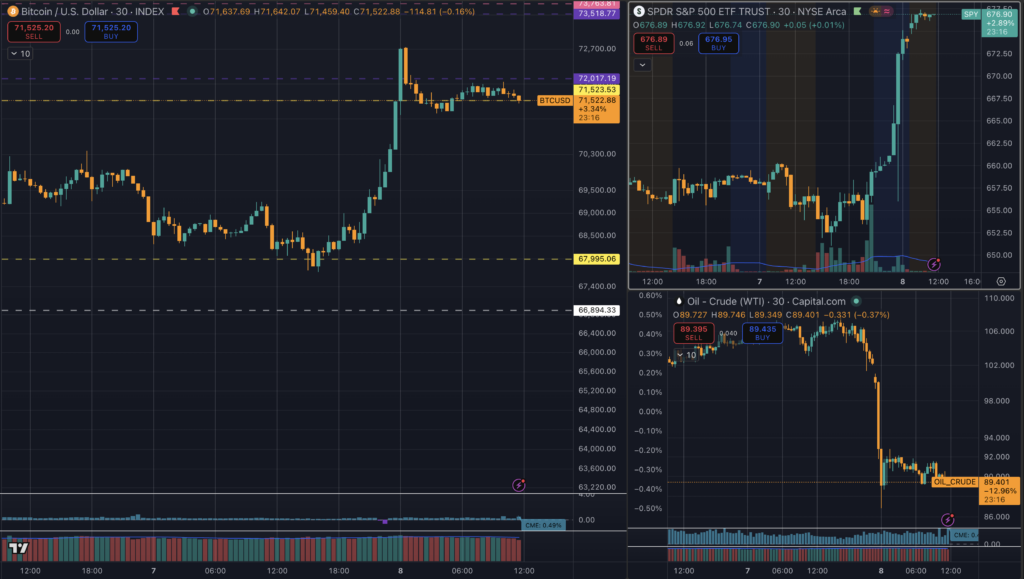 Three-panel market chart showing Bitcoin surging above $71,000, the S&P 500 ETF rising after hours, and crude oil falling sharply below $100.
Still, the following hour reinforced that sentiment. From 14:00 to 15:00 BST, Bitcoin declined by about 0.5%, SPY dropped approximately 0.3%, and crude increased by about 1.0%.
The market was assigning a higher likelihood to significant energy disruption and a lower likelihood to an orderly diplomatic resolution. Crude oil served as the clearest indicator of regional war risk, while SPY and Bitcoin absorbed the broader risk-off spillover.
Even then, the movement remained one of repricing probabilities rather than confirming a terminal outcome. Investors were navigating a range of scenarios: direct escalation leading to the deadline, a delay facilitated through intermediaries, or a last-minute political retreat from Washington.
This range helps clarify why the evening session became more nuanced before the ceasefire was publicly announced. The same BBC coverage tracked increasing attention on diplomatic pressure from Pakistan and whether Trump was genuinely prepared to follow through with his rhetoric by the deadline.
By the UK evening, price action had already begun to lean toward a softening of the deadline trajectory. From approximately 17:30 to 20:30 BST, Bitcoin rose from $68,220 to $69,002, SPY advanced from 656 to 659, and crude eased from $106 to $103.
That was still a modest movement compared to what followed overnight, but it carried significance as it indicated a market beginning to reduce immediate war risk before the final announcement arrived.
Trump’s ceasefire post triggered the most pronounced cross-asset repricing of the sequence
Crude was relinquishing part of the afternoon spike, equities were recovering, and Bitcoin was regaining altitude into the close. Those movements suggested investors were picking up indications that the deadline could be extended or that diplomatic channels were gaining enough traction to limit the escalation path.
The pivotal shift occurred late in the UK evening. Trump opted to suspend attacks, agreeing to halt military action about 90 minutes before his self-imposed deadline.
The ceasefire announcement came at 23:30 BST on Tuesday night. Sky News’ live coverage of the Iran ceasefire characterized it as an eleventh-hour intervention and traced the mediation through Pakistan, which had been advocating for more time.
Once the post was made, the market response was immediate and significantly larger than anything observed earlier in the day.
Between 23:00 and 00:00 UK, the three assets moved in a nearly textbook manner, culminating in a sudden collapse of the near-term war premium. Bitcoin surged from $70,416 to $72,714, SPY rose from 664 to 674, and crude fell from $100 to $89.
Crude’s movement was the most dramatic. The single largest half-hour down bar in the entire window occurred around 23:30, with a decline of approximately 7.2%, before losses extended into the next bar.
Related Posts
This movement only makes sense within a framework where supply disruption through Hormuz had been significantly influencing prices and then lost that influence all at once. SPY’s after-hours surge aligned with the same structure from the equity perspective.
The index rallied about 1.4% over the hour as investors recalibrated the likelihood of a broader regional conflict and, consequently, macro spillovers into growth, inflation, and central bank assumptions. Bitcoin’s breakout warrants separate emphasis because crypto traded alongside global risk rather than merely as a geopolitical hedge.
Once immediate escalation probabilities diminished, Bitcoin joined the relief movement with greater magnitude than SPY and greater persistence than crude’s initial rebound.
The political sequence following the Truth Social post helped stabilize that first wave of repricing. Sky reported that Tehran stated it would allow “safe passage” through the Strait of Hormuz during the ceasefire, with coordination involving its armed forces, and that Iran had presented a ten-point plan through Pakistan.
In market terms, that additional language shifted the ceasefire from a unilateral Trump declaration into something resembling an operational arrangement with implications for shipping and energy flows.
Once safe passage through Hormuz became public knowledge, the overnight movement became increasingly difficult to reverse.
This was evident in the subsequent set of bars. Bitcoin maintained its position above $72,000 through the 00:00 bar and only slightly retraced from its peak.
SPY preserved the after-hours gap. Crude rebounded from the initial shock low, though it remained near $90 to $91, significantly below the $100-plus levels that existed prior to the ceasefire announcement.
This represented a transition from panic premium to partial normalization. Energy traders removed the immediate blockade and supply-shock assumptions, although they did not restore pricing to a pre-crisis state due to the ongoing instability of the military and political landscape.
By Wednesday morning, markets had isolated the main conclusion even as the ceasefire remained partial
Equity traders welcomed the reduction in tail risk. Bitcoin traders lowered the immediate conflict risk and anticipated a broader recovery in global risk appetite.
The sequencing also clarifies why the afternoon escalation phase and the late-night relief phase were so asymmetrical. During the day, investors were contending with rhetoric, strikes, deadlines, and probabilities.
Late at night, they received a discrete policy signal, followed by a functional shipping signal, and then reinforcement from multiple sources covering the same de-escalation path. Once that cluster formed, the cross-asset alignment became remarkably sharp.
Crude no longer needed to maintain a high-end disruption premium. SPY no longer needed to factor in a fresh surge in energy prices and a worsening geopolitical drag. Bitcoin no longer needed to trade under the threat of an open-ended regional escalation.
The overnight market reaction, therefore, reflected the elimination of one specific scenario: direct movement into the deadline without a diplomatic release valve.
The next question is whether the ceasefire would hold across the entire regional theater. Here, the answer becomes more intricate.
Sky News reported overnight that Israel stated Lebanon was excluded from the ceasefire, contradicting an earlier claim from Pakistan. The same live coverage, citing Reuters, indicated that Hezbollah ceased attacks following Trump’s announcement, while the Israel Defense Forces continued operations in Lebanon and executed a final wave on Iran before pausing.
The military situation by dawn remained fragmented. The ceasefire reduced the likelihood of a direct U.S.-Iranian escalation and restored expectations for passage through Hormuz, although it did not resolve the broader regional conflict landscape.
This distinction is central to the morning market posture. Bitcoin retained most of its gains through the early UK hours, trading around $71,400 to $71,800 after peaking above $72,700.
Crude stabilized in the low 90s following the overnight washout. SPY, which has a data gap between 00:30 and 09:00 UK due to the session structure in the file, resumed at 675 by 09:00 BST, maintaining the after-hours step higher.
Those levels indicate that the market had already isolated the primary macro judgment. The larger issue was whether the immediate U.S.-Iran confrontation and the associated Hormuz risk had been downgraded.
By the London morning, the answer reflected in prices was affirmative.
Trump’s own remarks to Sky News in his morning statements reinforced that interpretation. Sky quoted him describing events as a “complete victory” and asserting that the United States had accomplished everything it aimed to do militarily.
Tehran, for its part, also claimed victory in separate comments reported by the same outlet. These victory claims highlight the political fragility of the arrangement, as mutually declared wins can sustain a pause for a time, though they rarely resolve the underlying dispute.
For markets, the immediate function is more straightforward. Competing victory narratives provided political cover for de-escalation.
This cover was sufficient to support the overnight repricing and maintain it into the next session.
| UK time | Event | BTC | SPY | Oil |
|---|---|---|---|---|
| 07 Apr 13:40 | Trump’s “whole civilization will die tonight” post raises the escalation ceiling ahead of the 01:00 BST deadline. | 68,377 | 30m -0.22% | 60m -0.35% | 656.06 | 30m -0.31% | 60m -0.25% | 106.00 | 30m +0.78% | 60m +0.98% |
| 07 Apr 14:12 | Vance says the US is aware of strikes on Kharg Island and says Iran has until 01:00 BST to respond. | 68,471 | 30m -0.49% | 60m -0.91% | 656.63 | 30m -0.34% | 60m -0.62% | 106.02 | 30m +0.96% | 60m +0.98% |
| 07 Apr 14:28 | Iran says it struck a Saudi petrochemical complex in Jubail. This is the clearest afternoon supply-risk headline. | 68,471 | 30m -0.49% | 60m -0.91% | 656.63 | 30m -0.34% | 60m -0.62% | 106.02 | 30m +0.96% | 60m +0.98% |
| 07 Apr 19:03 | Iran’s foreign ministry says a “civilized” nation will prevail over brute force. | 68,631 | 30m -0.10% | 60m +0.54% | 656.10 | 30m +0.10% | 60m +0.49% | 104.82 | 30m -0.20% | 60m -1.16% |
| 07 Apr 23:32 | Trump’s Truth Social post announces a two-week ceasefire about 90 minutes before the deadline. | 71,502 | 30m +0.58% | 60m +0.55% | 672.51 | 30m +0.21% | 60m +0.51% | 92.84 | 30m -1.54% | 60m -1.15% |
| 07 Apr 23:40 | Tehran says it will allow safe passage through Hormuz during the ceasefire, coordinated with its armed forces. | 71,502 | 30m +0.58% | 60m +0.55% | 672.51 | 30m +0.21% | 60m +0.51% | 92.84 | 30m -1.54% | 60m -1.15% |
| 08 Apr 07:32 | Trump says he sees the outcome as a “complete victory.” | 71,718 | 30m -0.12% | 60m +0.03% | 673.90 | 30m +0.30% | 60m +0.30% | 90.33 | 30m +0.55% | 60m +1.17% |
| 08 Apr 08:17 | Reuters via Sky says Hezbollah halted attacks after the ceasefire news, while Israel still says Lebanon is outside the deal. | 71,820 | 30m -0.11% | 60m -0.20% | 673.90 | 30m +0.30% | 60m +0.22% | 90.98 | 30m +0.44% | 60m -0.58% |
| 08 Apr 08:50 | Tehran and Trump each claim the ceasefire as a victory. The market response is already mature by this point. | 71,632 | 30m +0.06% | 673.90 | 30m +0.22% | 90.83 | 30m -0.41% |
| 08 Apr 09:20 | Sky says the IDF completed a final wave of strikes on Iran before pausing. | 71,742 | 675.91 | 91.38 |
The sequence over the last 24 hours distills into a clear analytical framework. During the UK afternoon, Trump’s “civilization” rhetoric and the reported strike on Saudi petrochemical infrastructure widened the energy risk premium and pushed broader risk assets lower, but markets did not take Trump’s veiled apocalyptic threat seriously.
During the evening, diplomacy, visibly led through Pakistan, diminished the likelihood of movement into the deadline. Around 23:30 BST, Trump’s Truth Social ceasefire post eliminated the highest-risk branch of the scenario tree.
Iran’s subsequent statements regarding safe passage through Hormuz provided the move with operational credibility. By dawn in London, even with Lebanon exclusions and ongoing localized military actions, the market had already made its primary judgment.
Crude no longer needed to price a near-term choke point through Hormuz with the same intensity, SPY no longer needed to carry the same tail-risk discount, and Bitcoin had regained its position as a higher-beta expression of relief.
This leaves the next market test in a narrow zone. Investors will be monitoring whether the ceasefire terms regarding Hormuz remain intact, whether any direct U.S.-Iran threats re-emerge, and whether the Lebanon exclusion expands the conflict back into a shape that could materially increase energy risk.
Prices have already narrowed the main conclusion. The overnight pivot was substantial. The largest premium had been removed from crude, the strongest relief had flowed through after-hours equities and Bitcoin, and the burden of proof had shifted back onto anyone advocating for an immediate return to the pre-escalation ceasefire path.
<
