Disclaimer: Information found on CryptoreNews is those of writers quoted. It does not represent the opinions of CryptoreNews on whether to sell, buy or hold any investments. You are advised to conduct your own research before making any investment decisions. Use provided information at your own risk.
CryptoreNews covers fintech, blockchain and Bitcoin bringing you the latest crypto news and analyses on the future of money.

Bitcoin’s surge remains a temporary rebound in a bear market unless it regains this crucial threshold.

Bitcoin (BTC) experienced a rise from approximately $67,000 to $72,000 in the days following the announcement of the US-Israel-Iran ceasefire, marking a 7.5% recovery that mitigated volatility and improved sentiment across risk assets.
Glassnode’s April 8 Week On-chain report indicated that this rebound and stabilization still align with the characteristics of a bear market recovery. BTC remains within a bear market valuation zone, and the threshold that would genuinely alter the outlook is $81,600.
This figure represents the Short-Term Holder Cost Basis, which is the cumulative breakeven price for Bitcoin acquired in recent months. Glassnode identifies this as the level the market must reclaim for rallies to be considered potentially sustainable.
Below this level, recent purchasers as a group are experiencing losses, and the report suggests that any rally into this range is likely to encounter selling pressure from holders looking to exit near breakeven.
The ceasefire alleviated macroeconomic shocks, leading to reduced volatility in the options markets. Short-dated implied volatility decreased to the low 40s, while the 6-month tenor settled around 45%.
Reuters reported on April 9 that the truce appeared fragile, with oil prices rebounding and overall risk sentiment weakening within a day of the announcement.
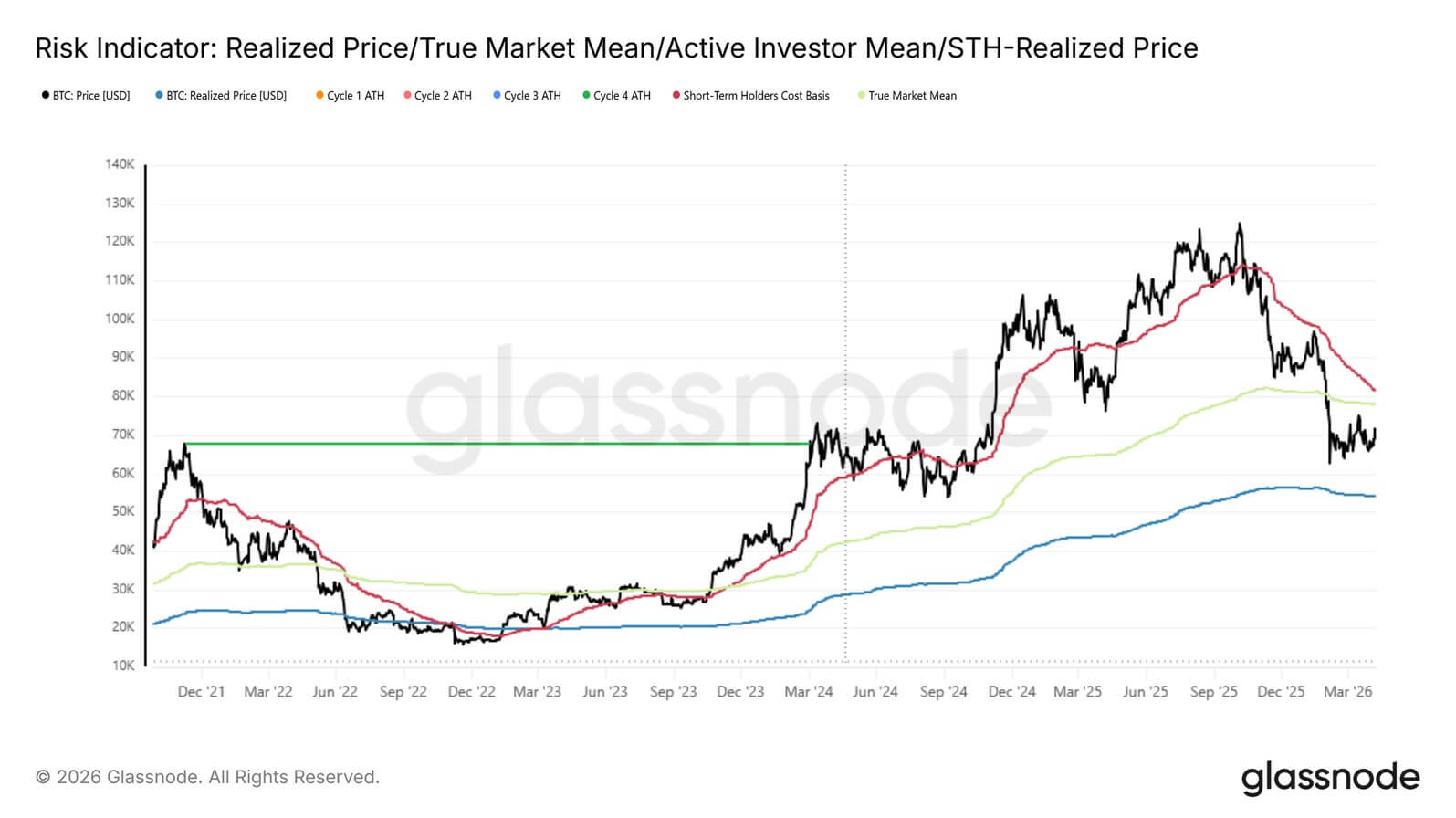 Bitcoin’s price dipped below the Short-Term Holder Cost Basis in early 2026 and is currently trading between the True Market Mean and Realized Price. Source: Glassnode
Three numbers
Glassnode’s framework simplifies to a clear progression, indicating the $69,000-$71,500 range as a zone where dealer positioning shows long gamma concentration, a mechanical structure that may assist in absorbing near-term selling pressure.
 Related Reading
The Bitcoin network is currently a ghost town as price is being controlled elsewhere
Fees, mempool pressure, and on-chain demand present a contrasting narrative beneath the price recovery.
April 9, 2026 · Liam ‘Akiba’ Wright
With BTC trading slightly above $72,000 at the time of writing, the market is positioned above the upper boundary of that support shelf. The $78,000 True Market Mean is 8.5% higher and represents the likely ceiling for any relief rally.
Glassnode reports the AVIV Ratio at 0.92, remaining below 1.0 since early February. The firm notes that this reading is comparable to the May-June 2022 period, which occurred during a bear market, and is significantly above the lowest capitulation levels of late 2022.
The current situation reflects a bounce within an ongoing bear phase, with a plausible floor, a likely near-term ceiling, and a more significant level above both.
Binance’s 30-day relative spot volume remains below its 1.0 baseline, which Glassnode interprets as weak organic demand. US spot ETF flows have turned modestly positive on a 14-day basis, ending a prolonged outflow period, although April 7 and 8 still recorded negative figures.
Futures volume sharply contracted and rolled over on a 30-day basis, while the 25-delta options skew continues to favor puts, indicating that traders are still paying a premium for downside protection.
Collectively, these indicators depict a market stabilizing amid low participation.
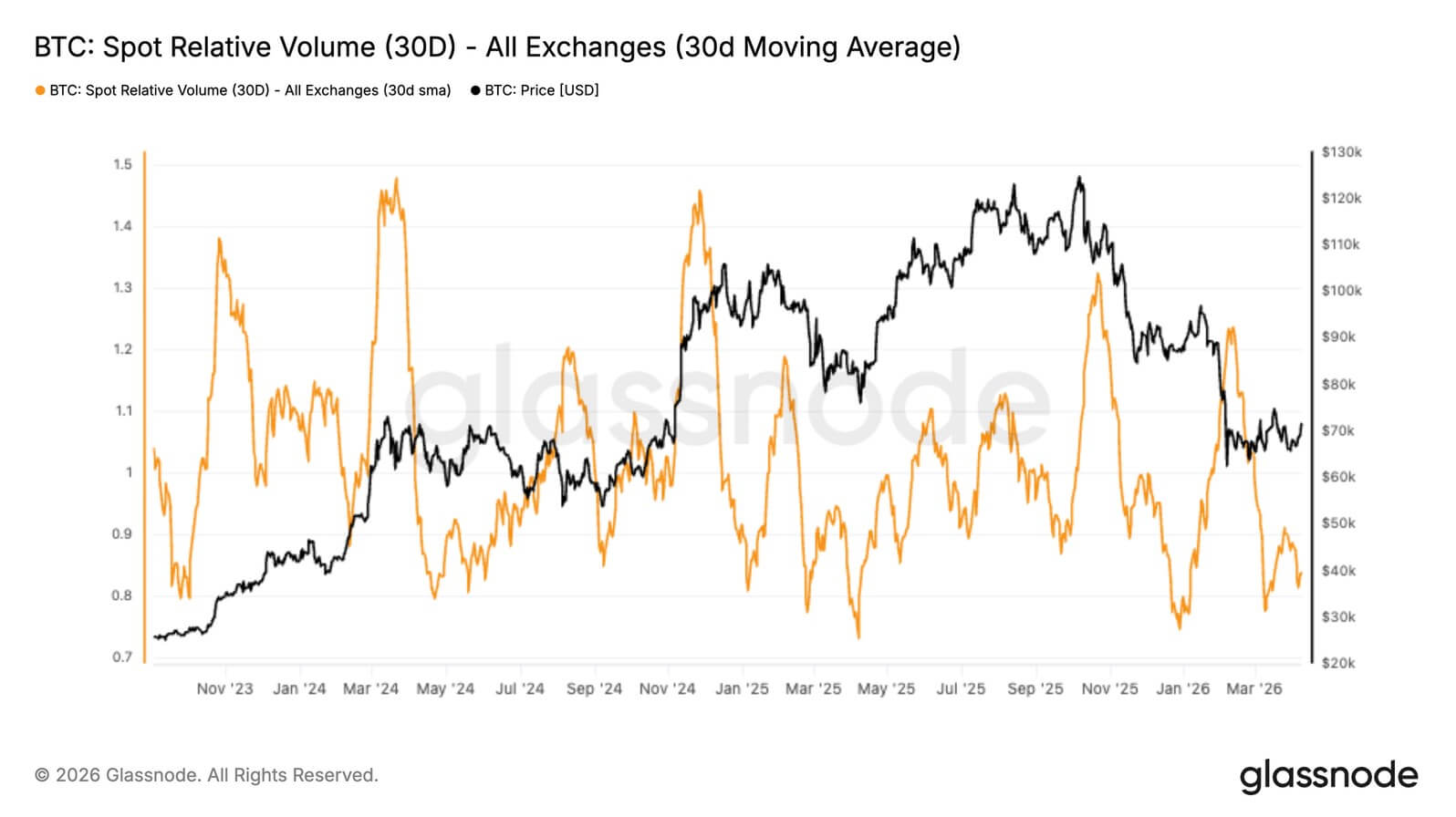 Bitcoin’s 30-day spot relative volume across all exchanges has dropped below 0.9 as of March 2026, marking its lowest level since the 2023 bear market. Source: Glassnode
The architecture of a relief rally
Glassnode asserts that the market has transitioned into a more balanced state, where severe downside risks are less imminent, a gradual move toward $78,000 is feasible, and the sustainability of this movement remains uncertain. The distinction lies in whether the buyer base is absorbing or distributing.
Related Posts
Below $81,600, recent purchasers are incurring losses, creating a mechanical limitation on upward momentum. Each rally toward breakeven offers an exit opportunity to a group that acquired at higher prices and has endured a drawdown.
Glassnode explicitly outlines this mechanism, stating that distribution pressure from trapped holders renders rallies within the current range structurally vulnerable.
Long-term holders have been realizing losses of over 4,000 BTC per day since November 2025. The report highlighted that reducing this figure to under 1,000 BTC per day, along with reclaiming $81,600, would represent the clearest on-chain signal of a genuine regime shift.
 Related Reading
Morgan Stanley’s new Bitcoin ETF puts pressure on BlackRock’s IBIT after strong debut
MSBT’s strong debut introduces a new fee and distribution challenge in the spot Bitcoin ETF competition.
April 9, 2026 · Oluwapelumi Adejumo
Potential pathways
In a bullish scenario, BTC reclaims $81,600, ETF inflows continue to grow, and futures participation expands, bringing volume back into the market.
Glassnode’s framework provides a falsification test: reclaiming the Short-Term Holder Cost Basis, combined with a significant reduction in long-term-holder realized losses, would be the most credible on-chain confirmation that the current bear phase is transitioning to a pre-bull recovery structure.
In this scenario, the ceasefire served as the catalyst for a genuine demand-regime transition.
In a bearish scenario, BTC loses the $69,000-$71,500 support range, and weak spot demand fails to absorb supply from trapped holders.
The relief rally falters well below $78,000, and the current bounce is noted as a volatility event. Glassnode’s data on declining futures, consistently defensive options positioning, and still-weak spot volumes align with this outcome based on the current participation profile.
The ceasefire diminished near-term volatility, but sustained demand improvement has yet to materialize.
| Scenario | What price does | What participation does | What it means |
|---|---|---|---|
| Bear-market bounce | Holds or loses $69K–$71.5K, stalls below $78K or $81.6K | Spot stays soft, futures stay weak, options stay defensive | Relief rally inside a bear structure |
| Credible recovery | Reclaims $81.6K | ETF inflows expand, futures re-accelerate, LTH realized losses cool toward under 1K BTC/day | Transition toward pre-bull recovery |
| Failure / relapse | Loses support shelf decisively | Trapped-holder supply overwhelms weak demand | Bounce becomes a volatility event, not a regime change |
Ceasefire late shock
The macroeconomic environment sets the upper limit on sentiment-driven demand. The US-Israel-Iran truce reduced volatility more rapidly than it rebuilt risk appetite, and the one-day reversal in oil prices reported by Reuters on April 9 illustrates why geopolitical relief rallies have a limited lifespan.
Once acute fears dissipate, the demand structure reasserts itself, and Glassnode’s data suggest that the underlying framework remains thin.
Realized volatility at 42.5% and implied volatility in the low 40s indicate a calm market that has yet to adopt a bullish stance.
Durable breakouts necessitate increasing volume, improving ETF flows beyond modest levels, and futures curves reflecting genuine speculative interest. According to Glassnode’s April 8 data, these conditions have not yet emerged.
For the moment, Glassnode’s clearer assessment is that Bitcoin has established sufficient support for a bounce.
Below $81,600, the market continues to rally within a bearish framework, and the participants most likely to sell during the next upward movement are the same buyers who have been underwater since the peak of the rally.
The post Bitcoin’s rally is still just a bear market bounce unless it reclaims this key level appeared first on CryptoSlate.
