Disclaimer: Information found on CryptoreNews is those of writers quoted. It does not represent the opinions of CryptoreNews on whether to sell, buy or hold any investments. You are advised to conduct your own research before making any investment decisions. Use provided information at your own risk.
CryptoreNews covers fintech, blockchain and Bitcoin bringing you the latest crypto news and analyses on the future of money.

Bitcoin price targets breakout as EIA indicates sub-$80 oil trajectory following easing of 20% global supply disruption.

Bitcoin has potential for an upward movement if diplomatic relations between Washington and Tehran continue to alleviate pressure on oil.
Since March 23, indications of notable de-escalation have surfaced, with President Donald Trump initiating a 5-day pause for “constructive discussions.”
Simultaneously, it has been reported that the United States conveyed a 15-point proposal to Iran via Pakistan, while Turkey also facilitated communication between the two parties.
Although a ceasefire has not been established, and there is no indication of a definitive negotiating process, Iran has publicly refuted the existence of direct discussions with Washington, with an Iranian military spokesperson stating that the United States was “negotiating with itself.”
Nonetheless, the signs of diplomacy have been significant enough for market reactions, with Brent crude decreasing by 5.2% to $99.01 per barrel and US West Texas Intermediate falling by 5.1% to $87.62.
Conversely, Bitcoin increased by 1.6%, maintaining its steady resilience above $71,000 as traders reduced some of the inflation and interest rate concerns that had accumulated during nearly four weeks of conflict.
 Related Reading
Bitcoin wipes $243 million longs as geopolitical shock reveals traders now price war risk before oil and Fed react
Bitcoin now responds more swiftly than traditional hedges, reflecting risk shifts across liquidity, flows, and macroeconomic stress in real time.
Mar 24, 2026 · Liam 'Akiba' Wright
Why this tentative diplomacy moves market
The supply aspect clarifies the pronounced reaction to headlines that consist of little more than mediated communication.
Iran is the third-largest producer in OPEC, extracting approximately 3.3 million barrels per day of crude and an additional 1.3 million bpd of condensate and other liquids. About 90% of its crude is exported through Kharg Island via the Strait of Hormuz, with recent exports ranging between 1.1 million and 1.5 million bpd.
Data from the US Energy Information Administration indicates that flows through the Strait of Hormuz averaged 20.9 million bpd in the first half of 2025, accounting for roughly 20% of global petroleum liquids consumption. Approximately 20% of the global liquefied natural gas trade also passed through the strait in 2024.
However, that volume has nearly ceased, with Andre Dragosch, Bitwise’s head of research in Europe, noting that there has been “1 ship today” that has traversed the route.
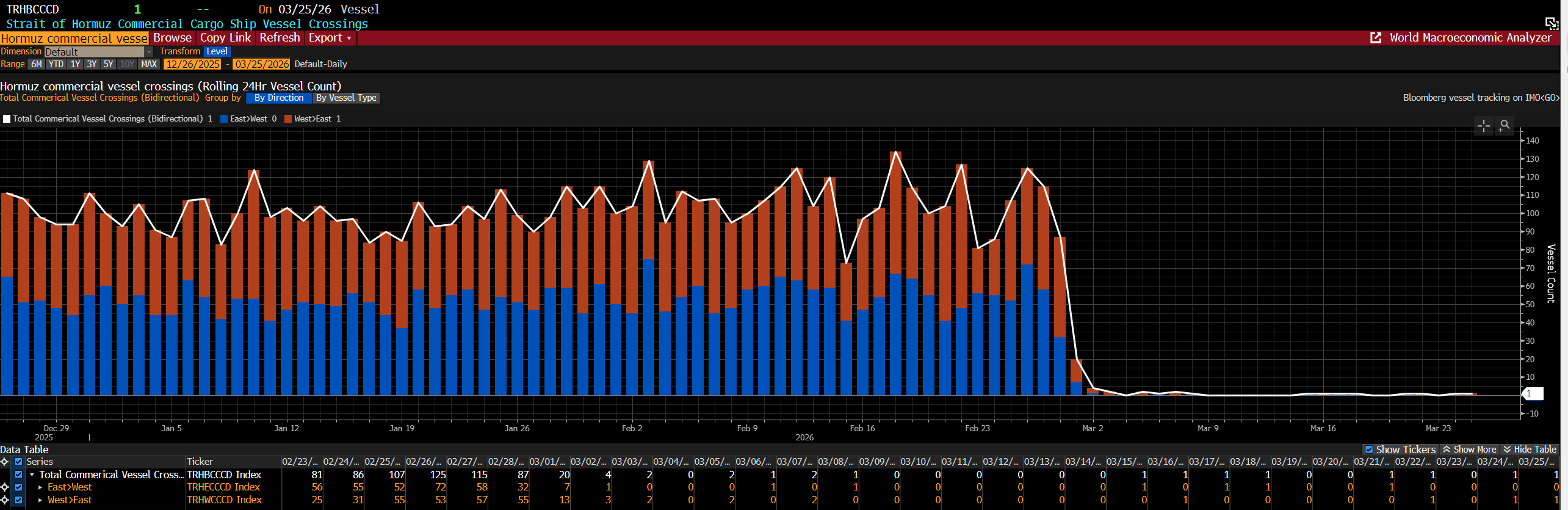 Oil Passage Through Straits of Hormuz (Source: Andre Dragosch)
Thus, any discussions regarding ceasefire terms, shipping access, or sanctions relief carry direct, volumetric significance for the oil market.
The forward curve strengthens the argument. In its March outlook, the EIA predicted that Brent would remain above $95 per barrel over the next two months, then drop below $80 in the third quarter and approach $70 by year-end if disruptions subside and inventories are replenished.
The agency anticipated global oil inventories to increase by an average of 1.9 million bpd in 2026, once production once again exceeds consumption.
This implies that a credible diplomatic process does not need to generate an immediate surplus supply. It merely needs to make that softer trajectory appear more likely.
The European Central Bank’s March 2026 staff projections quantify the stakes. The ECB modeled a negative energy scenario with oil at $119 per barrel and gas at €87 per megawatt-hour in the second quarter, raising euro-zone inflation by 0.9 percentage points.
Federal Reserve research independently finds that rising oil prices directly elevate headline inflation and, over approximately eight quarters, create a smaller but statistically significant pass-through into food and core prices.
In light of this, crypto market maker Wintermute articulated it in trading terms, explaining that if Brent stabilizes around $100 and diplomacy persists, the inflation concerns linked to energy disruptions should diminish enough to allow “some of the rate-cut expectations erased last week” to resurface.
 Related Reading
Related Posts
Bitcoin price jumps above $70,000 as US announces shock pause on Iran strikes
Diplomatic progress halts aggression and stimulates a rally in the crypto market, with Bitcoin leading the way.
Mar 23, 2026 · Oluwapelumi Adejumo
The oil-to-rates transmission
The optimistic scenario for Bitcoin here is that declining oil prices alleviate inflationary pressures. Furthermore, it diminishes the likelihood that central banks will maintain tighter rates for an extended period and enhances the liquidity environment for risk assets more broadly.
Significantly, Bitcoin has predominantly traded less like a geopolitical hedge and more like a high-beta reflection of global liquidity conditions during the ongoing US-Iran conflict.
For context, the recent rebound of the leading cryptocurrency above $70,000 was not driven by any crypto-specific catalyst. Instead, this occurred amid a sharp recovery in technology stocks and a stabilization of broader market risk.
The flow data supports that interpretation. According to CoinShares, digital-asset investment products attracted $230 million last week, with $219 million directed towards Bitcoin, despite $405 million in outflows following the Federal Open Market Committee meeting.
CoinShares attributed the pressure to the Fed’s hawkish stance, rather than the Iran conflict. The primary driver has been rates and liquidity, not geopolitics in isolation.
That is why the repricing in interest-rate futures is significant. Over the past several weeks, the conflict threatened to deliver a stagflation shock as oil prices soared to unprecedented levels.
CryptoSlate had previously reported that rate futures implied virtually no chance of Fed cuts before mid-2027 as the conflict drove energy prices higher. However, following Tuesday’s diplomatic headlines, expectations for a December rate hike decreased to about 16% from 25%.
Federal Reserve Governor Michael Barr reinforced the hawkish context on March 24, stating that policymakers may need to maintain rates steady for “some time” and that he would require evidence that inflation is “sustainably retreating” before considering further cuts.
 Related Reading
Bitcoin focus flips from oil to bonds as US and Japan 10-year yields spike into a critical week
A cross-market reset is in progress, with rising sovereign yields tightening conditions and necessitating a repricing of risk.
Mar 23, 2026 · Liam 'Akiba' Wright
What could happen next?
A prolonged diplomatic process without a formal breakthrough could still benefit Bitcoin if it caps oil prices. Brent remaining near current levels, or declining as shipping concerns ease, would likely alleviate pressure on yields and lessen the urgency surrounding higher-for-longer policy pricing.
The EIA’s projection of sub-$80 oil in the third quarter provides a macro framework for that scenario. Under such easing, BTC would have a clearer opportunity to revisit and surpass the highs reached earlier this month.
Meanwhile, a more credible ceasefire pathway would bolster that argument. The larger impact would stem from convincing markets that Hormuz is returning to normal operations, that regional energy infrastructure is no longer at risk, and that the inflation shock from the conflict is beginning to dissipate.
The ECB’s forecasts illustrate how much difference that can make. Even minor adjustments in the anticipated oil trajectory yield significant changes in inflation and growth projections.
However, a breakdown in negotiations would reverse the entire chain. Oil prices would likely rise again, shipping-risk fears would resurface, and markets would have to factor in a tougher policy path from the Fed and other central banks.
Past market behaviors have already demonstrated how swiftly that adjustment can occur. Within a few days, traders shifted from anticipating cuts later this year to pricing in a substantial chance of a December hike, before easing those expectations when oil prices fell amid diplomatic developments.
Bitcoin can still appreciate during wartime, but the clearer path upward emerges when the energy shock begins to unwind.
The post Bitcoin price eyes breakout as EIA signals sub $80 oil path after 20% global supply shock starts easing appeared first on CryptoSlate.
