Disclaimer: Information found on CryptoreNews is those of writers quoted. It does not represent the opinions of CryptoreNews on whether to sell, buy or hold any investments. You are advised to conduct your own research before making any investment decisions. Use provided information at your own risk.
CryptoreNews covers fintech, blockchain and Bitcoin bringing you the latest crypto news and analyses on the future of money.


Bitcoin‘s rally above $80,000 lost a key policy cushion on Sept. 4 when the August jobs report came in significantly stronger than the recent hiring trend. The robust data made it more difficult for the Federal Reserve to justify holding interest rates steady based solely on labor-market weakness.
Bitcoin hit an intraday low of $78,660 before recovering to trade near the $80,000 level.
Following the release, MarketWatch reported that the two-year Treasury yield rose to approximately 4.40% from just above 4.33%, while the 10-year yield climbed to near 4.80% from just under 4.75%. The Wall Street Journal noted that the dollar index touched 99.932, up from about 99.035 prior to the data release.
These aligned timestamps indicate that a more resilient labor market gave policymakers greater latitude to focus on inflation. Simultaneously, higher short-term yields and a firmer dollar tightened the financial backdrop for dollar-priced risk assets.
Payrolls Narrow the Fed’s Dilemma
The Bureau of Labor Statistics (BLS) reported that nonfarm payrolls increased by 162,000 in August, more than five times the average monthly gain of 31,000 recorded over the previous 12 months. The unemployment rate remained unchanged at 4.1%.
The BLS also revised June payroll growth upward to 31,000 and July growth to 21,000, adding a combined 55,000 jobs to its earlier estimates.
Average hourly earnings for private nonfarm workers rose 0.3% in August to $37.75, representing a 3.1% year-over-year increase.
The food services and drinking places sector accounted for 59,000 new jobs, while local government education added 42,000. In contrast, information employment fell by 23,000, and health care added 13,000 jobs, well below that sector’s average monthly gain of 32,000 over the prior year.
The report weakened the argument for an immediate pause in rate hikes based on labor deterioration, without necessarily indicating that every corner of the economy was overheating. Consequently, inflation now carries more weight in determining whether the Fed can maintain its patient stance.
Fed Governor Christopher Waller outlined one visible version of this tradeoff the day before the release. While his view does not bind the entire Federal Open Market Committee (FOMC), his published remarks provided a clear reaction function.
Related Reading
Bitcoin Faces New Macro Test as Fed Chair Kevin Warsh Highlights Sticky Inflation Metrics
Related Posts
Waller described the labor market as satisfactory and stable, with employment near its maximum sustainable level. He stated that August inflation data would heavily influence his stance in September.
Continued progress toward the Fed’s 2% inflation target would make him willing to hold the policy rate steady. However, a hot inflation reading or evidence that progress had reversed could prompt him to consider a rate hike.
The payroll report removed the obvious labor deterioration that might have outweighed an uncomfortable inflation print. September’s decision now hinges more cleanly on whether price pressures continue to ease.
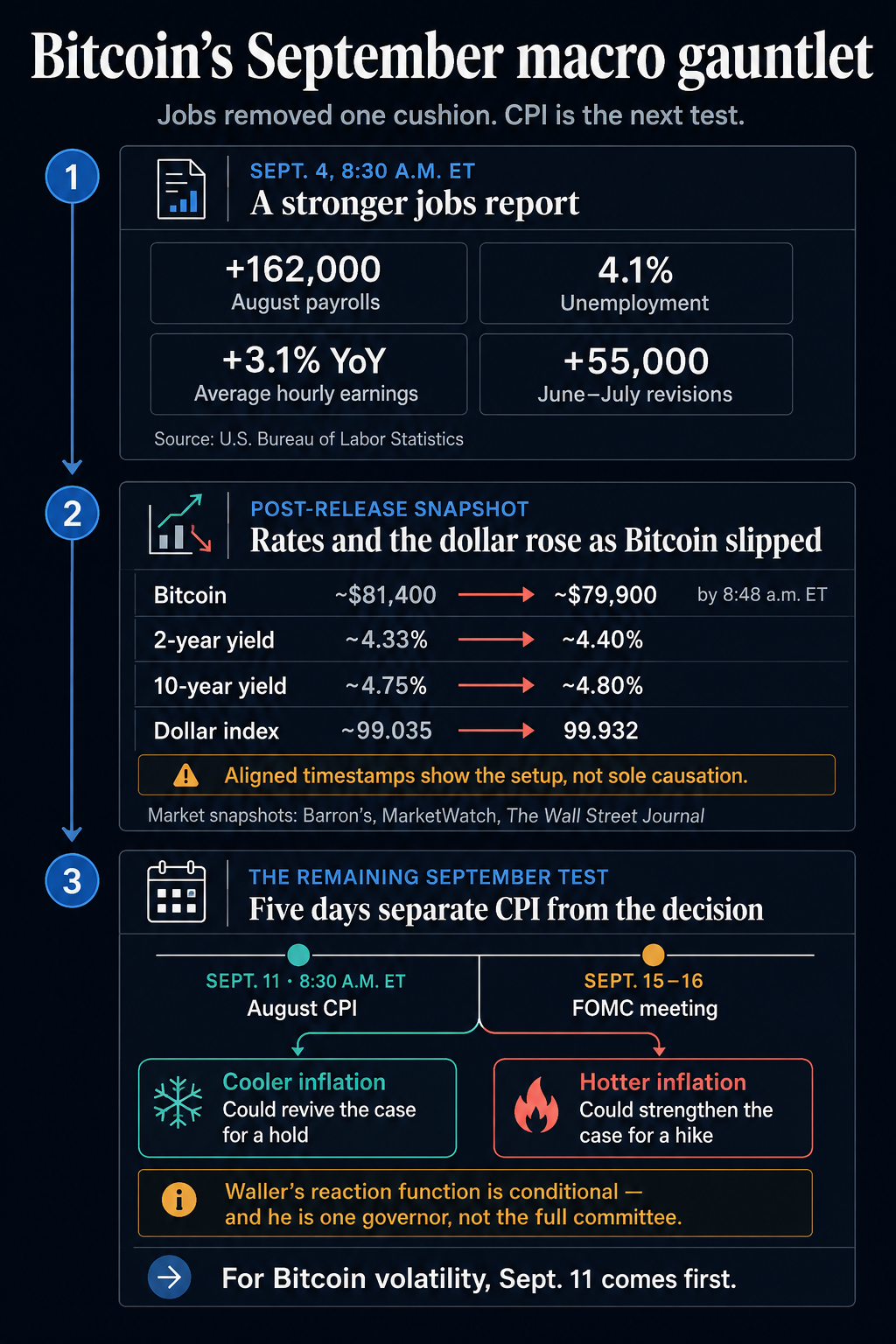
An infographic outlines Bitcoin’s September macro tests, including a stronger jobs report, post-release price decline, upcoming inflation data, and a Federal Reserve meeting.
CPI Becomes Bitcoin’s Next September Deadline
The BLS calendar schedules the August consumer price index (CPI) release for 8:30 a.m. ET on Sept. 11. The Federal Reserve calendar lists the FOMC meeting for Sept. 15-16, with the decision announcement on Sept. 16.
This five-day gap makes CPI the last major scheduled inflation test before the meeting. For Bitcoin traders, Sept. 11 is when the September rate debate can absorb new evidence, rather than when policymakers formally settle it.
A cooler CPI report would align with Waller’s condition for supporting a rate hold and could relieve pressure transmitted through short-term yields and the dollar. A hotter print would strengthen the case that inflation progress has stalled just as the labor market has shown renewed resilience.
Waller spoke only for himself, and a single inflation report will not erase other evidence policymakers weigh. However, CPI can shift the balance because payrolls have already answered the labor side of the debate more firmly than the recent trend suggested.
Bitcoin had rallied above $80,000 prior to these two closely spaced macro tests. After the payroll data, the asset fell back below that level as yields and the dollar rose.
A softer CPI reading could reopen the narrative for a rate hold and provide the rally with breathing room. A hotter print could leave Bitcoin approaching the Sept. 16 decision with both labor resilience and inflation pressure pointing toward tighter policy.
While the Fed meeting remains the ultimate policy deadline, Sept. 11 arrives first for Bitcoin volatility.
The post Bitcoin Falls Below $80,000 as Strong August Jobs Data Shifts Fed Policy Outlook appeared first on CryptoSlate.
