Disclaimer: Information found on CryptoreNews is those of writers quoted. It does not represent the opinions of CryptoreNews on whether to sell, buy or hold any investments. You are advised to conduct your own research before making any investment decisions. Use provided information at your own risk.
CryptoreNews covers fintech, blockchain and Bitcoin bringing you the latest crypto news and analyses on the future of money.


Abstract, an Ethereum layer-2 network, announced it will shut down on Dec. 15, 2026. In an Oct. 6 announcement, @AbstractChain instructed users to migrate their assets before that date or risk losing access to their funds.
The deadline highlights a distinction that can be obscured by the term “self-custody.” A holder may retain ownership and the authority to approve transactions while losing the infrastructure required to execute them. Cube, Inc., the company providing Abstract’s services, makes this separation explicit in its updated terms: the wind-down does not transfer assets to Cube or other parties covered by its terms, but the end of normal processing ends transfer access through discontinued services.
A completed exit requires a supported asset route, access to the authorizing wallet, a controlled destination, and every required processing or claim step.
A shutdown date is not every route’s deadline
@AbstractChain’s announcement directs users to the Migration Hub at migrate.abs.xyz or the native bridge at native-bridge.abs.xyz. The public Migration Hub repeats the Dec. 15 notice and lists Native Bridge, Stargate, Relay, Jumper, and project-specific instructions.
The general terms identify migration.abs.xyz as the official Hub and bridge.abs.xyz as the existing bridge interface. The Hub at that address also displays the shutdown notice and alternative bridge links. However, the announcement and terms name different interfaces; their addresses alone do not establish interchangeable routes. The Hub links also do not supply a complete map showing which token, NFT, or application position can use each one.
The existing bridge interface offers wallet connection, token selection, route priority, gas, and slippage controls, with 0x attribution. A visible interface and selectable route still leave user-specific questions: what can move, where it will arrive, and what remains to be done after approval.
Timing also has several layers. @AbstractChain says native-bridge users should expect a three-hour delay. Abstract’s bridge documentation describes native ETH and ERC-20 transfers between Abstract and Ethereum, while stating withdrawals can take up to 24 hours. L2BEAT’s Oct. 2 contract update tracks an effective execution delay of three hours.
An execution delay and the time needed to finish a withdrawal are different measures. Neither estimate establishes that starting three hours before shutdown will produce a completed exit.
Cube’s terms distinguish initiation, completion, and claim deadlines, any of which may come before chain discontinuation. A transaction submitted in time can still require a waiting period, destination-chain claim, transaction, or fee. The terms also state that any supported completion process continuing after discontinuation would follow its own disclosed conditions and cutoff; it would not provide a way to start new withdrawals for assets left on Abstract.
This makes Dec. 15 the announced chain shutdown date, rather than a universal last moment to click a bridge button.
Related Reading
Blast shuts down $20M layer-2 network, forcing Oct. 26 exit deadline
Wallet access and settlement require different controls
Abstract Global Wallet, or AGW, is a smart contract wallet. Its architecture separates the contract holding assets from an approved signer that authorizes transactions.
The documented setup generates a signer key through Privy’s embedded-wallet system and divides it into three shares: one on the user’s device, an authentication share on Privy’s servers, and a recovery share in a backup location chosen by the user. Access to any two shares is required to reconstruct the key.
This design does not make Privy’s normal login flow the only documented way to recover signing authority. Abstract describes combining the device and recovery shares if Privy is offline or the original login method becomes unavailable. That option depends on the user having access to those shares.
Recovering those shares restores signing authority, rather than the infrastructure that processes an exit.
Related Reading
New Bitcoin proposal rescues locked multisig wallets – At a hidden cost
Related Posts
Destination compatibility creates another boundary. The AGW FAQ states its contract code is EVM-compatible, but its SDK works only on Abstract. Cube’s terms separately warn that an AGW address may not be usable or controlled by its user on another chain.
A familiar-looking address is consequently insufficient evidence that its user controls the receiving wallet.
The same inventory problem applies to the assets being moved. Cube’s terms warn that an interface may not show every holding and identify NFTs, staked or locked assets, collateral, liquidity positions, and application-held assets as categories requiring review.
Migration also covers only the assets and amounts authorized. Moving the balance visible today does not automatically forward assets received later or resolve another application’s position.
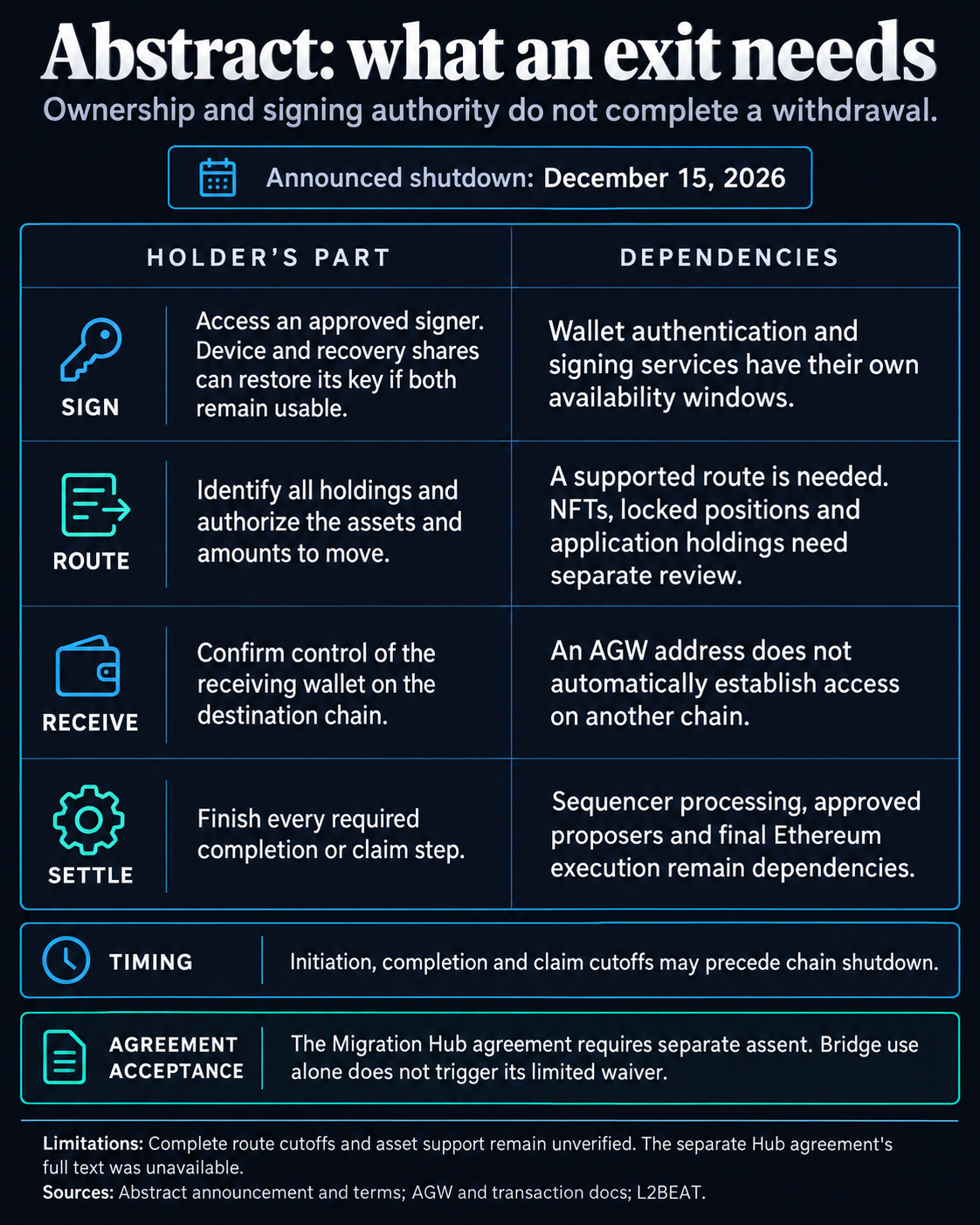
Abstract’s transaction lifecycle shows why a source-chain success message is not the whole exit. A transaction first receives execution and soft confirmation on Abstract. Batches then proceed through commitment, proof verification, and final execution on Ethereum.
L2BEAT’s assessment identifies the operating dependencies behind that sequence. Users can submit transactions through an Ethereum queue, but they cannot force the chain’s sequencer to process them if it stops. Only approved proposers can publish records of chain state to Ethereum; proposer failure freezes withdrawals, while governance can attempt a replacement through an upgrade.
They leave settlement dependent on continued processing even when a holder can sign.
The execution delay is also configurable. L2BEAT’s Oct. 2 update says chain administrators can increase their chain’s delay and the owner can set it, subject to a 30-day cap. The currently tracked three-hour delay is therefore a parameter, not an irrevocable completion guarantee.
Cube’s terms describe support in similarly bounded language. They commit to commercially reasonable information, assistance, and provider coordination during published support windows. An extension or alternative process depends on feasibility and provider or governance decisions, rather than becoming an automatic entitlement to a successful transfer.
Related Reading
7-day blockchain outage wipes out a full week of staking rewards after emergency aelf shutdown
What holders agree to
Authorizing a transfer also needs to be distinguished from accepting a contract. The Oct. 6 general terms require an initially unchecked agreement checkbox and affirmative confirmation. Holding assets, connecting a wallet, viewing information, or signing a transaction does not by itself accept that version.
The Migration Hub agreement has separate acceptance requirements. Section 17.2 of the general terms describes its limited waiver as concerning actual or attempted use of migration functions after valid acceptance, within that agreement’s scope and exceptions. Portal or bridge use alone does not trigger that waiver.
The separate agreement’s full waiver scope remains unresolved; the general terms’ description supplies only that limited distinction.
The general terms say acceptance does not itself extinguish existing claims. They separately address substantive rules for earlier conduct, dispute procedures, and effective opt-outs, subject to mandatory consumer protections. Those provisions do not settle enforceability for every holder.
As the wind-down proceeds, the decisive information will be the supported routes and their initiation, completion, and claim cutoffs, alongside availability windows for authentication and signing. Cube identifies @Abstract_Eco, @AbstractChain, and the Abstract Discord as its official operational channels, and states wallet, recovery, export, explorer, and support functions may end at different times.
The next operational notices will determine how long those parts of the exit remain available.
The post Abstract’s shutdown highlights the gap between asset ownership and transferability appeared first on CryptoSlate.
