Disclaimer: Information found on CryptoreNews is those of writers quoted. It does not represent the opinions of CryptoreNews on whether to sell, buy or hold any investments. You are advised to conduct your own research before making any investment decisions. Use provided information at your own risk.
CryptoreNews covers fintech, blockchain and Bitcoin bringing you the latest crypto news and analyses on the future of money.



Related Posts
The potential bottom for Bitcoin’s price may be established within the range of $46,000 to $54,000, according to Willy Woo, co-founder of the Bitcoin Vector project, who based his analysis on proprietary on-chain models.
In the price chart, the analyst highlighted an indicator that reflects the amount of capital invested in Bitcoin. He noted that since November, this metric has shown a downward trend, indicating a reduction in the total capital within the asset. Woo mentioned that a rebound could commence if the price falls below approximately $54,200.
Another model, known as the CVDD Floor, takes into account the duration of coin holding before they are moved. A decline in the indicator line typically signifies a strengthening of the bearish trend, while an increase may indicate a weakening of it. According to Woo, the line has started to rise at this time. The model suggests a level around $45,500 as a reference point for the onset of a correction.
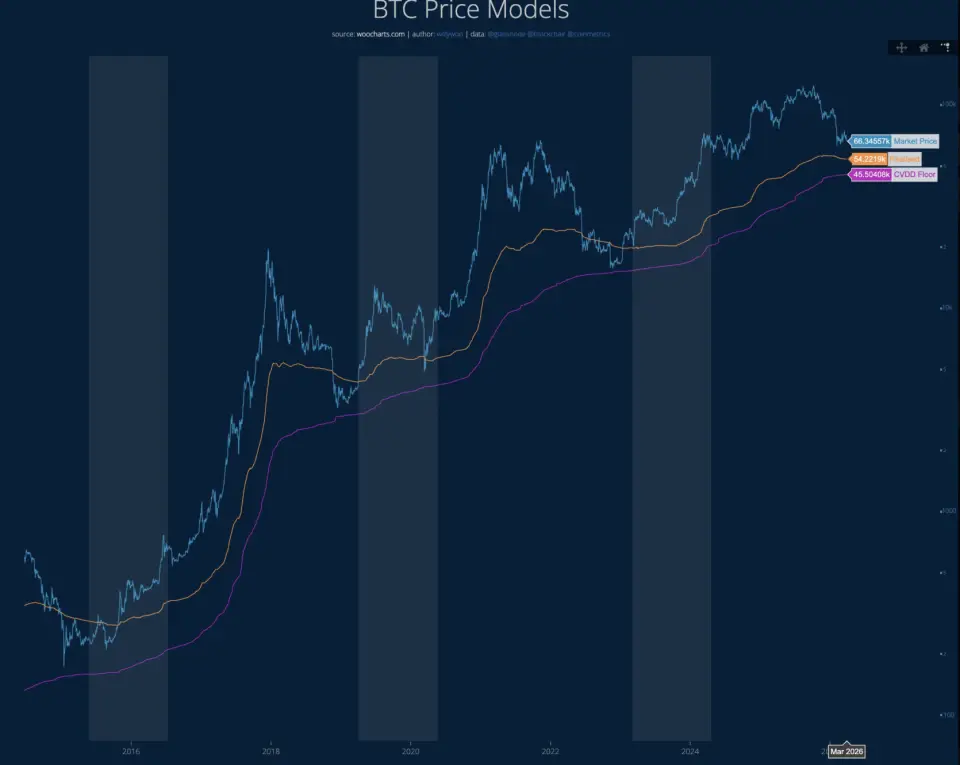
As of March 30, Bitcoin is trading near $67,600. Previously, on March 27, amid geopolitical uncertainty, the price had dropped to $65,600.
In mid-March, Woo noted that the market had only experienced part of the bearish cycle, and the establishment of a stable bottom could take several months. He also pointed out a decline in market participants’ sentiment: investors are becoming more inclined to realize losses, which increases pressure on the price.
He assessed that for a trend reversal to occur, there needs to be a reduction in BTC supply on exchanges, a decrease in selling from short-term holders, and signs of demand from larger players.
