Disclaimer: Information found on CryptoreNews is those of writers quoted. It does not represent the opinions of CryptoreNews on whether to sell, buy or hold any investments. You are advised to conduct your own research before making any investment decisions. Use provided information at your own risk.
CryptoreNews covers fintech, blockchain and Bitcoin bringing you the latest crypto news and analyses on the future of money.



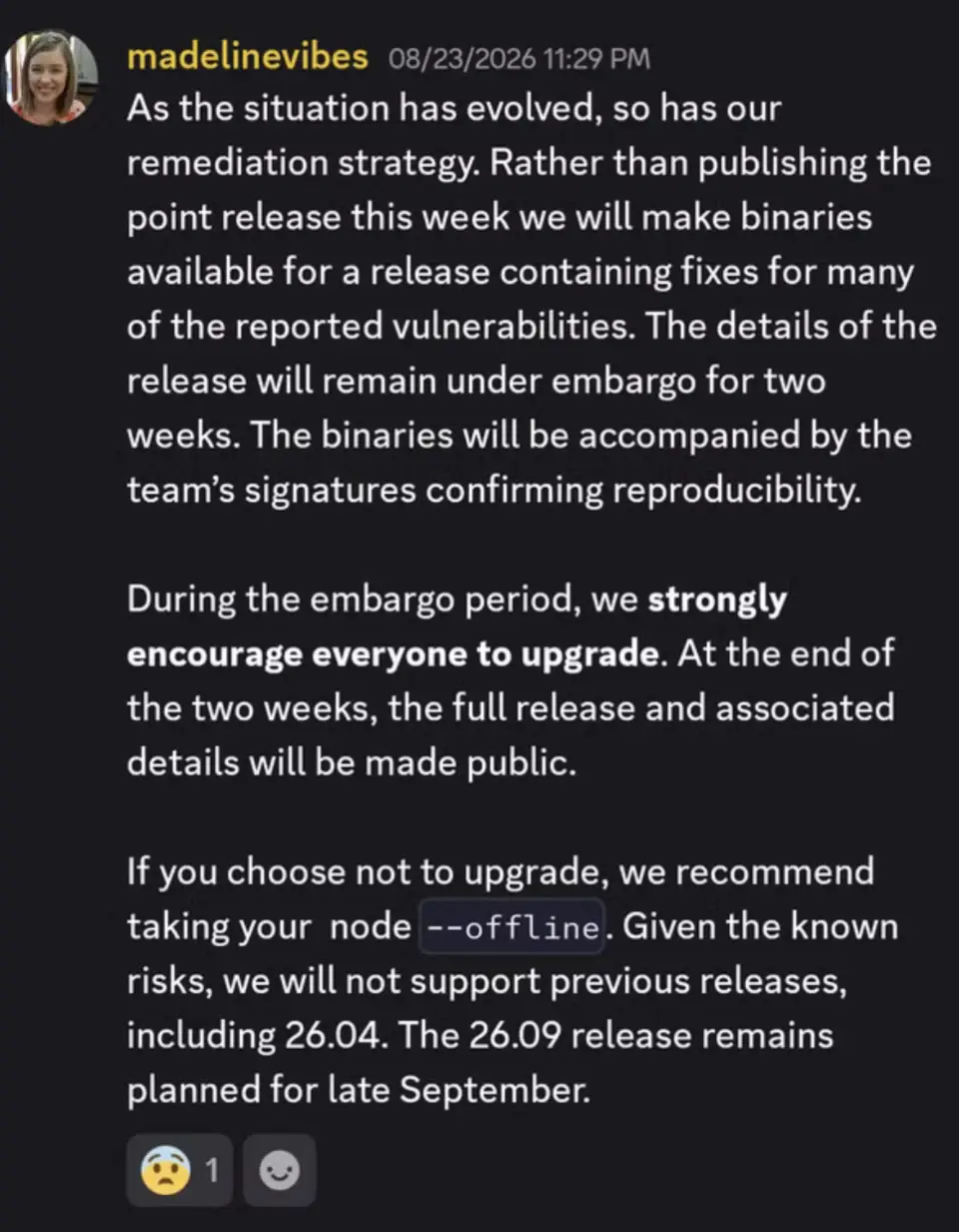
Developers of Core Lightning, the software implementing the Lightning Network protocol for the Bitcoin blockchain, have issued an urgent warning to node operators. The reason is a wave of vulnerability reports generated by artificial intelligence over the past ten days.
Developers believe the vulnerability could lead to the loss of user funds. All nodes running versions 26.04 and above are at risk. As an urgent measure, the project team recommends suspending payment routing and processing. For those unable to stop the node completely, restarting the background daemon with the “offline” parameter is advised. This mode disconnects the node from other Lightning Network nodes—payments cannot be sent, received, or routed—but the software continues to operate and monitor the Bitcoin blockchain.

The vulnerability has been assigned a CVE identifier, although technical details have not yet been clarified by specialists. A two-week embargo on publishing bug reports is intended to give operators time to install patches before attackers can analyze the changes.
Related Posts
This is not the first time AI has identified failures in the Bitcoin network. In late July, using AI models, the Bitcoin Red Team—a group of 16 developers—analyzed 390 Bitcoin project repositories and announced the discovery of nearly 5,000 security issues. Of these, 85 were classified as critical, and 635 as high-severity vulnerabilities. However, no detailed descriptions of the vulnerabilities were provided.
The Lightning Network operates on top of the Bitcoin blockchain, enabling faster transactions with lower fees without recording every payment on the main chain. To do this, two parties lock a specific amount of Bitcoin in a shared payment channel and repeatedly update the data regarding which portion of the funds belongs to whom. When the channel is closed, the final balance is recorded on the blockchain. The node must constantly monitor the network: if the other party attempts to close the channel using outdated data, the node can react on the blockchain and secure its funds. A completely powered-off machine cannot do this.
Previously, Charles Guillemet, technical director of hardware wallet manufacturer Ledger, announced the remediation of a vulnerability affecting clear signing in the Ethereum app. The error was discovered by the Ledger Donjon team using a vulnerability detection system based on artificial intelligence.
