Disclaimer: Information found on CryptoreNews is those of writers quoted. It does not represent the opinions of CryptoreNews on whether to sell, buy or hold any investments. You are advised to conduct your own research before making any investment decisions. Use provided information at your own risk.
CryptoreNews covers fintech, blockchain and Bitcoin bringing you the latest crypto news and analyses on the future of money.



The Bitcoin network’s hash rate decreased in the first quarter of the year from 1066 EH/s to 1004 EH/s. Analysts from Hashrate Index attributed the 5.8% decline primarily to the shutdown of older equipment.
Related Posts
Experts linked the redistribution of Bitcoin’s computational power mainly to a drop in mining profitability. According to Hashrate Index, market participants are optimizing their equipment’s performance and deactivating the least efficient setups.
The list of leading countries from January to March remained largely unchanged. The United States retained its top position with a share of 37.4%, despite a reduction in hash rate to 375 EH/s. This decline is attributed to the retirement of unprofitable capacities and a partial shift of resources to projects related to artificial intelligence.
Russia strengthened its position in second place, increasing its share to 16.9% from 16.4% at the end of the previous year. China remains in third place, with its share rising to 12%, although the total hash rate decreased from 125 EH/s to 120 EH/s. This reduction is due to the repercussions of the Chinese authorities’ crackdown on mining farms in the Xinjiang Uyghur Autonomous Region. Cryptocurrency mining is banned in China.
The top three countries account for approximately 65% of the global hash rate, reflecting a persistent concentration of power. However, analysts note a gradual expansion in mining geography: Ethiopia has entered the top ten, and countries in the Middle East and Southeast Asia have increased their shares.
Year-over-year, the most significant growth was observed in the following countries:
-
Kyrgyzstan (+300%);
-
Laos and Finland (both +100%);
-
Paraguay (+54%).
Experts attributed this outcome to access to inexpensive electricity and the deployment of more advanced equipment. Meanwhile, Iran lost about 7 EH/s out of 9 EH/s at the beginning of the year during the first quarter, amid military conflict with Israel and the United States.
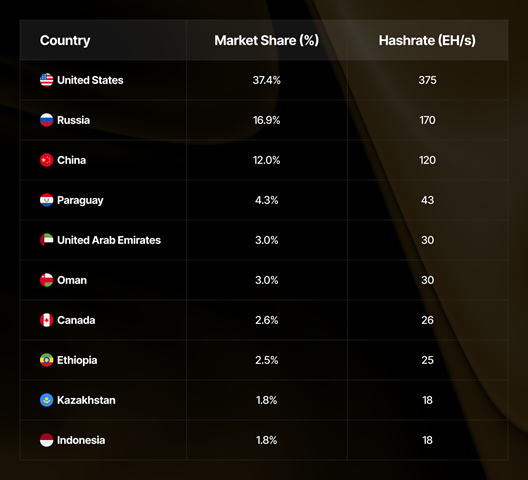
According to the findings of Hashrate Index analysts, the changes observed indicate the formation of a more decentralized network structure. The primary factors influencing jurisdiction selection remain electricity costs, regulatory conditions, as well as access to infrastructure and investor capital.
Previously, one of the largest mining companies in the world, Cango, announced the shutdown of 30% of its hash rate, citing infrastructure optimization as the reason. In February, the company’s operational hash rate was 34.55 EH/s with an installed capacity of 50 EH/s.
