Disclaimer: Information found on CryptoreNews is those of writers quoted. It does not represent the opinions of CryptoreNews on whether to sell, buy or hold any investments. You are advised to conduct your own research before making any investment decisions. Use provided information at your own risk.
CryptoreNews covers fintech, blockchain and Bitcoin bringing you the latest crypto news and analyses on the future of money.

MemeCoin Counter-Revolution: How MemeCore and Proof of Meme are Reviving Interest in Meme Coins, 2026/04/15 18:45:40

Opinion The price of the Memecore token reached a new all-time high this week on April 13. This is not a meme coin in the traditional sense; it is a project with its own specialized blockchain. What does the future hold for MemeCore and its Proof of Meme consensus mechanism?
What is MemeCore
Among the numerous assets in the crypto market, meme coins are often labeled as purely speculative instruments lacking “fundamental value.” However, the industry is evolving. In recent years, specialized blockchains have emerged, addressing specific challenges and building entire ecosystems. One of the most ambitious projects is MemeCore—a network aiming to reinvent the process of creating meme tokens by offering a Proof of Meme (PoM) consensus mechanism.
MemeCore is a Layer-1 specialized blockchain that is compatible with the Ethereum Virtual Machine (EVM). Its architecture is specifically designed for the economy surrounding meme tokens. To better understand who this project serves and why, let’s consider an example.
Imagine you have an idea for a viral meme and wish to turn it into a tradable token. On traditional blockchains like Ethereum or Solana, you would likely need to engage with smart contract code or utilize third-party services that carry high fraud risks.
MemeCore addresses this dilemma by providing an environment for creating meme coins. In other words, unlike Ethereum, Solana, and many other similar blockchains, MemeCore serves as a dedicated platform for the exclusive development of meme coins. The project creator, Jun Ahn, has set ambitious goals. He describes his concept of Meme 2.0 as a platform where the value of a token is determined not only by social media hype but also by “the community’s contribution to the network’s security.” The idea is to transform meme coins into a “sustainable source of value” rather than a fleeting trend.
In short, it sounds as if the project has been more influenced by marketers than developers. Let’s delve into how the platform is actually structured and whether it can achieve its stated objectives.
Vault and Token
One of the core components of the ecosystem is the Meme Vault. This is an automatically generated storage created upon the issuance of a token. The issuance follows the MRC-20 standard (analogous to ERC-20 but within the MemeCore environment). The mechanics are simplified: in just a few steps, one can generate a similar token, thus creating their own meme coin.
Technically, this may resemble the algorithm for creating meme coins on Solana and launching them on marketplaces like Pump.fun. However, there are fundamental differences. In the case of Solana, the issuer creates a product on the blockchain for various developers, whereas in MemeCore, the asset is created in an environment where, as claimed, the network validators are incentivized to promote the growth of the meme coin through the consensus mechanism. By the way, let’s take a closer look at that.
What is Proof of Meme (PoM)
Related Posts
The term Proof of Meme may sound nonsensical. Behind this marketing term lies a hybrid algorithm aimed at linking the economic security of the network with the culture of meme coins.
The primary technical distinction of Proof of Meme from more familiar Proof of Stake (PoS) and Proof of Work (PoW) lies in the mechanism of delegated meme staking. In MemeCore, a validator not only collects stakes in the native coin but also gathers a pool of MRC-20 standard tokens. This represents a hybrid of Proof-of-Authority (PoA) and Delegated Proof-of-Stake (DPoS) algorithms. Technically speaking, it cannot be said that MemeCore offers something fundamentally new that has never existed before.
According to the developers’ vision, MemeCore validators are motivated not just to maintain a node but to be active participants in the community and support meme projects. This is intended to create a feedback loop: the success of a meme coin enhances the network’s security, and a secure network attracts even more meme coin creators.
Comparison with Blockchains
Although MemeCore is EVM-compatible, as previously mentioned, it is an independent Layer-1 blockchain. Consequently, developers can utilize some familiar tools from the Ethereum ecosystem to create their own solutions within the MemeCore ecosystem.
When comparing the project to other well-known blockchains, the first that comes to mind is Solana. The rise in value of this cryptocurrency in previous years was largely tied to the wave of popularity surrounding meme coins and the convenience of platforms like Pump.fun. Solana proved to be an effective solution for creating such assets due to its high throughput (TPS), significantly surpassing that of Ethereum. However, it was not a specialized blockchain. In contrast to Solana, MemeCore aims to offer direct integration of meme coin staking into its consensus (Proof of Meme). Additionally, MemeCore reduces user interaction with third-party platforms at various stages of meme coin launches.
Strengths and Weaknesses of the Project
On one hand, MemeCore has certain advantages over traditionally used blockchains for creating meme coins, such as Solana. This includes a simplified process for creating such assets and a community of interested users/developers. So far, this has reflected positively on the token’s price and its entry into the top 30 cryptocurrencies by market capitalization.
On the other hand, the stated goal of “redefining the value” of meme coins as a phenomenon is clearly overstated by the project. Yes, the developers claim to support such coins, but it is unlikely they can endow any random meme coin with fundamental market value. Ultimately, Bitcoin gained popularity and demand because it was an innovation for its time and provided real benefits to people.
The situation with meme coins is different. In this segment of the crypto market, it is not enough to simply create another amusing coin; it must also capture widespread attention, as Dogecoin, Pepe, or Shiba Inu once did. Furthermore, while the developers encourage the launch of various meme coins on their platform, the sheer number of tokens does not necessarily correlate with quality—there is no guarantee that most will replicate the success of popular counterparts.
Technical Analysis
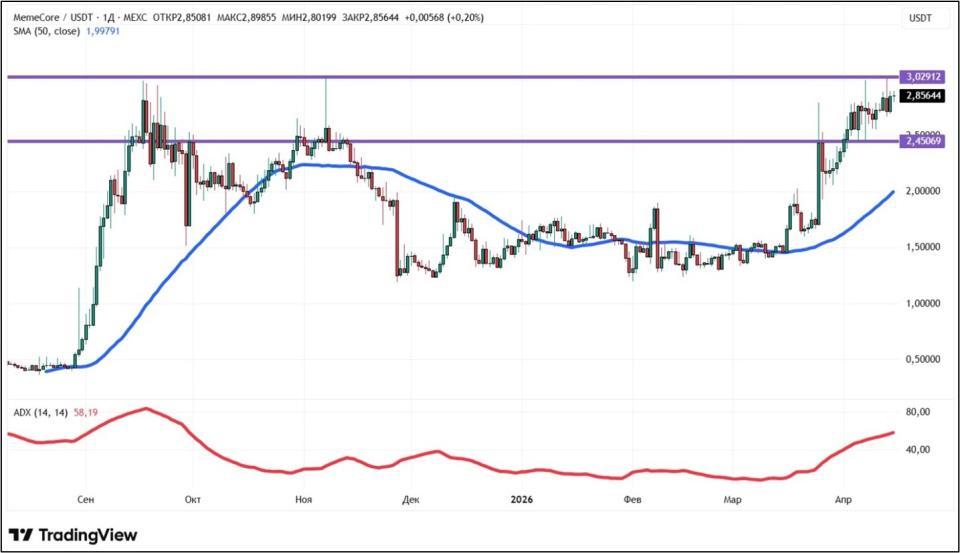
From a technical analysis perspective, the trend for the MemeCore coin is upward. This is indicated by the price exceeding the 50-day moving average (marked in blue). The strength of the trend is high, as confirmed by the ADX indicator value (58.19). Continued price growth will depend on maintaining levels above the resistance level of $3.03. MemeCore has unsuccessfully attempted to breach this stronghold twice before April 2026 (in September and November 2025). If the price falls below the support level of $2.45, the trend will shift to a downward one.
Source: tradingview.com
Conclusion
MemeCore represents an attempt to take a new step in the development of the meme coin market. The Proof of Meme concept, despite its marketing title, offers a method for engaging the community in maintaining a decentralized network. The platform provides a more streamlined toolkit for creating meme coins from scratch. However, the developers’ plans to move away from “social media hype” towards “fundamental value” for meme coins are exaggerated given the very nature of such assets. Nevertheless, the price of the MemeCore coin set a new record in April, primarily driven by the increase in the number of tokens launched on the platform.
This material and the information contained herein do not constitute individual or any other investment advice. The opinions expressed may not align with those of analytical portals and experts.
