Disclaimer: Information found on CryptoreNews is those of writers quoted. It does not represent the opinions of CryptoreNews on whether to sell, buy or hold any investments. You are advised to conduct your own research before making any investment decisions. Use provided information at your own risk.
CryptoreNews covers fintech, blockchain and Bitcoin bringing you the latest crypto news and analyses on the future of money.



Perspective Since reaching its historical peak in October 2025, Bitcoin has lost more than $60,000. This unprecedented drop has sparked discussions about the onset of a crypto winter. But is this really the case? And if so, when will it end? What will signal the beginning of spring? Let’s find out.
What is a Crypto Winter?
“Crypto winter” is an informal term referring to a significant correction in the cryptocurrency market, which typically occurs one to one and a half years after a Bitcoin halving event. During this cold season, prices fall not only for the first cryptocurrency but also for altcoins. Crypto winters are accompanied by decreased interest in digital assets on social media, reduced trading activity, and a lower risk appetite among crypto investors. But how long do they last?
How Long Does a Crypto Winter Last?
The baseline period is measured from the new price maximum Bitcoin reaches after a halving event to the next market bottom.
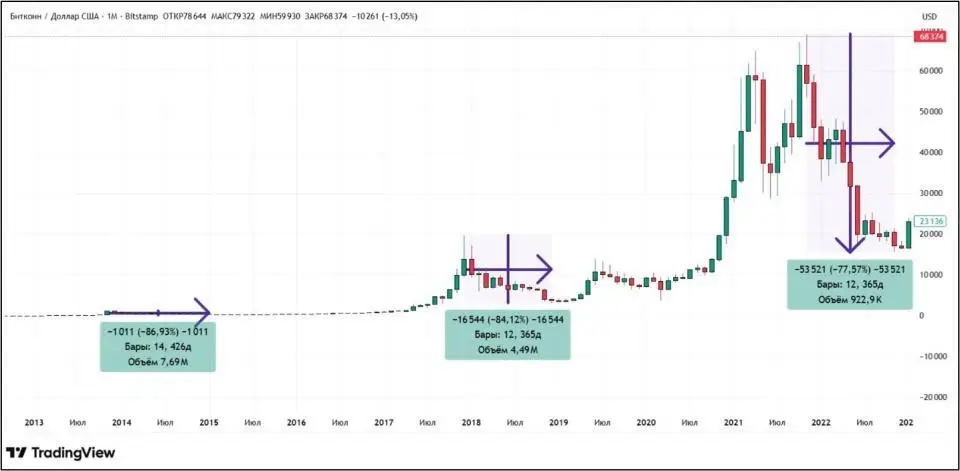
The longest was the first crypto winter, which lasted from November 2013 to December 2015. It spanned fourteen months and led to an 86.93% drop in Bitcoin’s value.
The second crypto winter occurred from December 2017 to December 2018. It lasted exactly one year and was also quite severe, trailing only slightly behind the first: Bitcoin fell by 84.12%.
The third crypto winter lasted from November 2021 to November 2022, also exactly one year. However, the third winter ultimately proved less harsh than the previous two. This time, Bitcoin’s decline was only 77.57%.
Related Posts
On the chart, each instance of a crypto winter is marked with purple arrows, indicating the amplitude of the drop and its duration.
Source: tradingview.com
Can the price decline at the end of 2025 and early 2026 already be considered a crypto winter?
Crypto Winter 2025-2026
It depends on interpretation. Some publications and experts, including The Wall Street Journal, The Economist, and Mark Yusko, founder of investment firm Morgan Creek Capital, have already confidently labeled the situation from October 2025 to February 2026 as a crypto winter. Overall, there is ample reason for this: the absolute drop in Bitcoin’s value during this period was the highest in history. The Economist even hastened to call the fourth crypto winter the coldest.
But what if we look at the situation from another angle?
If we consider formal mathematical criteria, the situation at the turn of 2025-2026 does not yet correspond to a crypto winter.
-
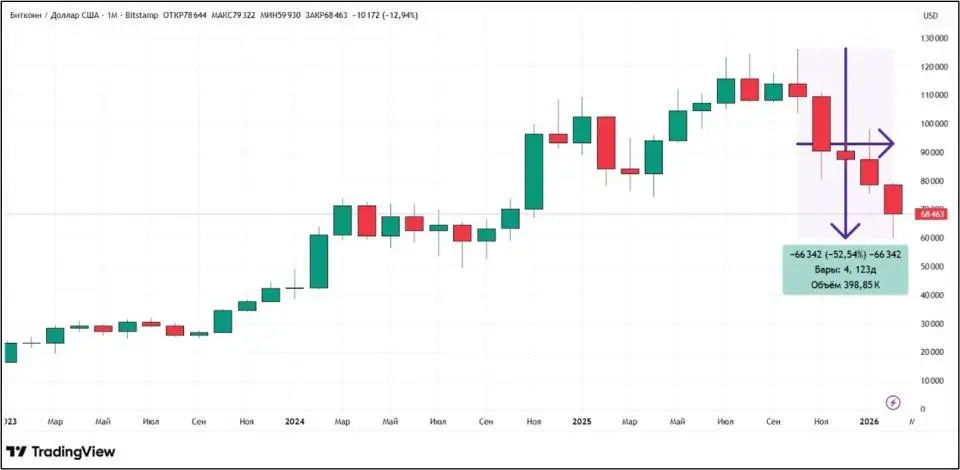
First, the duration of previous declines averaged 12.7 months. So far, the freeze has lasted only four months.
-
Second, the average depth of a crypto winter correction is 82.9%. However, by mid-February 2026, the maximum drawdown for BTC was only slightly over 52.5%.
The only mathematical criterion that the 2025-2026 decline meets is that it began one and a half years after the Bitcoin halving.
Source: tradingview.com
So, can the autumn 2025 – winter 2026 decline already be considered a crypto winter? De facto, undoubtedly yes. As noted by Mark Yusko himself, the crypto industry of the mid-2020s differs significantly from what existed previously. The expert believes that Bitcoin, at its last peak in October 2025, only slightly exceeded its fair value, which differs greatly from cases in previous years. Furthermore, Yusko emphasizes that the crypto industry itself has changed significantly due to the development of decentralized technologies and much greater involvement of corporate capital.
De jure, based on formal criteria, the 2025-2026 correction does not yet correspond to a crypto winter. However, one should not forget that the cryptocurrency rally has not yet begun. Thus, the situation may fully correspond to a crypto winter in terms of duration and decline, meeting all three formal indicators.
How Does the ‘2025-2026 Crypto Winter Differ?
The main difference between the fourth crypto winter and previous ones lies in the root causes. The crypto market crash in 2014 was largely related to the shock from the collapse of the Mt. Gox exchange and the reaction to the ban on cryptocurrencies in China. In 2018, the decline in digital assets occurred after the mass ICOs (Initial Coin Offerings) of 2017, many of which turned out to be outright scams. Finally, in 2022, the LUNA/Terra project collapsed, triggered by the decoupling of the algorithmic stablecoin UST from the dollar. Essentially, in all previous cases, the drivers of the decline were internal to the crypto industry.
In 2025-2026, the source is primarily external. Huge, unprecedented international tension, uncertainty regarding future US policy, the expansion of cryptocurrency industry legislation (Genius Act, Clarity Act, MiCA, Russian laws, etc.), and the attraction of significant capital from corporate investors, including through ETFs, all played a key role in the movements of the crypto market both up and down.
How should one act during the 2025-2026 crypto winter?
Investment Strategy ‘2026
It all depends on the behavior of the specific market participant. Long-term investors will calmly wait out the crash (if they haven’t already taken profits), buying the dip—following the “buy the dip” principle. Short-term speculators will try to profit from any intraday movement. The most vulnerable category becomes newcomers to the crypto market. Given that everything is new to them, a sharp drop can cause panic and rash actions. In such cases, the best strategy is:
- minimizing leverage to avoid rapid liquidation of positions;
- trading with funds that are not your last, ensuring a safety cushion;
- diversification by acquiring various cryptocurrencies.
How Long Will the ‘2025-2026 Crypto Last?
Here, three scenarios can be identified: pessimistic, baseline, and optimistic.
In the worst-case scenario, one should expect the crypto winter to drag on for 12.7–14 months. In other words, the duration will be from average to maximum. In this case, one would have to wait until the end of 2026 for the “end of the cold” in the crypto market.
The most realistic scenario at the moment appears to be one where the crypto winter is somewhat shorter than in previous years. For example, analysts at the investment and brokerage firm Bernstein consider it realistic that a turnaround will begin in the first half of 2026. At the same time, they allow for the possibility that the crypto market decline could take a year. Overall, the duration should be 8–12 months. This is even more likely given that in May, Jerome Powell, a proponent of tight monetary policy from the world’s largest economy, steps down from his post as Chair of the US Federal Reserve.
Finally, in the best-case scenario—the crypto market has already bottomed out. In this case, the crypto winter would have lasted only four months, and warming would begin soon. We just need to wait for the first spring price growth.
Conclusion
The 2025-2026 decline has all grounds to be called a deep freeze based on its depth. Nevertheless, based on formal average mathematical criteria, the market decline does not yet correspond to prolonged freezes. However, given that the decline has not yet ended and the situation in the crypto market in 2026 differs significantly from previous years, many experts and crypto enthusiasts have already labeled this crash a crypto winter.
This material and the information contained herein do not constitute individual or other investment advice. The editorial opinion may not coincide with the views of analytical portals and experts.
