Disclaimer: Information found on CryptoreNews is those of writers quoted. It does not represent the opinions of CryptoreNews on whether to sell, buy or hold any investments. You are advised to conduct your own research before making any investment decisions. Use provided information at your own risk.
CryptoreNews covers fintech, blockchain and Bitcoin bringing you the latest crypto news and analyses on the future of money.

How to Revitalize Cryptocurrency Trading: Key Aspects of the RVI Indicator, 2026/03/16 23:59:56


To establish a profitable cryptocurrency trading system, it is beneficial to continually broaden one’s understanding of technical analysis. Relying solely on the same well-known indicators can often lead to errors. Profits may come from less recognized analytical tools, such as the RVI.
What is RVI
RVI is a technical analysis indicator belonging to the oscillator group. Its full name is Relative Vigour Index. The most common translation into Russian is “Индекс относительной бодрости”. On the TradingView platform, the indicator is referred to as the “Индекс относительной волатильности”.
The RVI was first introduced in the book by technical analyst John Ehlers titled Cybernetic Analysis for Stocks and Futures: Cutting-Edge DSP Technology to Improve Your Trading. The index is based on the assumption that during an upward trend, closing prices should be higher than opening prices, while in a downward trend, the opposite occurs.
How is the “relative vigour index” calculated mathematically?
Calculation of RVI
The classic formula is quite straightforward: the difference between closing and opening prices is divided by the difference between the highest and lowest prices:
RVI= (Close – Open) / (High – Low),
where Close is the closing price,
Open is the opening price,
High is the highest price for the period,
Related Posts
Low is the lowest price for the period.
If the indicator needs to be calculated over a specific time frame, simple moving averages of the initial data are used in both the numerator and denominator:
RVIn = SMAn(Close-Open)/SMAn(Close – Open),
where SMA is the simple moving average,
n is the calculation period.
Additionally, the RVI line is complemented by a signal line, which is calculated using the formula:
Signal line = (RVI + RVI n-1 *2 + RVIn-2 *2 + RVIn-3)/6
RVI, RVI n-1, RVIn-2, RVIn-3 are the RVI values at the final time period, as well as one, two, and three bars/candles prior, respectively.
The calculation of the indicator may seem cumbersome, but it is actually quite simple. In modern conditions, where all processes are automated, any trading software can perform the calculation in fractions of a second. The only requirement from the user is to set the period parameter.
How can RVI be utilized in practice for actual trading?
Trading Signals of RVI
Given that the oscillator consists of two lines, it is not surprising that the first signal from the indicator is a crossover. This is the signal that John Ehlers preferred over others, noting that interpretations of the analytical tool can be quite flexible. If the RVI crosses its weighted moving average from below, it indicates a forthcoming increase. Conversely, if it crosses from above, it suggests a potential decline.
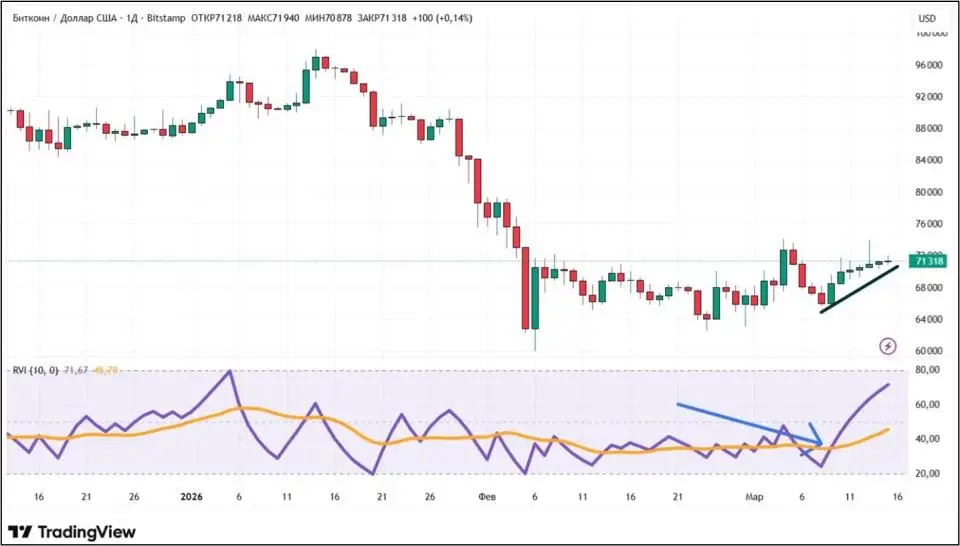
For clarity, let’s examine an example. On the daily chart of Bitcoin from the Bitstamp exchange, it is evident that the price increase began right after the RVI line (purple) crossed its moving average from below (indicated by the blue arrow).
Source: tradingview.com
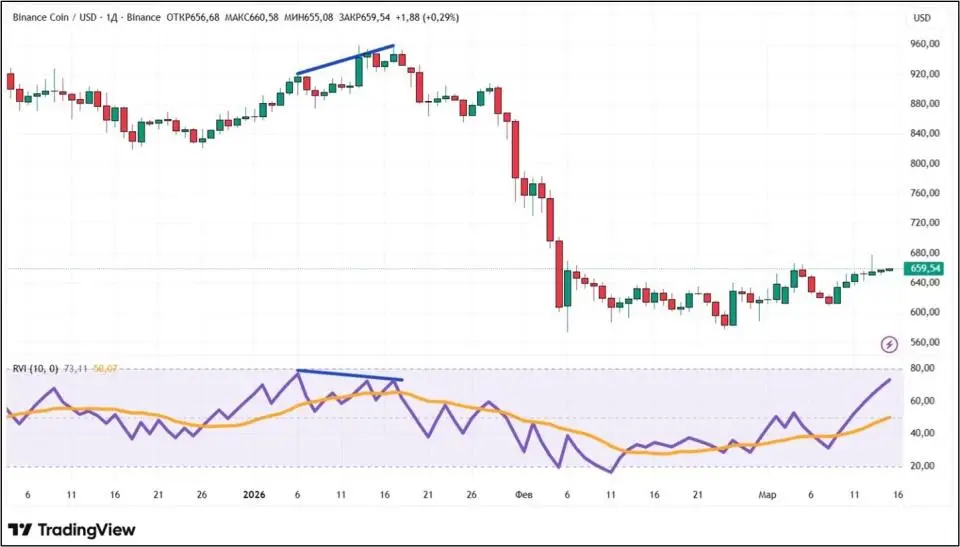
Another popular RVI signal among traders is divergence, which refers to the discrepancy between the indicator’s trajectory and the price. Divergence can be either bullish or bearish. The bullish scenario occurs when the price hits a new low while the indicator starts to rise. The bearish scenario arises when the price of the crypto asset continues to reach new highs while the RVI begins to decline.
A classic bearish divergence formed on the daily chart of BNB in January 2026. The price continued to rise, while the relative vigour index had already started to fall (marked by blue diagonal lines).
Source: tradingview.com
It is also worth noting that some online sources associate RVI signals with the identification of overbought and oversold zones. However, this is quite contentious. The Relative Vigour Index does not have predefined levels like 30 and 70 for RSI or 20 and 80 for stochastic indicators. The overbought and oversold zones are suggested to be interpreted based on extremely low or high indicator values, which is highly subjective.
Like most indicators, RVI has certain drawbacks.
Disadvantages of RVI
The primary drawback of the indicator is the generation of numerous false signals during sideways movement. Additionally, RVI is classified as a lagging indicator, meaning it may provide signals somewhat later than the actual onset of price movement. Furthermore, the oscillator requires precise calibration by the individual trader for each specific instrument—each cryptocurrency. There are no specific settings that work equally well across the board. The optimal strategy for using RVI would be to combine it with other technical and fundamental analysis tools that can confirm the validity or invalidity of the signals.
Conclusion
Thus, the relative vigour index is a technical analysis indicator that is better suited for trend trading. During consolidation, when prices fluctuate up and down, RVI generates many false signals. The best approach when trading would be to combine this indicator with other analytical tools.
This material and the information contained herein do not constitute individual or any other investment advice. The views of the editorial team may not align with those of analytical portals and experts.
