Disclaimer: Information found on CryptoreNews is those of writers quoted. It does not represent the opinions of CryptoreNews on whether to sell, buy or hold any investments. You are advised to conduct your own research before making any investment decisions. Use provided information at your own risk.
CryptoreNews covers fintech, blockchain and Bitcoin bringing you the latest crypto news and analyses on the future of money.



Bitcoin mining has not always been a multi-billion dollar industry. In fact, many years ago, when the network of the first cryptocurrency was at its most vulnerable, it was solely supported by enthusiasts. Most importantly, Bitcoin as a phenomenon might not have existed without the early “Patoshi mining.”
Mining the First BTC
Unlike today’s industrial mining companies that utilize expensive and high-performance ASIC equipment, the initial Bitcoin miners generated blocks with minimal effort. At that time, this process did not require enormous energy consumption, and cryptocurrency was mined using standard home computer CPUs.
The total hash rate and network difficulty in the early years following the coin’s launch were significantly lower than today’s record levels. Consequently, the network was technically more susceptible to a 51% attack. Nevertheless, as we know, it endured, and BTC became so sought after that it is now among the largest assets by market capitalization.
Analyzing early mining activity suggests that, in a state of extreme vulnerability, someone took timely measures to ensure the secure launch and maintenance of the entire decentralized system. This was later referred to as the “Patoshi Pattern.”
Related Posts
Who is Patoshi
The term “Patoshi Pattern” was first introduced by researcher and cryptographer Sergio Lerner as a method for analyzing early mining. The essence lay in observing changes in the ExtraNonce field, specifically identifying a pattern during uniform early mining. The crypto enthusiast elaborated on this in his blog in 2013.
Lerner proposed that an anonymous miner, possibly the creator of Bitcoin, Satoshi Nakamoto, mined the first BTC with a specific regularity, pursuing multiple objectives. This means that the mining was conducted according to a defined pattern. We do not definitively know whether this unknown miner was Nakamoto or someone else, whether they acted immediately after the network’s launch, or if they possessed a deep understanding of how the first cryptocurrency operated—at a level close to Nakamoto’s.
How did the regularity work?
Patoshi Graph
During mining, the hash sum of the block header is calculated, taking into account the current network difficulty. During this process, the overflow of the nonce increments the value of ExtraNonce. In the case of the “Patoshi Pattern,” the increase in ExtraNonce occurred anomalously compared to other miners.
The dynamics can be visualized graphically:
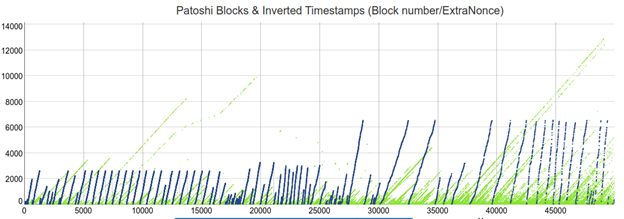
Source: blog.lopp.net
Lerner’s original graphical visualization from the network’s launch until January 2010 allows for the identification of similar slopes in ExtraNonce:
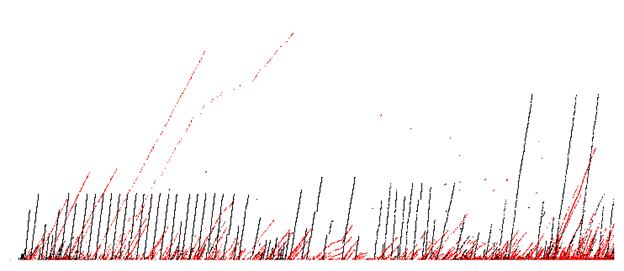
Source: bitslog.com
Besides Lerner, the issue of “Patoshi mining” has been raised by other researchers. Based on this data, analysts from Elementus examined the early clustering of blocks.
How many bitcoins did the mysterious miner manage to obtain as a reward?
Patoshi’s Wealth
It is impossible to assess the wealth of the hypothetical Patoshi in dollar terms. We do not know if they have access to the mined riches from the past, nor whether they mined “outside the pattern” in later years. However, various experts continue to attempt to estimate the wealth of the presumed creator of Bitcoin.
Based on Lerner’s research, analysts from Whale Alert suggested that Satoshi might have mined new blocks up to a blockchain height of 54316, accumulating over 1.1 million BTC in the process. This is now worth more than $77 billion. From October 2025 to February 2026, due to a decline in the coin’s price, particularly during the drop in early February, Nakamoto lost over $56 billion.
Supporting the credibility of the “Patoshi Pattern” idea, Whale Alert researchers point out that the early BTC mined using this method were sent by Nakamoto to Hal Finney as the first transaction in the Bitcoin network.
But what was the purpose of this mining?
Patoshi’s Goals
At first glance, it may seem that the anonymous miner aimed to profit from cryptocurrency mining. This argument appears at least questionable, as BTC had not yet gained popularity and high value during its earliest stages. Moreover, its future was not entirely clear. Thus, initially, after the network’s launch, Patoshi was likely mining at a loss. Additionally, the “wealth of Patoshi” remains largely untouched in crypto wallets to this day. There is a belief that this could be seen as a form of altruistic gesture from the system’s creator to the world. This view is held, for example, by Michael Saylor, the head of the largest public corporate holder of bitcoins, Strategy.
Another interesting fact: by maintaining the network’s functionality initially and thereby protecting it from a 51% attack, Patoshi might have intermittently turned off their equipment. This could be explained by the desire to make the network resilient and reliable while also providing other participants with an economic incentive to mine. This clarifies why Nakamoto reduced their own hash rate over time as the project’s popularity grew.
At the same time, to support the network, Satoshi-Patoshi likely used a special client that differed in multithreading from the early versions of the software. This does not seem surprising against the backdrop of discussions about “advanced GPU mining” on the early Bitcoin forum Bitcointalk. In other words, the anonymous individual likely envisioned possible scenarios for “advanced mining” from the outset. Even in 2009, Satoshi urged others to postpone the “GPU arms race” for as long as possible for the common good, allowing the network to grow sustainably and enabling new users to familiarize themselves with the technology while providing everyone with the opportunity to earn.

Conclusion
The phenomenon of “Patoshi mining” represents significant strategic actions taken to protect the Bitcoin network in its early days, likely undertaken by the cryptocurrency’s creator. Although Nakamoto managed to mine over 1.1 million BTC during this time, nearly all of the coins remain inactive to this day. Their potential deliberate withdrawal from circulation, in light of limited issuance, is viewed by crypto enthusiasts as a gift from the mysterious developer to the world.
