Disclaimer: Information found on CryptoreNews is those of writers quoted. It does not represent the opinions of CryptoreNews on whether to sell, buy or hold any investments. You are advised to conduct your own research before making any investment decisions. Use provided information at your own risk.
CryptoreNews covers fintech, blockchain and Bitcoin bringing you the latest crypto news and analyses on the future of money.



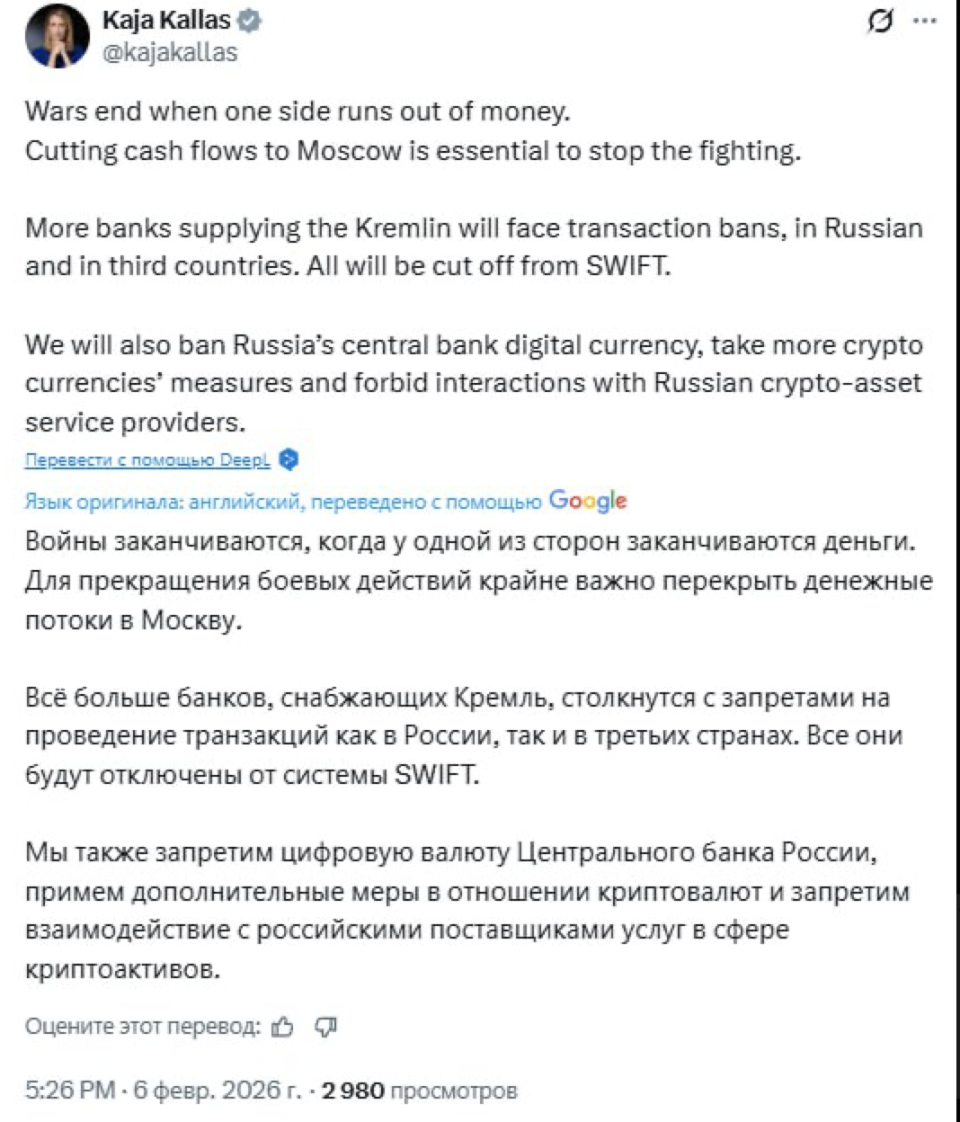
The European Commission has released the text of a document regarding the 20th sanctions package aimed at the Russian economy. Vice-President of the European Commission, Kaja Kallas, has assured that among other measures, the EU will prohibit the digital ruble issued by the Central Bank of Russia.
Related Posts
The EU plans to implement new restrictions against the shadow tanker fleet and limit Russia’s ability to establish “alternative payment channels” for financing economic activities, as stated in the document.
“We are adding 20 more regional Russian banks to the sanctions list and will take action against cryptocurrencies, companies trading them, and platforms facilitating crypto trading to prevent circumvention of sanctions,” the European Commission stated.
The document does not specify which alternative channels and cryptocurrency companies are being referred to. On social media, Kaja Kallas mentioned that the EU will block the digital ruble of the Central Bank of Russia and will also prohibit any interaction between European companies and Russian service providers in the crypto asset sector.
The digital ruble is currently in the testing phase and is not widely used. Starting from September 1, 2026, the obligation to accept the Central Bank’s digital currency will apply to businesses in trade and services with an annual turnover of at least 120 million rubles. By September 2027, this requirement will extend to banks and trading entrepreneurs with a turnover of 30 million rubles or more. From September 2028, authorities plan to mandate that all financial institutions and retail outlets with a turnover exceeding 5 million rubles accept payments in digital currency.
In 2025, the volume of cryptocurrency transactions related to sanctions evasion surged by 400%, according to TRM Labs. A significant portion of these transactions involved the A7A5 stablecoin, which is pegged to the Russian ruble. In the previous year, the inaugural year for the token, over $72 billion was processed through A7A5, while wallets associated with A7A5 handled an additional $39 billion. The majority of these transfers were directed towards companies in China, Southeast Asia, and South Africa, with the largest amounts flowing into China and Hong Kong. TRM Labs identified the exchanges Garantex and Grinex as the primary platforms for transactions involving the ruble-pegged stablecoin.
