Disclaimer: Information found on CryptoreNews is those of writers quoted. It does not represent the opinions of CryptoreNews on whether to sell, buy or hold any investments. You are advised to conduct your own research before making any investment decisions. Use provided information at your own risk.
CryptoreNews covers fintech, blockchain and Bitcoin bringing you the latest crypto news and analyses on the future of money.


A significant debate has emerged in the United States regarding the income generated from holding stablecoins. The bill known as CLARITY is currently stalled in the Senate, primarily due to dissatisfaction among American banks. What exactly is at stake between cryptocurrency entrepreneurs and bankers? How will the outcome of this conflict impact stablecoin holders globally?
What is the CLARITY Act
CLARITY, also referred to as the Clarity Act, officially known as the Digital Asset Market Clarity Act, aims to clarify the regulatory landscape for digital assets. The primary author is Congressman James French Hill, a Republican from Arkansas, who is supported by 21 co-sponsors, including five from the Democratic Party and 16 from the Republican Party.
The main objective of the Clarity Act is to delineate the regulatory authority over cryptocurrencies between two U.S. regulators: the Securities and Exchange Commission (SEC) and the Commodity Futures Trading Commission (CFTC). The proposal suggests that each agency will have its own defined area of responsibility. The bill seeks to amend two existing laws: the Securities Act of 1933 and the Commodity Exchange Act of 1936.
It is important to note that CLARITY is not a recent document; it was first introduced in May 2025. What concerns bankers about this legislation? Why are representatives from financial institutions dissatisfied with the current form of the act?
What Concerns Bankers
Bankers are more troubled by the potential impact on their businesses than by the division of authority between the SEC and CFTC. They believe the Clarity Act does not sufficiently regulate platforms that offer rewards for holding stablecoins. In essence, these platforms resemble banks but operate under less stringent regulations than traditional financial institutions.
Since July 2025, the primary legislation governing stablecoins in the U.S. has been GENIUS. According to this law, companies issuing digital assets tied to real-world assets are prohibited from providing any form of user token rewards. However, this restriction does not apply to third parties, including affiliated entities, which can offer reward programs to stablecoin holders.
These rewards often exceed the interest rates available on bank deposits. In the U.S., interest rates on deposits range from approximately 0.5% to 4% annually. Cryptocurrency platforms can present more attractive options. For instance, Nexo offers an annual interest rate of 11% on USDC deposits, while DAI deposits can yield up to 14%. Consequently, purchasing these dollar-pegged digital currencies and holding them in makeshift digital deposits is often more advantageous than depositing funds in banks.
“Stablecoins are Dangerous and Undesirable”
Related Posts
Jeremy Barnum, CFO of JP Morgan, described stablecoins as akin to a parallel banking system, asserting that issuers and their partners exhibit all the characteristics of banks, including something resembling deposits. However, he noted that they do not provide the “prudent protections” developed over many years, making them dangerous and undesirable, according to the executive of one of America’s largest banks.
Brian Moynihan, CEO of Bank of America (BofA), expressed concern that the Clarity Act could lead to a $6 trillion outflow from bank deposits over three years. He likened existing stablecoin models to mutual funds rather than deposits.
David Solomon, CEO of Goldman Sachs, believes that resolving the issues that have sparked disputes between bankers and cryptocurrency entrepreneurs regarding the Clarity Act will take considerable time.
How Banks Can Navigate the Situation
One might wonder why financial institutions do not simply triple their interest rates. However, bank interest rates are tied to the key rate and actual inflation, meaning that if banks raise deposit rates threefold, they would incur significant losses. To remain competitive, they are attempting to influence legislators and have achieved some success.
Recent amendments to the Clarity Act, specifically in section 404, state that stablecoins cannot generate profits while “static,” or in a deposit-like state. However, stable tokens can provide additional rewards when in “dynamic” conditions. This has led to dissatisfaction among representatives of cryptocurrency companies.
Brian Armstrong, CEO of Coinbase, remarked that the recent changes have made CLARITY worse than before, stating, “Better no law than a bad one.”
Conversely, Michael Novogratz, CEO of Galaxy Digital, believes that the Clarity Act should be approved, even if it is not perfect, as it can be refined in the future. He argues that the law is necessary in any form to avoid hindering the growth of the crypto industry.
The CEOs of Ripple and Cardano, Brad Garlinghouse and Charles Hoskinson, even engaged in a debate. Garlinghouse asserted that the Clarity Act is preferable to chaos, stating, “Perfection is the enemy of good.” However, Hoskinson disagreed, saying, “Sorry Brad, this is not better than chaos. Choose chaos and fight for what is right. The act hands all the keys to the cryptocurrency kingdom to the SEC.”
When Will CLARITY Become Law
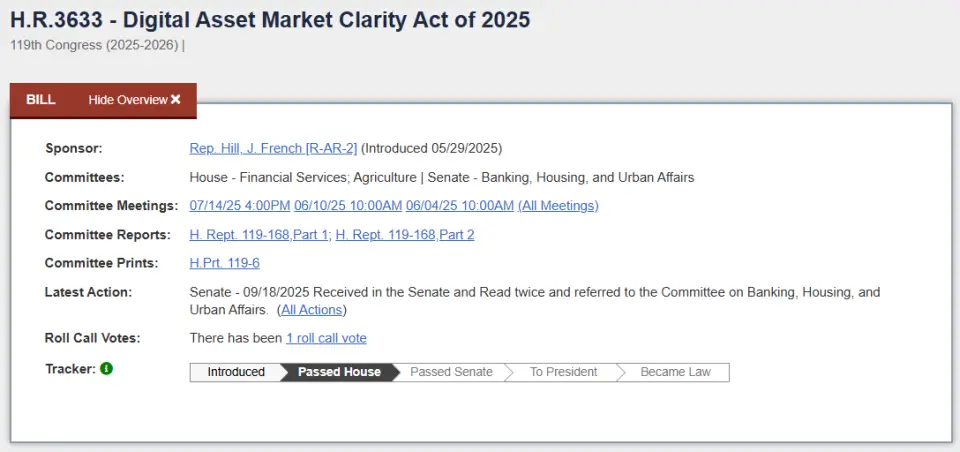
In the U.S. legislative process, a bill must pass several mandatory stages: approval by the House of Representatives, approval by the Senate, and the President’s signature. As of early February 2026, the Clarity Act has completed its initial stage but is currently stalled in the Senate.
Source: congress.gov
The Senate Agriculture Committee supported the Clarity Act on January 29 with a narrow vote of 12 to 11. All Democratic congressmen on the committee opposed it. The Senate Banking Committee has yet to provide its approval. Only after the versions of the Clarity Act from both committees are reconciled will the bill be brought to a vote in the full Senate.
On December 2, a meeting took place at the White House involving Patrick Witt, the executive director of the President’s Advisory Council on Digital Assets during Donald Trump’s administration, along with representatives from the banking and crypto industries. The outcome included several general statements emphasizing the importance of reaching a consensus, and the meeting was considered a significant step forward. However, no tangible progress was made, and the document remains with the Senate Banking Committee.
Conclusion
The discussions surrounding CLARITY stem from concerns among American bankers that they may lose substantial revenue due to clients moving to stablecoin issuers. Bank representatives, particularly from smaller institutions, are currently successfully opposing cryptocurrency entrepreneurs in the Senate, who wish to continue offering attractive rewards to stable token holders. The outcome of this conflict may influence the fate of stablecoins in other jurisdictions, as many look to the legislation of the world’s largest economy for guidance.
This material and the information contained herein do not constitute individual or any other investment advice. The views of the editorial team may not align with those of analytical portals and experts.
