Disclaimer: Information found on CryptoreNews is those of writers quoted. It does not represent the opinions of CryptoreNews on whether to sell, buy or hold any investments. You are advised to conduct your own research before making any investment decisions. Use provided information at your own risk.
CryptoreNews covers fintech, blockchain and Bitcoin bringing you the latest crypto news and analyses on the future of money.


Vitalik Buterin, the co-founder of Ethereum, has voiced concerns about decentralized autonomous organizations (DAOs) potentially monopolizing the selection of node operators within liquidity staking pools.
In a blog post dated September 30, Buterin cautions that as staking pools implement the DAO model for governance over node operators—who ultimately manage the pool’s assets—it may expose them to risks from malicious entities.
“With the DAO approach, if a single such staking token dominates, that leads to a single, potentially attackable governance mechanism controlling a very large portion of all Ethereum validators.”
Buterin points to the staking protocol Lido (LDO) as an instance where a DAO whitelists node operators. Nonetheless, he stresses that depending solely on one layer of security might be inadequate.
“To the credit of protocols like Lido, they have implemented safeguards against this, but one layer of defense may not be enough,” he remarked.
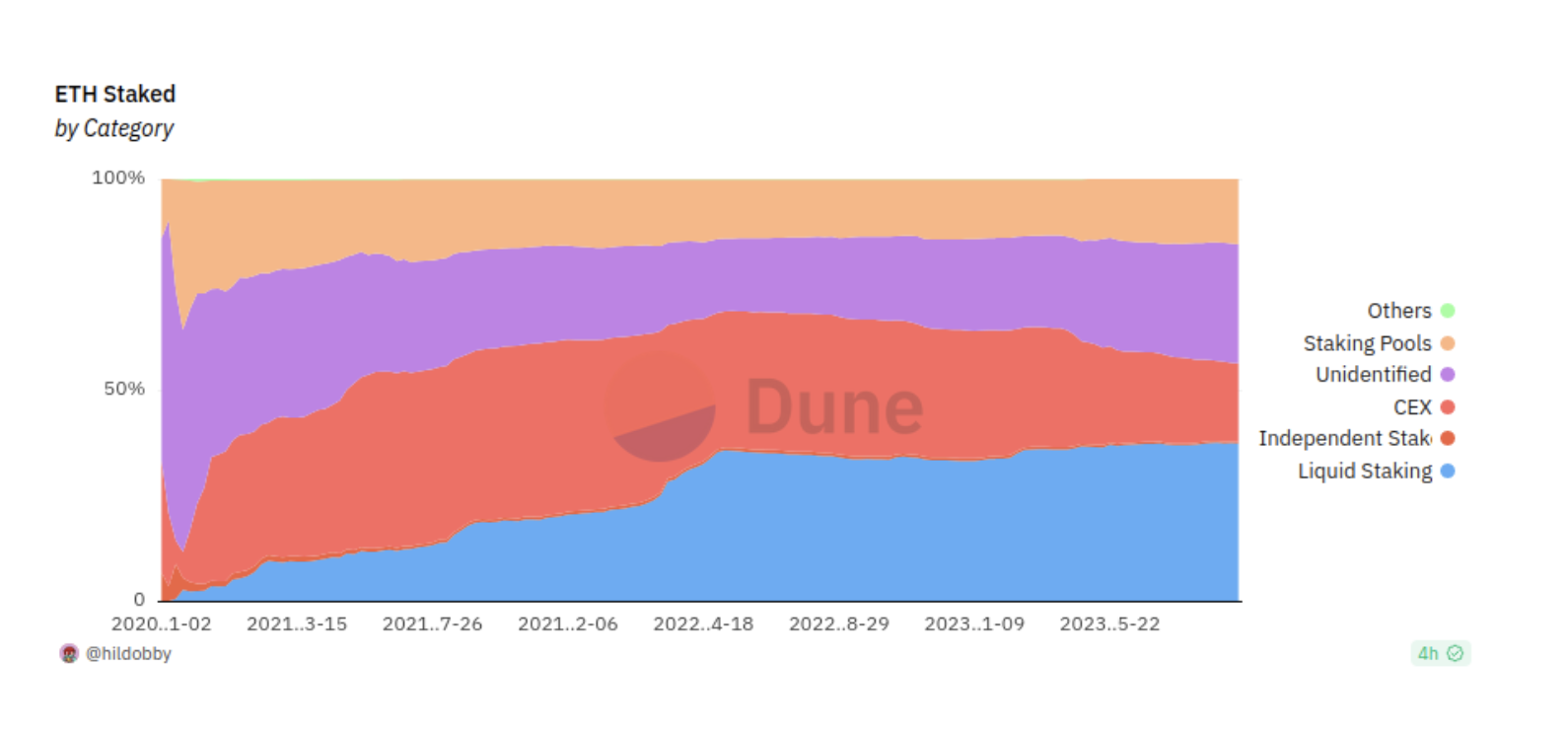 ETH staked by category chart. Source: Vitalik Buterin
Related Posts
At the same time, he explains that Rocket Pool allows anyone to become a node operator by making an 8 Ether (ETH) deposit, which, at the time of this writing, is roughly equivalent to $13,406.
However, he points out that this method carries its own risks. “The Rocket Pool approach allows attackers to execute a 51% attack on the network, forcing users to bear most of the costs,” he stated.
Related: Ethereum is about to get crushed by liquid staking tokens
Buterin suggests that one potential solution to this challenge is to motivate ecosystem participants to engage with a diverse range of liquid staking providers.
He clarifies that this would reduce the chances of any single provider growing too large and creating a systemic risk.
“In the longer term, however, this is an unstable equilibrium, and there is peril in relying too much on moralistic pressure to solve problems.”
Magazine: Are DAOs overhyped and unworkable? Lessons from the front lines
